Anthony Bertram Miller
(1926-2017)
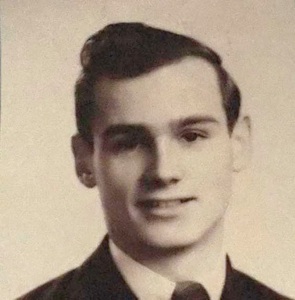
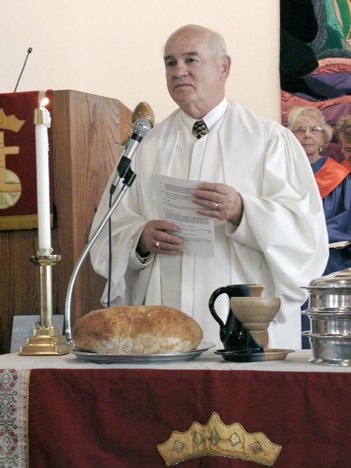
Reverend Anthony Bertram Miller
Anthony Bertram Miller
Served church July 1, 1950- Fall, 1956
Anthony Bertram Miller was born 1926, in New Haven, CT, to Rev. Ray Marcus and Mary E. Crum Miller. He was one of five children, Julia F., Anthony B., Richard C., Mary J. and Martha Jean. His father, born 1896, in Belmore, Ohio, was a Congregational minister. His parents were married in 1924. For the first ten years, Bert and his family lived in Redfield, Spink County, South Dakota.
.jpg) Bert’s grandfather and namesake, Anthony Miller, was born 1849, in Bremen, Germany. He came to the US in 1872. He is shown at right. He died 1923, a few years before Bert was born.
Bert’s grandfather and namesake, Anthony Miller, was born 1849, in Bremen, Germany. He came to the US in 1872. He is shown at right. He died 1923, a few years before Bert was born.
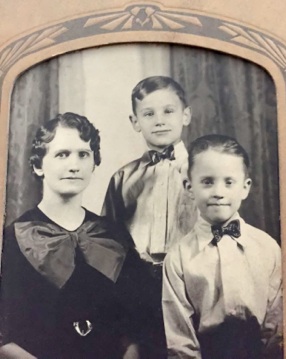 At left, is a picture of Bert (at back) with his younger brother, Richard, and their mother Mary.
In 1944, Bert graduated from high school in Meriden, CT as valedictorian. He attended Bates College in Lewiston, Maine, as part of the Navy’s V12 program. His plan was to be a Navy chaplain. In June of 1946, he was transferred to the NROTC Program at Harvard to be trained as a deck officer. He used this as an opportunity to earn a Harvard degree. He completed his AB in philosophy in June 1947. His thesis was entitled, The Conflict Between Egoism and Altruism.
At Harvard Bert roomed with Richard Reinhold Niebuhr, the son of H. Richard Niebuhr. H. Richard Niebuhr was Bert’s mentor at Yale Divinity School. Bert said, “I learned most of what I know about ethics from Professor Niebuhr." Bert’s suite-mate at Harvard was Bobby Kennedy.
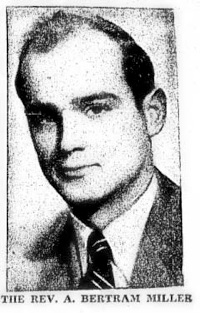 Rev. A. Bertram Miller arrived in Austin on July 1, 1950, after graduating from Yale Divinity School with a BD He lived for short time in the old parsonage adjacent to the church. The previous minister's family chose not to live there because of noise and disruptions from fraternities and sororities. A new parsonage had been built on a lot donated by J. M. Kuehne, and the Millers were its first occupants. It was located on McCandless Street. The Lutheran Campus Ministry began in the old parsonage beside the church, but the building was later used for a child care establishment.
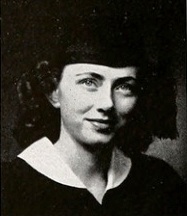 The summer before Bert finished his degree at Yale, he served a summer internship as student pastor at the Congregational Church of Coral Gables, Florida. It was there he met a beautiful member of the choir, Mary Margaret Robarts. Mary Margaret had graduated in 1947 in sociology from Maryville College and had done graduate work at Florida State University. They remained in contact and were married on December 30, 1950, at the Coral Gables Congregational Church. Bert’s father, Rev. Ray Marcus Miller, pastor of the Center Congregational Church in Meriden, CT, performed the service, assisted by Rev. Fred E. Cole, Pastor of the Coral Gables Congreegational Church.
Mary Margaret was born 1925, in Lake City, FL to George Andrew Lites and Frances Elizabeth Engle Robarts. Mary Margaret’s brother married Bert’s sister. Bert and Mary Margaret’s daughter, Elizabeth Ann Miller (Nestler), was born 1959. Mary Margaret was a public school teacher.
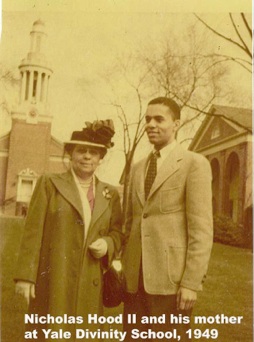 Rev. Miller taught at Huston-Tillotson College for a year while serving as pastor. He was Executive Secretary to the Austin Council of Churches. This was a time when the Civil Rights Movements was beginning to stir, and Bert was very active in furthering the cause. Each year, The University of Texas had a Religious Emphasis Week. It had always been segregated. Bert invited Rev. Nicholas Hood, a Yale Divinity School classmate and minister from New Orleans, to participate. Rev. Hood went on to help found the Southern Leadership Conference with Martin Luther King. He was a minister in Detroit and served on the City Council there for many years. He also developed low income housing in Detroit.
There was a church camp in Ardmore, Oklahoma, that children from the church attended. Bert arranged for children from Rev. Hood’s church in New Orleans to join with his church’s children and attend. They were successful, though there was tension at the camp.
Each year, there was a group of Congregational ministers that met in Dallas. Bert invited a black minister from a large church in Houston. He recalled that the meetings were cancelled after that. He also invited the black ministers in Austin to join the Austin Council of Churches. He received support from the ministers in the area.
It was during Bert’s tenure that the first black member of the church joined. She was Evelyn Demetta Moore, a student at Huston-Tillitson and also the daughter of Rev. John and Frankie Moore. John was the pastor of Pilgrim Congregational Church in Houston, Texas.
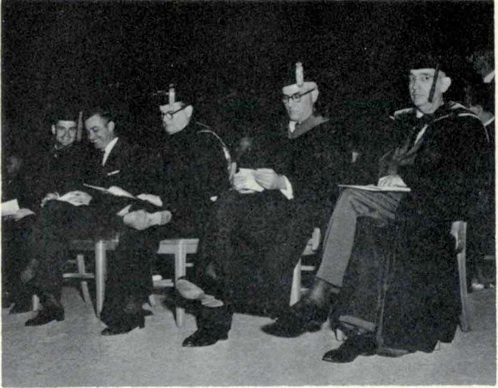 Bert was chosen by the University of Texas as the minister for Commencement in 1956, quite an honor for one so young. Left to right, in photo at right, Rev. A. Bertram Miller, Jack McGuire, John Jay Hopkins, President Logan Wilson, and Dean of Arts and Sciences and Professor of Physics, Charles Paul Boner.
The name of the church was changed on March 28, 1951, to The Congregational Church of Austin. Some members left the church to start a separate Unitarian church. According to Reverend Miller, the church had a requirement that to be a member one needed to have been baptized. This presented a problem for the Unitarians in the congregation. They grudgingly went along with christening children, however, when Clark Hubbs sought membership and Bert baptized him during a service, this was the last straw, so they resigned their membership. A member of The Congregational Church of Austin left a legacy to the Unitarian church which paid for its present building.
Student work and social emphasis continued and the church became financially self-supporting with some funds being furnished for student work. The Millers left in 1956, to pastor the South Congregational Church in St. Johnsbury, VT. He served as pastor of the South Congregational Church, St. Johnsbury from 1955-63. He left to start a new church in Miami Lakes, Florida. He was there until 1977, when he left to be associate pastor of The Church by the Sea in Bal Harbor, Florida.
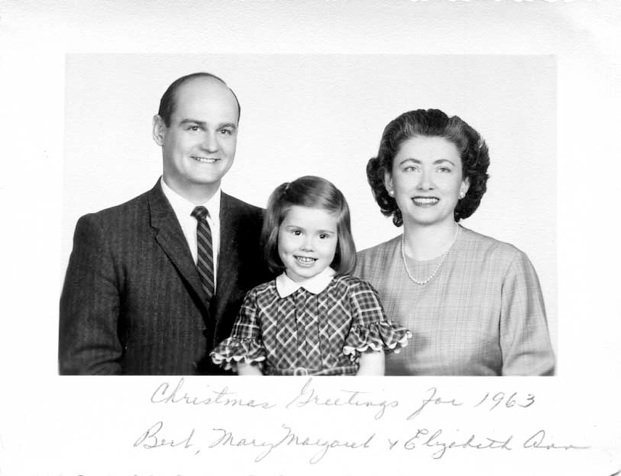
Bert, Mary Margaret and daughter Elizabeth Ann
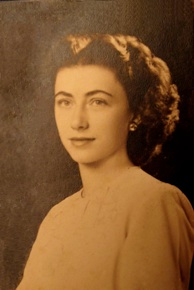 Bert was not the only Miller to work for civil rights. In 1969 or 70, in an effort to begin to be more integrated, the public schools in Dade County, FL asked for teachers to volunteer to be assigned to schools where they would be a minority, and Mary Margaret did. She left an all-white school to team teach kindergarten at an all-black school—Bunche Park Elementary, and years later, at predominantly-black North County Elementary until her retirement. At both schools she became friends with her teacher team-mates—both black— and quite fond of her students, many of whom she remembered for years. She was a strong advocate for and defender of her students when it came to standardized testing.
Following retirement in 1992, Bert and Mary Margaret remained in Florida where he served as interim minister at several churches in Dade County, FL: Key Biscayne Community Church, Miami Lakes Congregational Church and Christ Congregational. He continued to be involved with South Congregational Church in St. Johnsbury, VT, where he had spent vacations since 1964 and retirement summers. He also continued to be active in the choirs of both Miami Lakes Congregational Church and Church By the Sea. Until perhaps five years ago, he served as a UCC annuitant visitor, and he still serves on the finance committee of the UCC Florida Conference. Bert also help found the Counseling Ministry of South Florida (now Samaritan Counseling Centers).
Bert and Mary Margaret returned to Austin in 2001 to help celebrate the 100th Anniversary of the church. They are shown below; note the photo of Professor John Kuehne and his daughter, Hildegaard.
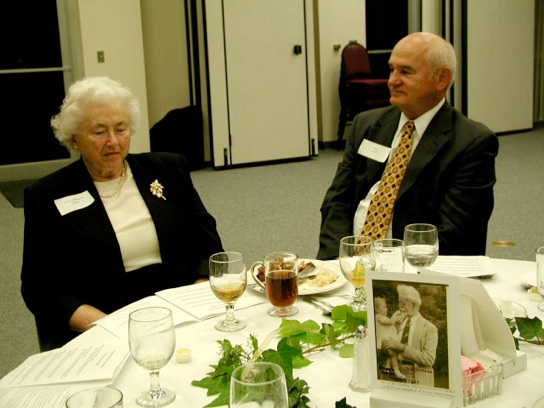
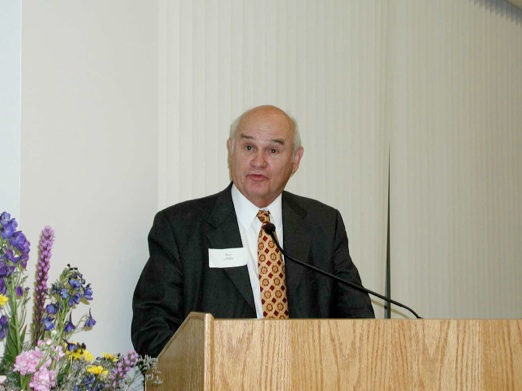
Mary Margaret Miller died February 7, 2014. Her obituary read,
Obituary for Mary Margaret Miller
“Mrs. Mary Margaret Miller, 88, of Bay Harbor Islands died Friday February 7, 2014, at the Suwannee Valley Care Center after an extended illness. She was the daughter of the late George A.L. and Elizabeth Engle Robarts Sr. She was preceded in death by one brother, George A. L. Robarts, Jr. She was a member of the United Church of Christ, a kindergarten teacher for twenty-five years. She enjoyed china painting, traveling and spending time with her family. Mary is survived by her husband of sixty-three years of marriage, The Reverend A. Bertram Miller, Bay Harbor, FL; one daughter, Elizabeth Ann Nestler (Peter) Lebanon, NH; one brother, William Robarts (Barbara) Lancaster, NH; one grandson, Michael H. Nestler, two sister-in-laws, Martha Jean Robarts and Julia Merrill, and numerous nieces and nephews also survive. A service for Mary Margaret was held at her home on Sunday February 9, 2014, with a visitation from 1:00 P.M. until 4:00 P.M., with a service following. Interment will take place at a later date.”
As of this writing, Bert Miller remains in good health. He lives in Bay Harbor Islands, Florida. He kindly provided many recollections from his days in Austin. In 2015, Bert provided a generous donation to the Congregational Church of Austin Endowment Fund, given “In memory of Mary Margaret Miller and all her church friends from the years 1951-1956. May God have blessed them all.”
Sadly, Bert passed June 22, 2017, in North Carolina, as a result of a fall.
Thanks to Elizabeth Miller Nestler, Bert's daughter, for many of the pictures used in this biography.
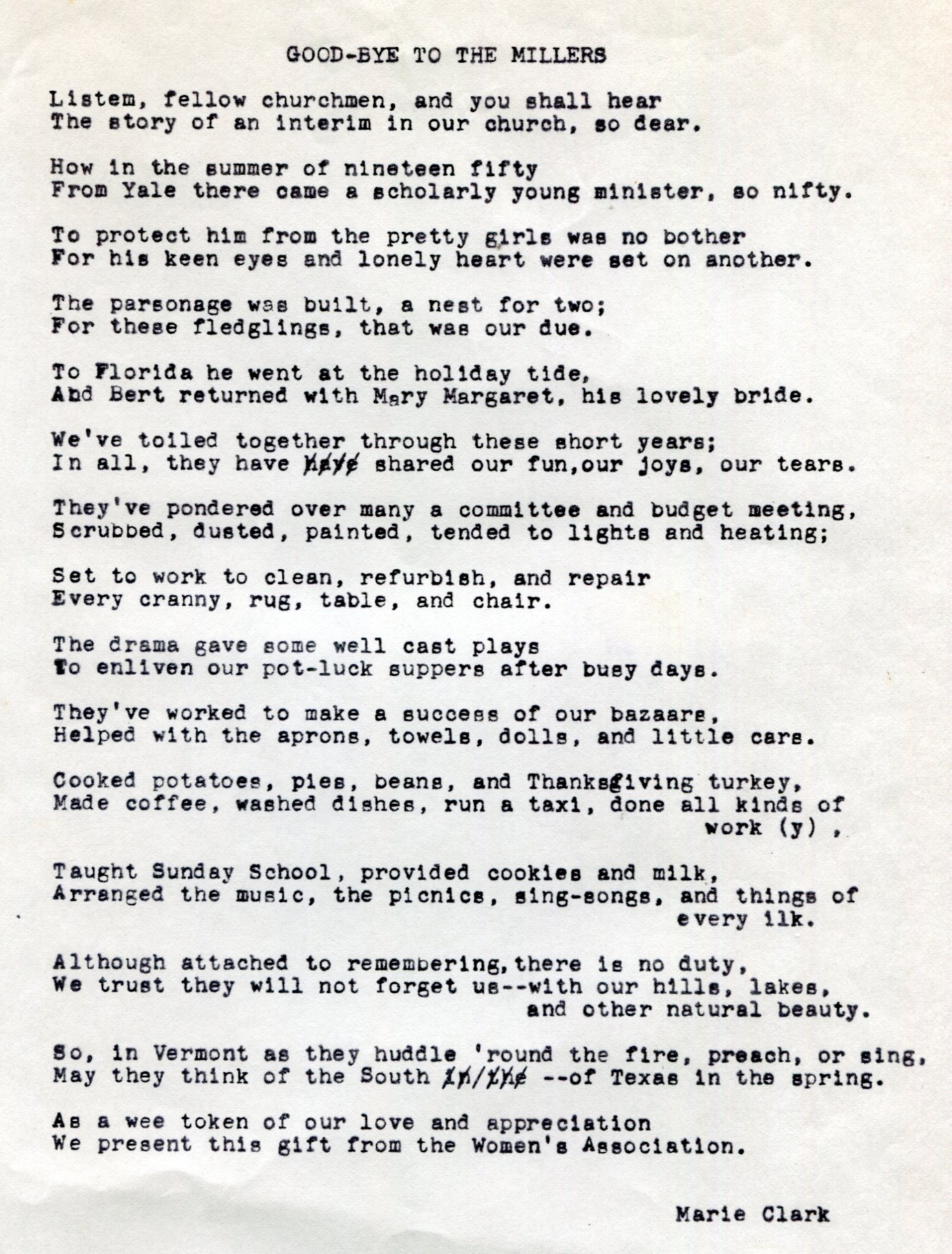
A. Bertram and Mary Margaret Miller Photo Gallery |
|---|
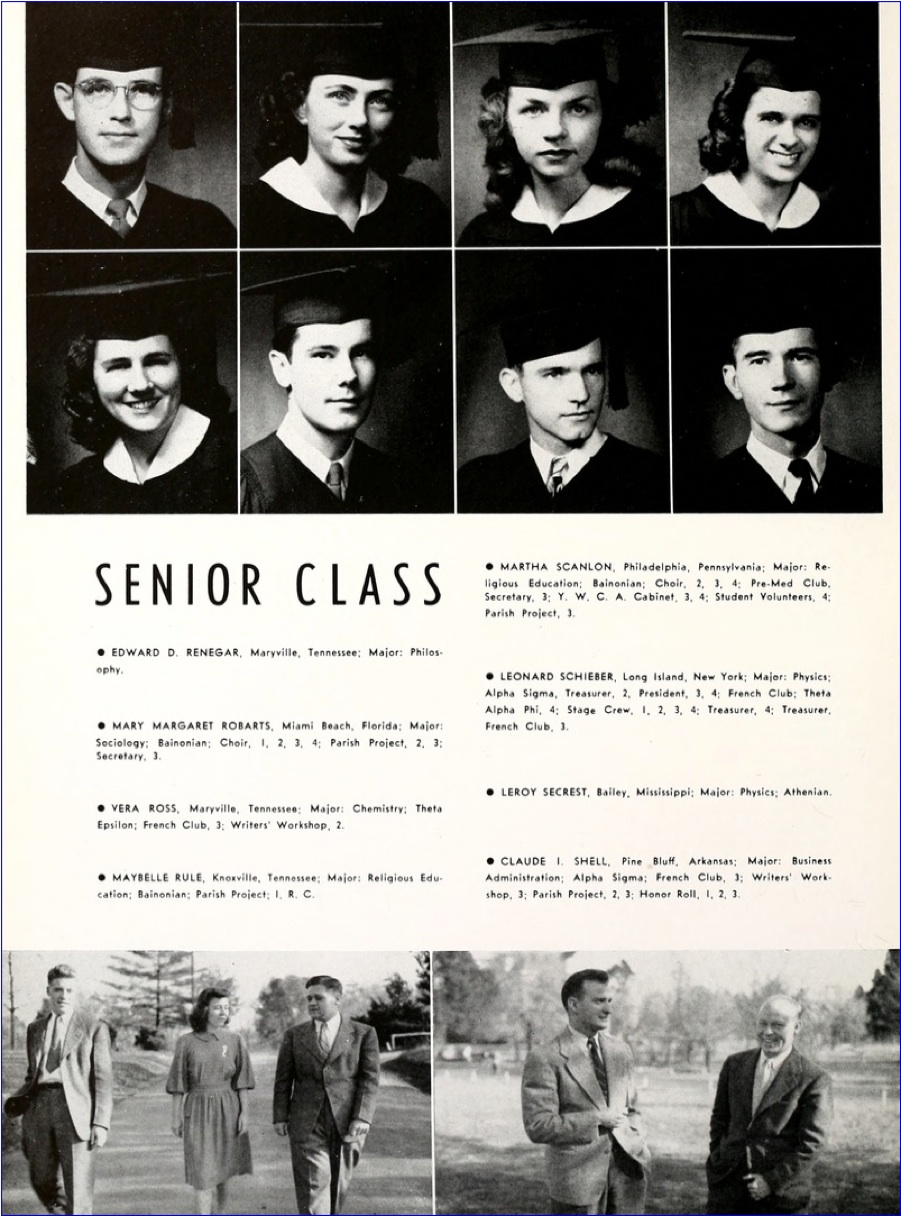
Senior Class, Maryville College, 1947
Mary Margaret Robarts, top row, second from left.
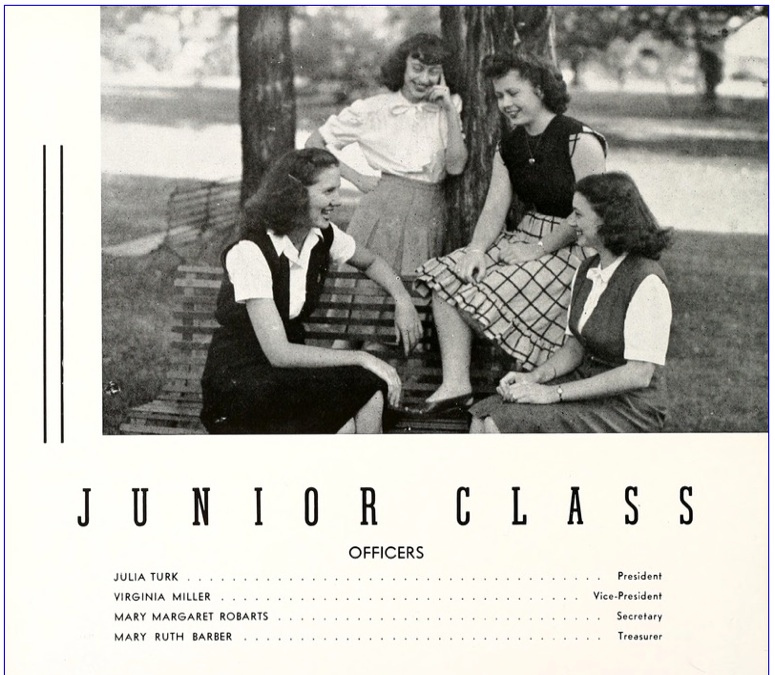
Junior Class Officers, Maryville College, 1946
Mary Margaret Robarts, second from right.
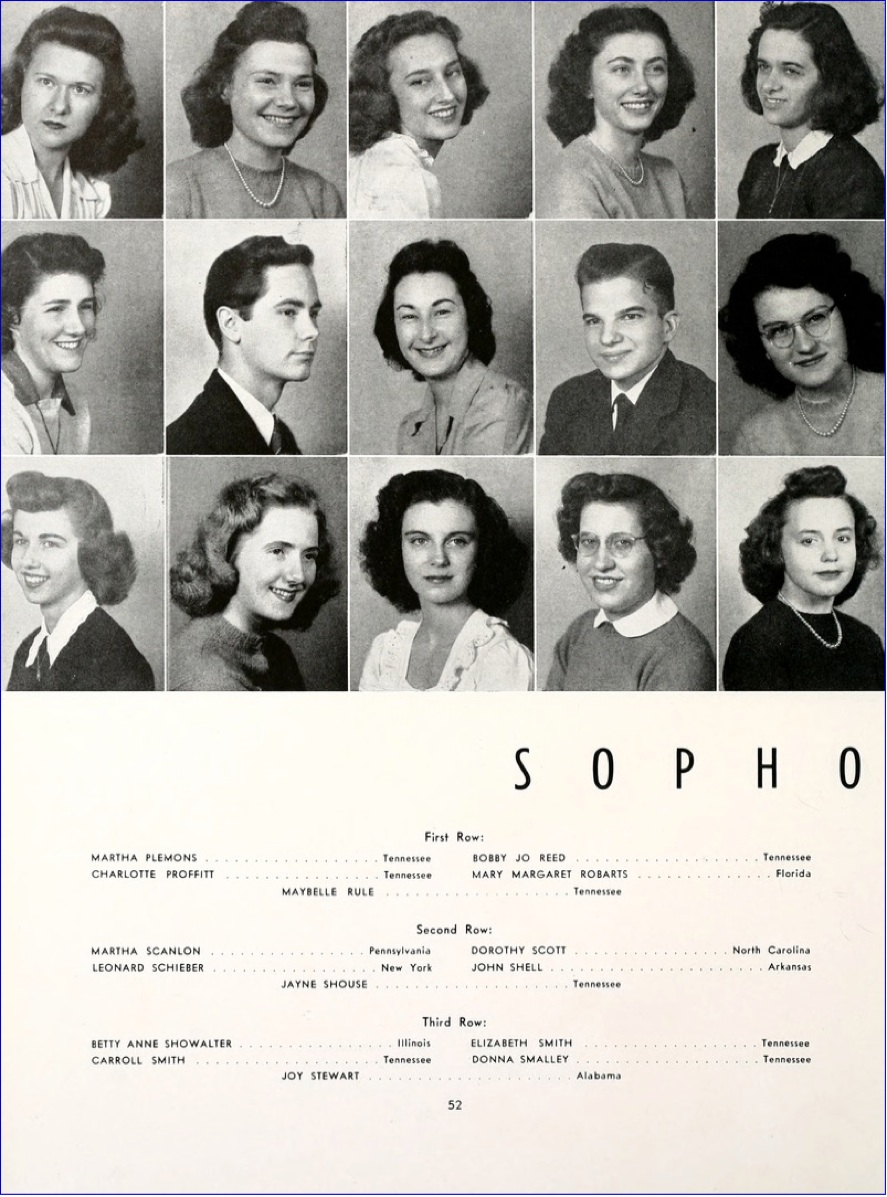
Sophomore Class, Maryville College, 1945
Mary Margaret Robarts, bottom row, second from right.
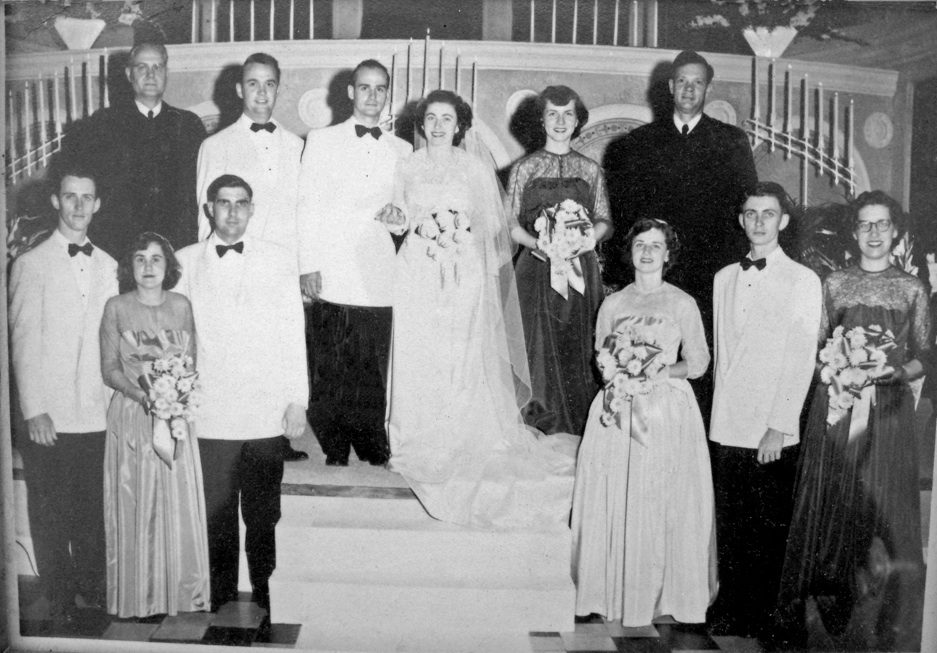
Back Row, L to R: Rev. Ray Marcus Miller (father), Richard C. Miller (brother), Bert Miller, Mary Margaret Robarts Miller, Virginia Engle (cousin of bride), Rev. Fred Cole
Front Row: George A. L. Robarts (brother of bride), Mary Joan Miller (sister of groom), Rev. Kenneth C. Johnston, Eleanor Kelley (Mrs. James A. Hardin), William Robarts Jr. (brother of bride), Donna Smalley (Mrs. Kenneth J. Chapman) December 1950, Coral Gables Congregational Church, Florida.
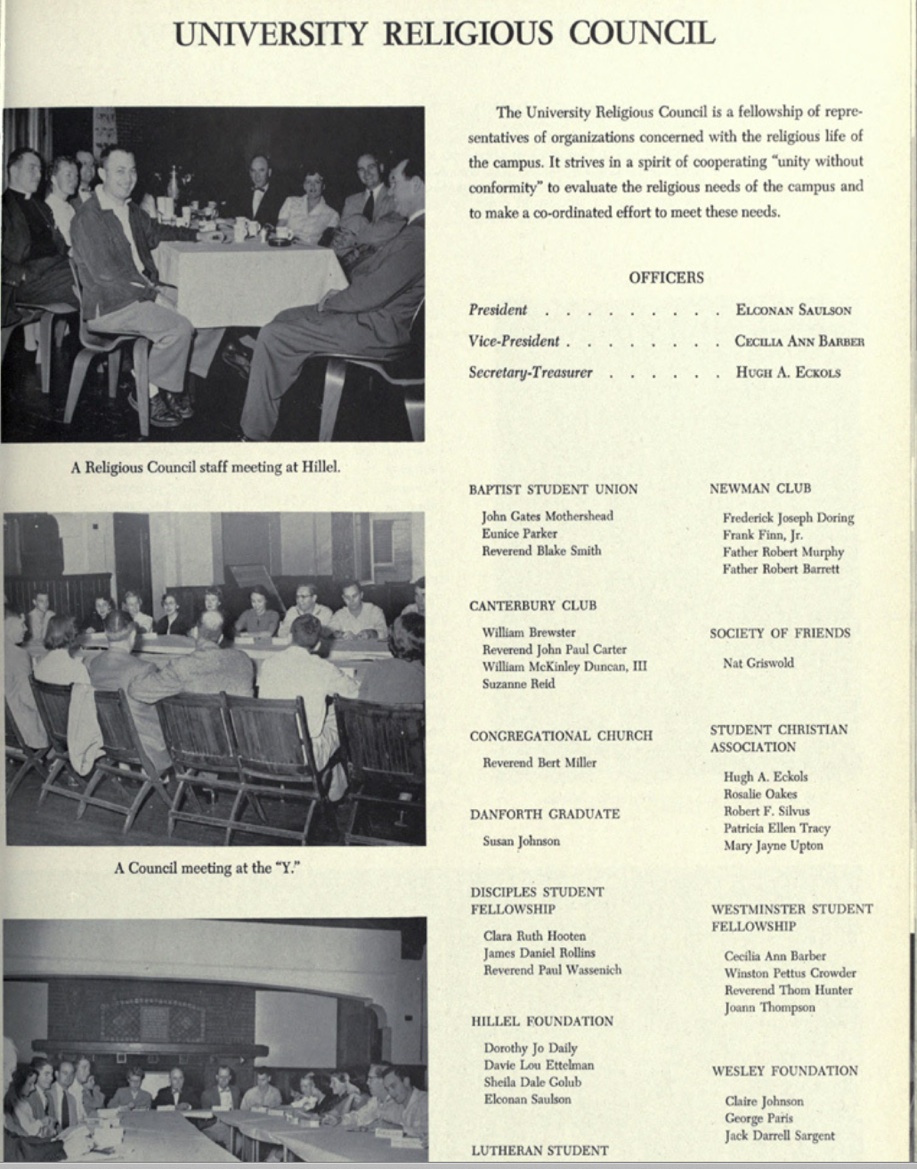
University Religious Council, UT Cactus, 1955
Bert Miller is second from right in top photo. He is third from left in bottom photo.
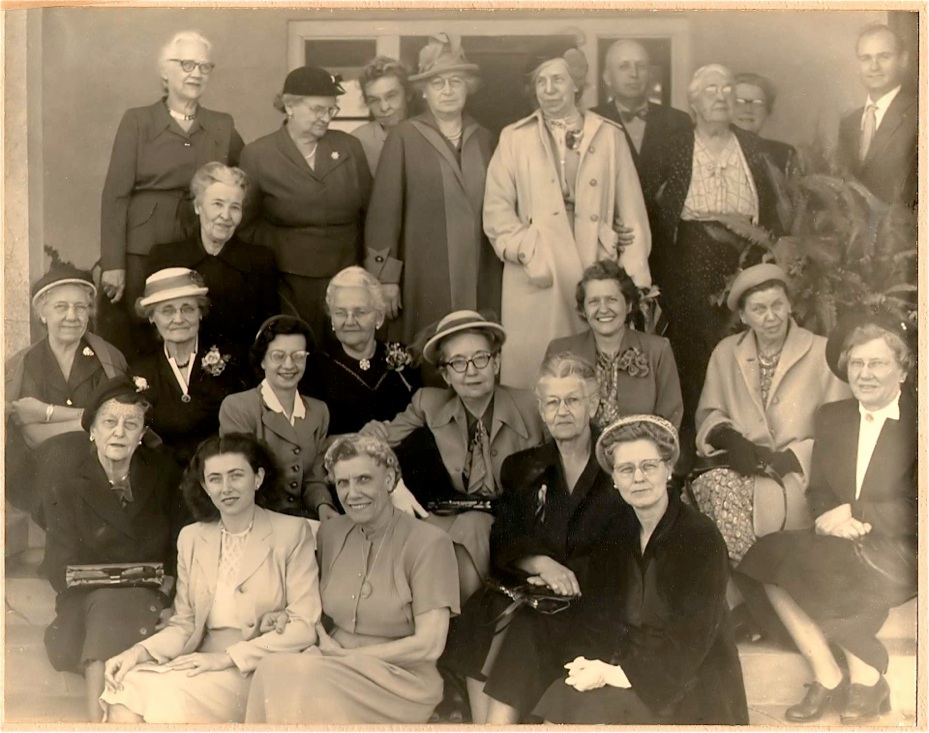
Ladies Aid Society, ca 1950s. Bert Miller, back right, Mary Margaret Miller, front left, light suit.
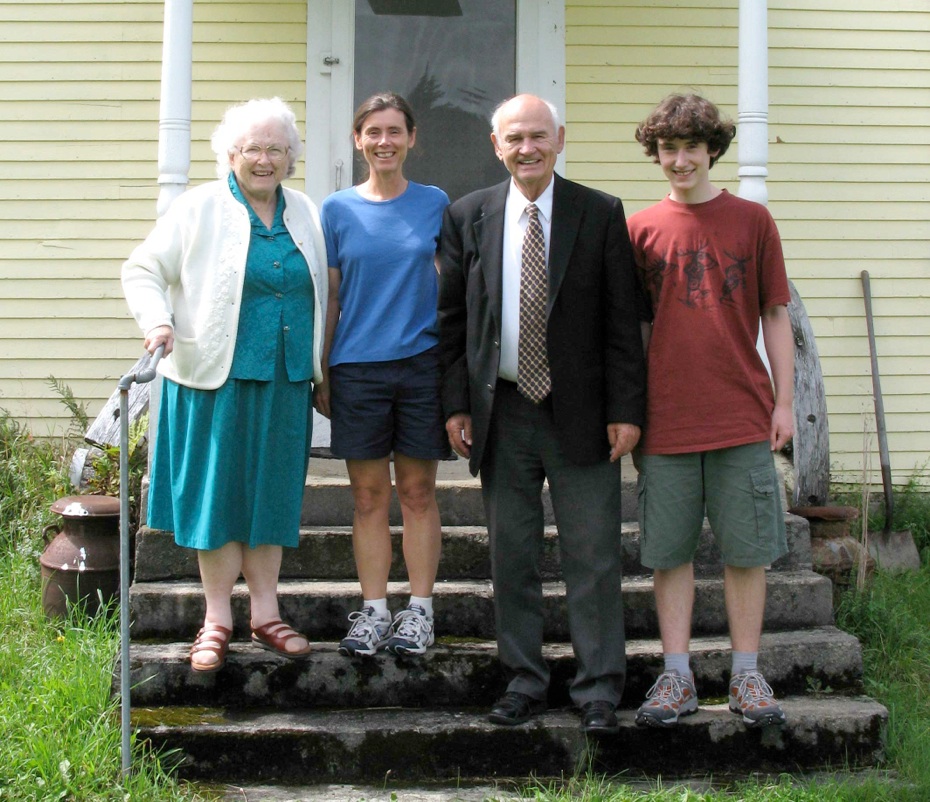
Mary Margaret, Elizabeth (daughter), Bert and Michael (grandson), Schoolhouse, Sutton, VT, 2007
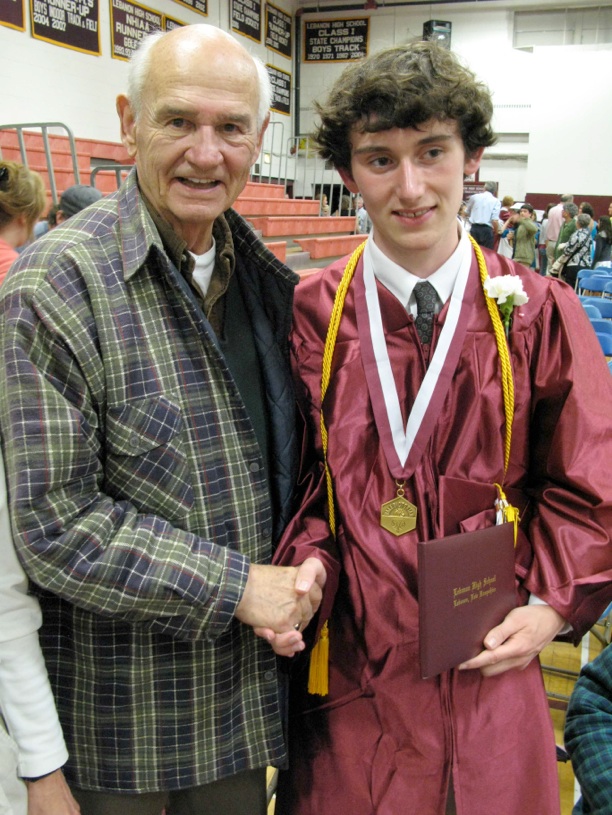
Bert and grandson, Michael, Valedictorian, Lebanon High School graduation, Lebanon, NH, June 2010
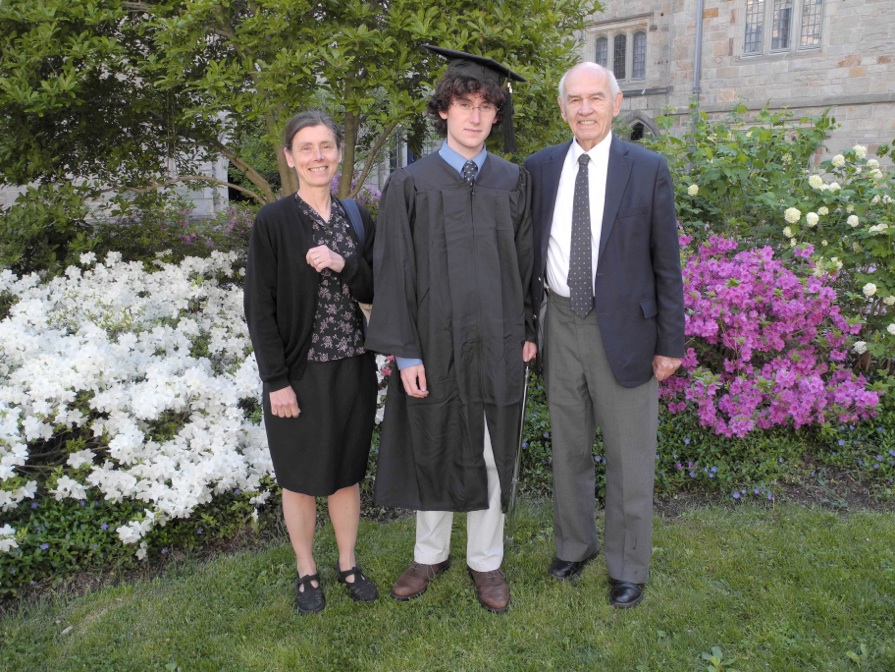
Elizabeth Miller Nestler, Michael Nestler and Bert Miller, Yale graduation, May 2014
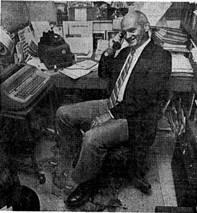
Bert in his office. Where and when unknown.
Comment about Church and Reverend Bert Miller written by E. P. Schoch, celebrated chemist
MY HOUR AT CHURCH
E. P. Schoch November 11, 1950.
It is now nine o'clock ~ Sunday. The streets are quiet, and the few cars and people in them are mostly on their way to church — dressed for the occasion — and with faces that show the repose resulting from the momentary dismissal of their routine cares. I, also, lapse into that frame of mind as I look forward to the hour at church. On my way there I meet friends whom I may not have seen for many days, and at the church I meet those who are drawn there by the same desire which draws me there — a quiet hour in which to think of matters of greater than individual concern ~ in which to hear some of the finest strains of music that master minds ever composed — and, finally, in which to hear the thoughts of a young, but already mature and great exponent of the world‘s religious truths as first taught by Christ, the greatest teacher of the doctrine of love among men and of hope as our ever-sustaining impulse during our many trials in life. Why am I drawn particularly to our little church? It is because I meet there many kindred souls — men and women who have realized that Christianity's first duty is to help men and women to live a useful, contented life, and to help their fellow man to do so; men and women who dismiss all worry of their existence after death through the conviction that we are masters of our lives on this earth, and that,,if we have lived according to Christ's precepts, we can pass on without worry as to the future. And again — I am drawn to our little church because i want to hear what our young minister has prepared to say to us. This little church has been very fortunate in the ministers who have come to us, and this good fortune has continued in the coming of our young friend, Bertram Miller. As I listen to him, I marvel at his sagacity, his maturity — yet he is still in the twenties. But then I recall that the greatest Teacher was only thirty when crucified. We want to take no one from his own church — the church where he can get the quiet hour on Sunday mornings that we all need to realize that we are more than a moving being. But I want those — and there are many of them — who do not have such a church to realize that they can have this Quiet hour, this fellowship with kindred spirits, and this sermon backed with human interest if they will come to our little church.
Bio of E. P. Schoch:
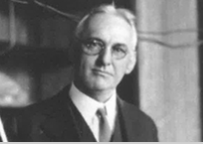 Eugene Schoch was born to American parents in Berlin in 1871, and moved to Texas in the early 1880s. He grew up on a farm near Floresville, Texas, and entered the University as an undergraduate shortly after it opened. He graduated with a degree in civil engineering in 1894, and spent a period as a surveyor in San Antonio. He returned to Austin and received a Master's degree in chemistry in 1896. He served as an instructor in the Chemistry Department thereafter, spending his summers pursuing a PhD at the University of Chicago. At Chicago he studied under Julius Stieglitz, and his dissertation, The Red and Yellow Mercuric Oxy-Chlorides, was accepted in 1902.
Schoch was a member of the UT faculty for 65 years. He was the founding father of the discipline of chemical engineering at UT, and advocated vigorously for its recognition as a separate department, which occurred in 1938. He organized the Bureau of Industrial Chemistry in 1927, and served as its director for 25 years. His interest in Industrial Chemistry (later known as chemical engineering) followed earlier contributions to the study of theoretical chemistry, for which he was known worldwide. Schoch was also a beloved campus figure and popular teacher. He organized the University Orchestra, and later founded the Longhorn Band. He was director of them both for many years.
As one of the early founders of the School of Chemistry, Schoch allied himself with Bailey and Harper to demand adequate time for research and publication. In those days, pure research was widely dismissed as a frivolous activity that interfered with teaching. He devoted much of his research career to the betterment of Texas' natural resource consumption and conservation. A true pioneer in industrial chemistry, Schoch worked in such disparate areas as water treatment, natural gas and methane conversion, mineral resources, and oilfield development. He sought fundamental principles that could be applied to industrial processes and economic benefit.
Eugene Schoch was one of the most important figures in the history of the University of Texas. He remained actively involved in university life until his death at the age of 89 in 1961. The then-Chemical Engineering Building was named in his honor in 1969.