Das Kelly Barnett
(1914-1973)
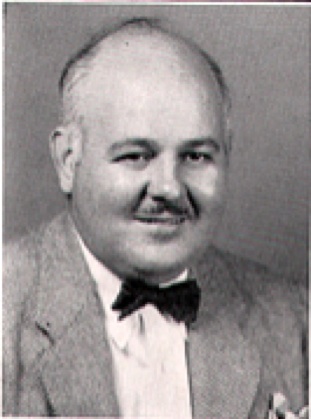
Reverend Dr. Das Kelly Barnett
Regularly preached sermons in 1959
Reverend Dr. Das Kelly Barnett, who taught "Church and Society" at the Episcopal Seminary of the Southwest, supplied the pulpit, and the Mr. Frank Horak, who was working for a degree, provided student leadership. Dr. Kelly Barnett suggested as a possible pastor the present minister, John C. Towery, who arrived in September, 1959.
Here is an excerpt from the book, Macon Black and White: An Unutterable Separation in the American Century
By Andrew Michael Manis. Published 2004. It discusses Kelly Barnett while he was on the faculty of Mercer College.
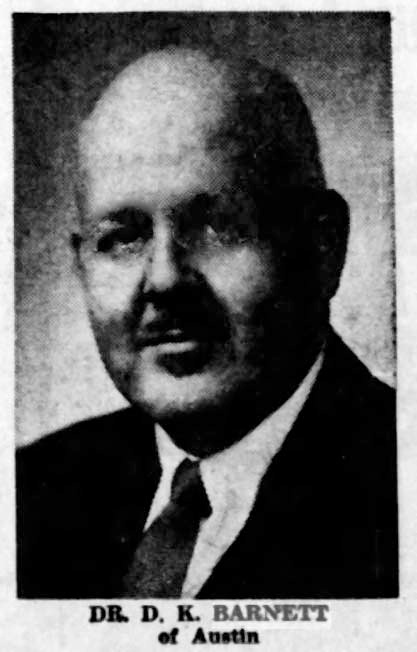 “Another professor hired by Dowell who undermined his students’ conventional wisdom on race was Dos Kelly Barnett. Arriving at Mercer in the late 1940s with a doctorate in theology from the Southern Baptist Theological Seminary in Louisville, Kentucky, Barnett was a gifted preacher and idealistic enough to believe his oratory could change Southern Baptists. Besides filling Georgia Baptist pulpits on occasional Sundays, he taught courses in Christian and biblical ethics in the Mercer Christianity department. From his lectern, he informed students that “basic civil rights are essentially spiritual, and to deny these rights to one is to endanger the same rights for others.” In another 1947 course, he gave a great proportion of his lectures to explaining the Social Gospel to his students, highlighting all the major works of the leading spokesperson for the movement, Walter Rauschenbusch. He told students that, in the previous forty years, the labor movement had done the most good for people in the United States, while “churches have just passed a few resolutions. The more un-Christian," he noted, “have upheld the Christian principles." He called the god of the Ku Klux Klan “a tribal god,” and informed students that the biblical book of Ruth refutes “racial intolerance.” Barnett was later known for deliberately riding in the “Negro" sections of Macon buses. Eventually, however, Barnett grew weary of trying to change Baptists. Always ambitious for bigger things, he left the denomination when he was overlooked for a prestigious position at his seminary alma mater in Kentucky. Becoming an Episcopalian, partly for that tradition’s social progressiveness and partly for its more liberal views on alcohol, he finished his career teaching in a seminary in Texas.”
Das Kelly Barnett, born Dec 16, 1914, died June 22, 1973 (maybe in Hancock, Houghton, Michigan), buried in Boonville, NC with wife Virginia A. Barnett (maybe Virginia Craver (?-2001) Professor of Christian Social Ethics, Seminary of the Southwest, Austin.
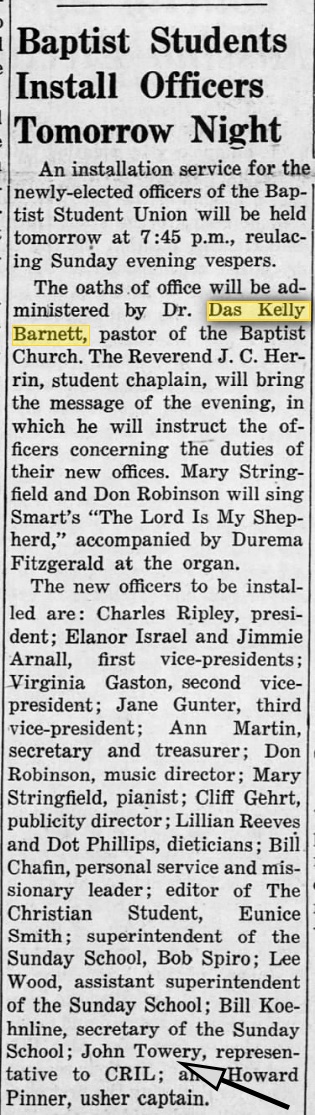
Below is the link between Dr. Kelly Barnett and John Towery.
From The Daily Tar Heel (Chapel Hill, North Carolina), March 9, 1946.
Man that is born of a woman is born in one time and no other. Man that is born of a woman is born in one place and no other. No man that is born of a woman chooses the time and the place when he comes into the world. Rather through the will of his parents and through the wisdom of the Eternal One, man begins his human experience in one time and one place. He is not asked about time. He is not consulted about place. He has no choice in his parents.
Yet that one time and one place both forms and deforms a man. Where a man is born determines to a large extent who and what he is. The time and place in which a man is born determines what his attitude is about life and other men. The time in which a man is born limits what he can be. The place in which a man is born also gives him the opportunity to become what he is in later life.
Some men are born rich. Some men are born poor. Some men are born in the city. Some men are born in the rural world. Some men are born in a new and changing America. Some men are born in the old and unchanging America. Some men are born in the world of letters. Some men are born in the world of sweat and toil.
Kelley Barnett was born in 1914 in Heber Springs, Arkansas to Monroe Washington and Johnie-Grace Birdsong Barnett. He was born in the South, but more than just the South. he was not born in Virginia or the Tidewater and its veneer of gentility and culture. He was not born in Texas with its beginning of the West. He was not born in New Orleans and its view of the Sea and the world beyond. He was not born in present day Atlanta and its burgeoning prosperity and success. He was not born in present day Florida with its opulence and luxury.
Rather, Kelley was born in Heber Springs, Arkansas in that special and sometimes unknown part of the South. The South that was before the Civil War, the West. 125 years ago it was the West with the brutality and challenge and power that a frontier and the outer reaches of the world can give to men. It was a land where the gentility of the Old South was often lost. It was a place where powerful men through the sweat and toil of other men brought great changes in a little while. It was a land of elementary passions. A land of great love and also great hate.
But Kelley was born in the South in 1914. At a time when the Civil War was still a living memory. At a time when the issues of that War were not resolved. In a place where the land was old, where living was hard. In a place where prosperity was past and where the rest of this country hardly penetrated. But a place where the passions of the past were still a present reality. It was a land where kin and family still loomed important. It was a place where the love was as great as the hate. It was above all a place where the White and the former slave were locked together in a crucible which formed all. It was a place where Black and White were locked together in an ever present reality but in an unresolved love and hate.
In that time and that place Kelley was born. not because he chose, because no man chooses his time or place because that is a given. not because he was asked, because no one is consulted about what his forming experiences will be. But because Monroe Washington and Johnie-Grace willed it and the wisdom of the Eternal One wanted it.
But if no man chooses where and when he is born each man does have a choice as to how he deals with the encounter with God that comes in the time and place where he lives his span. If no man is asked where he is to be born each man is asked to respond to the Almiqhty in the reality of his life.
And Kelley responded to the encounter with God in the time and place in which he was placed. First as a 12 year old boy preacher speaking to his people in a way that we who were not those people find it hard to understand, but must accept as real. Then ordained at 17 in the Baptist Church and ordained by men the calluses of whose hands were felt as they laid their hands upon him. He responded to the call of God in Chapel Hill in North Carolina at the Baptist Church where he worked with that representative of all that is best in the South - Senator Frank Graham. In 1953, he responded to the call of God by being ordained in this branch of Christ's Holy Catholic Church. Ordained by John Kines, our present great Presiding Bishop, who has challenged this Church to living the Gospel as few have dared and less have done. Kelley answered the asking of the Eternal One as priest, teacher, pastor and friend as encounters with God came.
But above all Kelley responded to the call of God as a priest forever after the order of Melchizeder. A priest who was not so much a preacher, though he was also that. A priest who was not just a teacher, though he was certainly that. But a priest who was a prophet who spoke of his encounter with God from the time and place he came and to the time and place he lived.
Kelley was a prophet who spoke about man's everlasting inhumanity to man as we practice it in our time and our place. He spoke as one who was born in the crucible of his time and place in the South and how Black and White must live together and that hate must end in all the land. He was a prophet who said that there was greatness in both Black and White and that love must begin so that each could stand proud before the other.
Kelley was a prophet who spoke this truth of his encounter with God which traversed a lifetime. He spoke it in Louisville in early days. He spoke it in Chapel Hill before it became the fashion with many people. He spoke this truth of Black and White together in the Episcopal Church before John Hines challenged this Church. He spoke this truth in the fearful days of the Civil Rights Revolution of the 60's.
And like all prophets he paid the price of telling people of his encounter with God and the truth he had found. Like Melchizeder in the early pages of the Old Testament he became as without father and mother. Separated in part from the time and place where he began. Separated sometimes from the Church he was part of because it could not or would not hear the hard truth he spoke about all men. He paid the price of a prophet both mentally and physically.
None of us chooses the time or place where we are born but fortunate is the man who is born in a time and a place where reality is stark and the issues are clear. In such a time and such a place Kelley Barnett was born and formed. Happy is the man who responds to the encounter of God as he finds it in his time and place. So did the prophet Kelley Barnett respond to the encounter of God in a lifetime.
I would like us to close by thinking about the words from the anthem of the 60's Civil Rights Revolution — an anthem that tells us all that Kelley stood for.
We shall overcome. We shall overcome. We shall overcome someday. Deep in my heart I do believe, we shall overcome someday.
Black and White together. Black and White together. Black and White together someday. Deep in my heart I do believe, we shall overcome someday.
For Kelley now it is "Black and White together.” For Kelley now has "overcome."
If we remember Kelley Barnett's time and place it will be for us “Black and White together.” If we remember Kelley Barnett's encounter with God we too shall “overcome someday."
Sermon preached at Das Kelley Barnett's funeral June 26, 1973 at Trinity Church, Houghton, Michigan by the Rev. Carlson Gerdau.