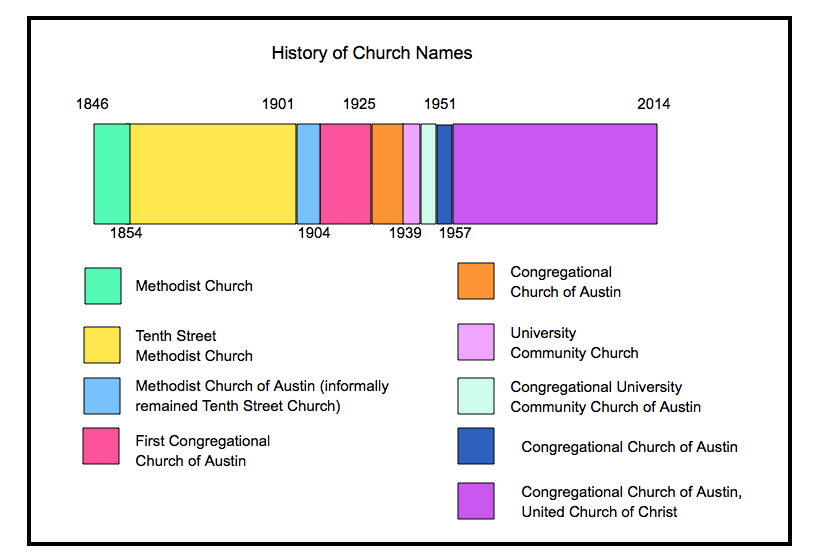
History of Church Names
Tenth Street Methodist Church
It was 1840, and in Austin, the newly designated capital of the Republic of Texas, a dozen or so Methodists were listening to the new preacher, the Rev. John Haynie, a 52-year-old former mercantile store owner from Knoxville, Tenn, who received his preaching license in 1811.
The Mississippi Conference had appointed Haynie in December 1839 to the Texas Mission’s “Austin Circuit,” an area that included part of Bastrop County and what would soon become Travis County.
Haynie journeyed to the Republic of Texas from Tuscumbia, Alabama, where he had spent 14 years as a merchant and minister. He arrived in Velasco in January 1839, and preached his first Texas sermon in May at Bastrop.
As a circuit rider, he preached in the area from Bastrop to Austin, avoiding Indians because he refused to bear arms. In November 1839 he served as chaplain of the House of Representatives of the first Congress of the Republic of Texas to meet in the new capital city.
Worship in Austin was held in a log house built by the men of the community and located south of what is now Wooldridge Park and west of the Austin History Center. Haynie’s first year of ministry included a wedding on May 7, 1840, the first marriage ceremony recorded in Travis County.
After serving the Austin area a second year, Haynie was succeeded in 1841 by the Rev. Josiah Whipple of Illinois, who preached in the Austin Circuit for two years, accompanied by a rifle and pistol in the pulpit, in case of an Indian raid or Mexican invasion. His caution was justified: 1,500 Mexican soldiers invaded San Antonio in September 1842. In fact, so great was the threat of raids, uprisings and invasions that it was impossible for the church to continue in an organized fashion from 1843-45.
After conditions improved, the Rev. Homer S. Thrall was appointed to Austin by the Texas Conference. When he came to the capital of the soon-to-be state, he could find none of the original church members. Lacking a congregation, he walked to the Capitol at the corner of Eighth and Colorado Streets, where he preached in the halls of the Legislature. Thrall taught school to support himself and slept at night on the floor of a lawyer’s office.
In December 1846, Thrall again was appointed to lead the Austin Methodists, including Texas Gov. J .P. Henderson. A lot was purchased for $26 at the northeast corner of Congress and Cedar (now Fourth Street), and on Dec. 19, 1847, the board and batten structure was ready for the first worship service.
In late 1853, the original church building was sold to the Christian Church, and lots were purchased at the northeast corner of Brazos and Mulberry (now Tenth Street). Here a small, red, brick church was commenced in 1854 during the pastorate of the Rev. John W. Phillips. The new church was the worship home to a membership numbering 90, including 30 Negro slaves and servants. By 1858, the membership had grown to 231 members including 135 slaves.
During the Rev. Josiah Whipple’s pastorate at the end of the Civil War, the roll totaled 77 when former slave members left after emancipation. With help from the Rev. Isaac Wright, a minister of the Methodist Episcopal Church, the freed slaves formed Wesley Chapel Methodist Church.
The Austin congregation worshiped in the red-brick building until 1883 when, under the leadership of the Rev. A. E. Goodwyn, it was razed and replaced by a steepled structure built in the Roman style of architecture. Among those who contributed to the construction of the new church were Gov. John Ireland and former governors E. M. Pease and F .R. Lubbock.
It was in 1892, during the pastorate of the Rev. R. J. Briggs, that the church reached its peak 19th-century membership of 675. For a time, the church was called Central Church, South; later it was referred to as Tenth Street Church until 1902, when it was officially called First Methodist Church. However, the term “Tenth Street M. E. Church” remained in common use until 1923, when the congregation began to worship in the basement of the present structure at Twelfth and Lavaca Streets, built during the four-year pastorate of the Rev. Edward R. Barcus. In 1928, the upper portion of the main building was completed. The Rev. W. F. Bryan was pastor. Total cost: $200,000.
An excerpt from the First United Methodist Church of Austin web site.
The Methodist Church
The history of the Congregational Church of Austin, Texas had its beginning when twelve charter members of the Methodist Church of Austin signed Articles of Incorporation on March 21, 1901, and filed them with the Secretary of State of the State of Texas on April 2. 1901. There is an entry in the 1903, Austin City Directory for German Methodist Episcopal Church at 303 East Ninth Street. Rev. Carl Halm is pastor; John M. Kuehne is Superintendent of Sunday School.
First Congregational Church of Austin
The Methodist Church of Austin held its services in the Odd Fellows Hall located on the second floor of a two-story brick store building at the northeast corner of East Ninth Street and Congress Avenue. Under the inspiring leadership of Dr. Briggs, the membership in the church and in the Sunday School increased rapidly in the next few years, and, in 1906, a beautiful, large church was erected at the corner of West Ninth and Colorado Streets. Mr. A. O. Watson, a charter member of the church, was the architect. This building project was made possible by means of a liberal grant of money and a substantial loan to run for many years at a very low rate of interest Congregational Church organization, and, by vote of the congregation changed the name to First Congregational Church. The influence of the church and the Sunday School increased the the years, and the membership attained the numerical figure of two hundred and fifty and the Sunday School had nine classes with a membership of ninety.
In 1937, the church is listed in Austin City Directory as First Congregational Church.
In the 1939 Austin City Directory, the church was listed as the First Congregational Church of Austin.
Congregational Church of Austin
The Reverend Ruel P. Snider became pastor in January 1925. He emphasized work with students at the University of Texas. Many members of the University faculty and their families as well as students, became members of the church, and, in time the name changed to the Congregational Church of Austin.
The University Community Church
Many members of the University faculty and their families, as well as students, became members of the church. Reverend S. Marcus Hogue suggested that a name change would be helpful for growth. On May 12, 1939, it was decided to let the entire congregation vote on the name change. The ballots were counted and certified on May 30. The vote was 71 for and 15 against. The name was changed to The University Community Church. The listing on stationary was “University Community Church, Congregational-Christian.”
Congregational University Community Church of Austin
Sometime in the 1940s, the name was changed back to Congregational Church of Austin. In Annie Doom Pickrell’s obituary inthe Austin paper, the church is listed as Congregational University Community Church. In a 1948 article in the American Statesman, the church is mentioned as “University Community Congregational Church.”
Congregational Church of Austin
On March 28, 1951, the name was changed to Congregational Church of Austin. In Annie Doom Pickrell’s obituary in the Austin paper, the church is listed as Congregational University Community Church. The 1952 City Directory listed the church as “Congregational Church of Austin.”
Congregational Church of Austin, United Church of Christ
On Tuesday, June 25,1957, at Cleveland, Ohio, the Evangelical and Reformed Church, 23 years old, passionate in its impulse for unity, committed to "liberty of conscience inherent in the Gospel," and the Congregational Christian Churches, 26 years old, a fellowship of biblical people under a mutual covenant for responsible freedom in Christ, joined together as the United Church of Christ. The new church embodied the essence of both parents, a complement of freedom with order, of the English and European Reformations with the American Awakenings, of separatism with 20th-century ecumenism, of presbyterian with congregational polities, of neo-orthodox with liberal theologies. Two million members joined hands.
The story of the United Church of Christ is the story of people serving God through the church. Co-President James E. Wagner, a graduate of Lancaster Seminary, parish minister, seminary professor, and instructor in Bible, brought intellectual and spiritual stature, wisdom and brotherly warmth to match the generous personality of Co-President Fred Hoskins, gifted Congregational Christian professor and pastor, of liberal theological orientation and consummate organizational ability.
A message was sent to the churches from the Uniting General Synod, signed by its moderators, Louis W. Goebel and George B. Hastings, its co-presidents, and co-secretaries Sheldon E. Mackey and Fred S. Buschmeyer. After acknowledging the separate ancestries of the parties to the union and citing ecumenical "relatives" of both denominations, the message stated, "Differences in ecclesiastical procedure, which in sundry places and times have occasioned tensions and disorders, are appointed their secondary place and are divested of evil effect." The union, the message continued, was possible because the "two companies of Christians hold the same basic belief: that Christ and Christ alone is the head of the Church ... From him [we] derive the understanding of God, ... participation in the same spirit, the doctrines of faith, the influence toward holiness, the duties of divine worship, the apprehension of the significance of baptism and the Lord's Supper, the observance of church order, the mutual love of Christians and their dedication to the betterment of the world" ("Report on the Uniting General Synod:" Advance, July 12, 1957, p. 22).
A Joint Resolution, declaring the basis of union, adopted by both parties at the Uniting General Synod, said in part: "Delegates of the Evangelical and Reformed Church and the General Council of the Congregational Christian Churches, in joint session assembled this day in the city of Cleveland, Ohio, do hereby declare that The Basis of Union with the Interpretations has been legally adopted ... that the union ... is now effected under the name of 'The United Church of Christ' ... that the union be formally pronounced ... in the name of the Father, and of the Son, and of the Holy Spirit ... that until the adopting Constitution ... The Basis of Union shall regulate the business and affairs of the United Church of Christ .... "