Ira Hobart Evans
April 11, 1844-April 19, 1922
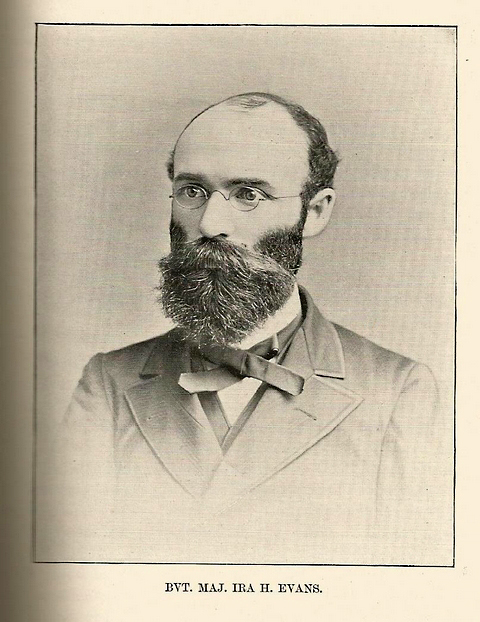 | 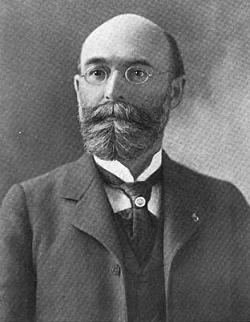 |
EVANS, IRA HOBART (1844–1922). Ira Hobart Evans, soldier, legislator, and businessman, son of Ira and Emeline (Hobart) Evans, was born in Piermont, New Hampshire, on April 11, 1844. He attended public schools in Barre, Vermont (graduating in 1862), enlisted in the Vermont Volunteer Infantry (Company B, Tenth Vermont Volunteers) in July 1862, and was commissioned first lieutenant in 1863 (in the 9th U.S. Colored Troops) and captain in 1865. In March 1865, he attained the rank of brevet major and was appointed acting assistant adjutant general of the Twenty-fifth Army Corps, Army of the James.
{In March, 1865 he was promoted to brevet major "for gallant conduct and meritorious services" and assigned as assistant Adjutant of the XXV Army Corps, Army of the James. Medal of Honor action[edit] General William Birney, as quoted in 1897's "The Story of American Heroism" compiled by J.W. Jones:"In the early days of April, 1865, when General Grant was moving on Petersburg, my division (the Second of the 25th Corps) held a portion of the Union line near Hatcher's Run. The main body was sheltered by a low ridge from the enemy's fire, but the rifle pits in which the pickets were posted and the open space between the pits and the ridge, was swept by the Confederate cannon and musketry. Confederate deserters were numerous, most of them reaching the rifle pits late at night or about daybreak, where, for their safety, they were detained until nightfall. An afternoon assault on the Confederate works being intended, it was very important to learn what changes had been made in them. I was directed from headquarters to have the newly arrived deserters interviewed. Being unwilling to order any member on my staff on so dangerous a duty, I called for a volunteer. Captain Evans was the only one who responded. Dismounting, he passed rapidly over the ridge in front of the division, being at that time the only Union soldier in view from the Confederate line. The enemy opened a sharp fire of musketry upon him, and continued it until he disappeared in one of our rifle pits. Having questioned the deserters and obtained the desired information, he returned through another shower of bullets and reported to me. It was a gallant feat."–Wikipedia)
After Robert E. Lee's surrender at Appomattox, Evans was sent to Texas as a member of the occupation force of Maj. Gen. Philip Henry Sheridan. After the war, Evans’s command was sent to the Rio Grande border in support of American diplomatic efforts to oust the French from Mexico. France had installed Maximilian as emperor in that country while the United States was diverted by the Civil War. He held various administrative positions in the Brownsville area until he was transferred to New Orleans in September 1866. He received his discharge on January 31, 1867. In 1867, he settled in Texas north of Corpus Christi and began raising stock. He lost his investment there through the dishonesty of a partner.
Evans then joined the Freedmen's Bureau at Wharton but resigned on January 31, 1868, angered by his superiors in the bureau, whom he considered incompetent. He subsequently worked for the Internal Revenue Service, first in Eagle Pass and then in Corpus Christi. At the urging of Republican gubernatorial candidate Edmund Jackson Davis, in 1869 Evans ran for and won a seat in the Texas House, representing the Western District of Texas. He was elected speaker of the House in 1870; at age twenty-five he was the youngest person ever to hold this office. He took an active interest in all legislation, especially that relating to a railroad system.
In August 1870, an election law was passed that violated the Constitution of 1869 by postponing the date of the next election by one year to 1872. Evans strongly opposed this measure and was supported by all Democrats in both houses and by a few Republicans. He and his Republican supporters were called before a caucus of the Republican party and denounced, and afterward the caucus voted to remove Evans from the office of speaker. The next morning, the office was declared vacant. Evans completed his extended term as representative, but when the Twelfth Legislature adjourned on December 2, 1871, he left political life.
He then pursued a business career. He was elected general manager of the Texas Land Company of Houston on January 16, 1872, and secretary of the Houston and Great Northern Railroad Company in 1873. After the merger of the International Railroad with the Houston and Great Northern, he was elected secretary of the consolidated International-Great Northern Railroad Company in 1874. He was director of this railroad from 1875 to 1908 and president of the New York and Texas Land Company, Limited, from 1880 to 1906. He was a co-founder of the Austin National Bank in 1890 and director of the bank from 1890 to 1922. He was appointed receiver of the Austin Rapid Transit Railway Company in 1897 and held that position for five years. He was president and director of the Austin Electric Railway Company in 1902–03.
Evans's lifelong interest in the advancement of southern blacks was manifest in his support for Tillotson College in Austin. He was a member of the board of trustees of that college from 1881 to 1920 and president of the board from 1909 to 1920. He donated $10,000 to the college for use in training students in construction skills and an academic program in home economics; as a result of this gift, the college was able to construct a building that bears his name. Evans bequeathed an additional $10,000 to be used to build a residence for the president of the college.
.jpg)
Evans Industrial Building, Huston-Tillotson College 1802 East 8th Street, Austin, Texas. Built during 1911-1912 by Tillotson students. Named to the National Registry in 1982, it was completely restored in 1984 and designated as a Texas historic landmark. The building currently houses the Education and Kinesiology departments, their faculty, staff and several classrooms. The Teaching Resource Center, the Human Performance Laboratory, and a Distance Learning Laboratory are among the available classrooms.
The building has a striking presence and is one of two historic preservation sites on the campus. It is located near the entrance of the campus. The building is very popular among those who visit the campus because of the scenic view it provides from the second story front porch.He served as president of the American Missionary Society and the Sunday School Association. He was one of the organizers of the First Congregational Church in Palestine, Texas, in 1881 and served that church prominently for many years. He was a member of the board of trustees of the First Presbyterian Church in Austin for twenty-two years and president of the board of trustees of the First Congregational Church of Austin for five years (1909-1914). He was also a member of numerous military, historical, scientific, and political organizations. (He was a member of the Texas and general society SAR., having been six years as president of the former and serving as vice president of the latter.,member Society Colonial Wars, Military Order of the Loyal Legion, Military Order of the Medal of Honor, Society Army of Potomac, American and Texas Historical Societies, New Hampshire Historical Society, Texas Academy of Science, National Economic League, American Sociological Society and American Political Science Association.) His Austin home served as a meeting place for a group that later became the Texas State Historical Association. He was a member of the University Club and the Army and Navy Club of New York City.
Among the many honors conferred upon him was the Medal of Honor, which he was awarded for distinguished bravery at Hatcher's Run, Virginia, on April 2, 1865. He was selected as one of the officers of the honor guard to march in President Abraham Lincoln's funeral cortège. for a video describing his gallantry click here: Fritz Wetherbee:; Ira Hobart Evans Medal of Honor

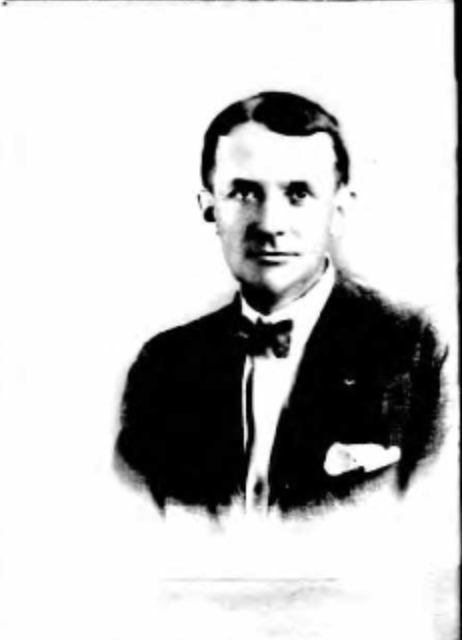 The Ira Evans family in Austin, TX around 1896. Standing (l-r) William Leslie Evans (1872–1943), Mrs. Ira Hobart Evans (Francese Abigail Hurlburt (1838–1924)), and Francis Hurlburt Evans (1880–1963). Seated (l-r): Hobart Yale Evans (1876–1961), Maj. Ira Hobart Evans, and nephew, Wilburforce Hurlburt Young (1872–1948). In 1918, Wilburforce Hurlburt Young applied for a passport for travel to France for the National War Work Council of the Young Men's Christian Association of the USA to work with US troops. He graduated in 1894 from Knox College and became president of Austin Electric Railway Company. His passport photo is shown at right.
Evans married Frances Abgail Hurlburt (original spelling: Hurlbut) of Upper Alton, Illinois, on July 13, 1871, and they had three sons. Her father was Rev. Thaddeus Beman Hurlbut, 1828 graduate of Hamilton College and Auburn Theological Seminary 1934, was a close associate of Rev. Elijah Parish Lovejoy* and a founder of the Upper Alton Presbyterian Church. He was one of the gallant defenders of Lovejoy's press on the night of Lovejoy's murder and one of only a few people present when Lovejoy was secretly buried. For many years, he championed the cause of a monument to Rev. Lovejoy.)
*(Lovejoy was born in Albion, Maine, in 1802, and graduated from Waterville College in 1826. The next year, he arrived in St. Louis where taught school and then worked as an editor at the St. Louis Times. In 1832, he decided to become a minister and traveled back east to study at Princeton Theological Seminary, completing the three year course in fourteen months. The Presbyterian Church in the U.S.A. ordained him in 1833.
Upon his return to St. Louis, Lovejoy founded a religious and antislavery newspaper, the St. Louis Observer, while also serving as pastor of Des Peres Presbyterian Church. His strong abolitionist stance spurred anger in St. Louis, and three times, opponents destroyed his printing press. In May 1836, Lovejoy decided to move with his family across the Mississippi River to Alton, Illinois, where he founded the Alton Observer and served as pastor at Upper Alton Presbyterian Church (now College Avenue Presbyterian Church) and as stated clerk of the Presbytery of Alton.
Attacks on Lovejoy's printing press continued in Alton. In November 1837, a mob attacked Gilman's Warehouse in Alton where he had tried to hide his new press. Lovejoy tried to ward off the mob, but he was shot and killed, and the mob destroyed the new printing press by throwing it out a window and then tossing the pieces into the river. )
Ira and Frances's forty-six-year marriage ended in divorce in 1917. He was married again, to Jessie M. Stewart, on October 14, 1920 in Springfield, MA. She was the daughter of John Edward Stewart of Marengo Park, Mass. Jessie had never married as she cared for her mother until her death. After the wedding, the couple visited New York before returning to their future home at 209 West Seventh Street in Austin, Texas. Evans moved to San Diego, California, in 1921 and died on April 19, 1922. He was buried in the family plot in Montpelier, Vermont.
(Source: Handbook of Texas Online, H. Leslie Evans, "EVANS, IRA HOBART," accessed May 01, 2019, http://www.tshaonline.org/handbook/online/articles/fev04. )
Some additional material was added to the article by Mel Oakes and is in italics.
In October 1917, Major Evans attended the National Council of Congregational Churches in Columbus, Ohio as a delegate. He made a speech urging more support for Negro colleges. He was a member of the National Service Committee. A panorama of the delegates was for years displayed in the church. However, in April of 2019, someone broke into the education wing and tossed many church records and the panorama and frame from the second floor. With the help of William McCarthy of the Congregational Church Archive and Library in Boston, MA, copies of portions were scanned from their records and merged into again a panorama. The photo is shown below.
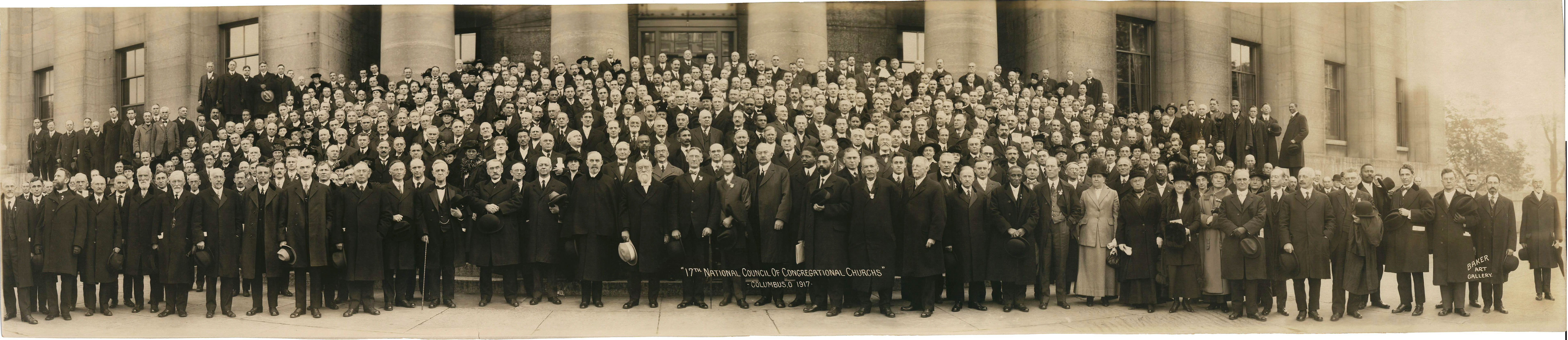
Ira Hobart Evans is in the middle of the front row with his hat in his right hand. Rev. Kunio Kadaira, delegate from California Bay District is the only Japanese delegate. He is about three people to the left of Major Ira Evans and about one row back.
For a larger version of the photo check here. Panorama of National Council of Congregational Churches 1917.
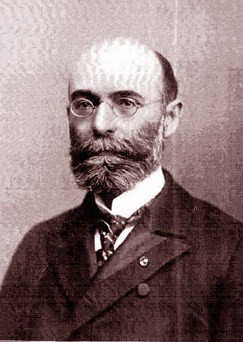
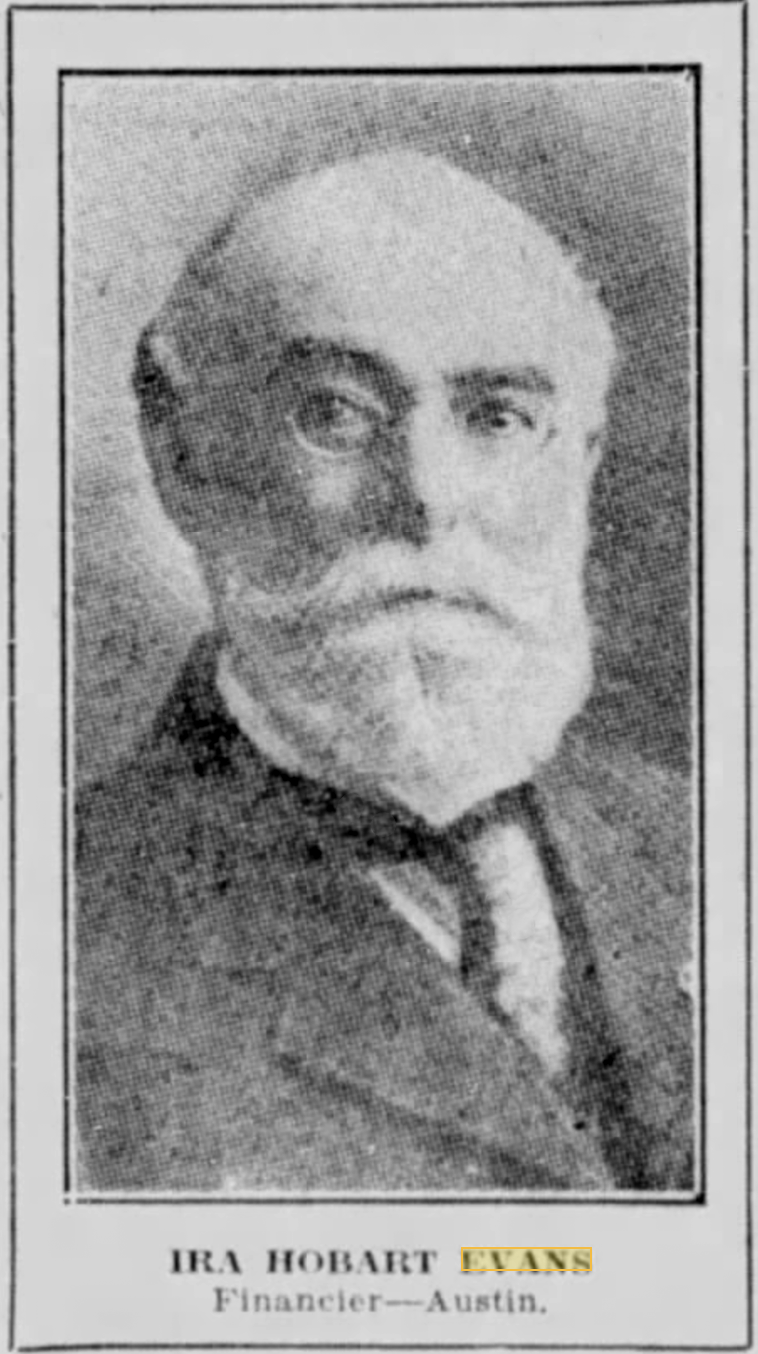
Below are some additional photos of Major Evans.
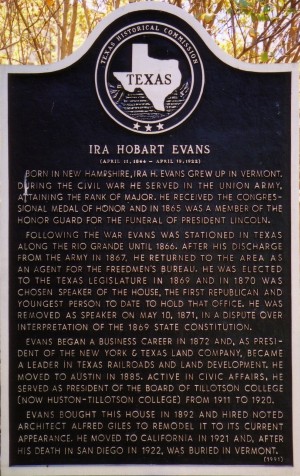
Marker located at Bellevue Palace, 708 San Antonio Street, Austin, Texas, current home of Austin Womens Club
Marker Text: Born in New Hampshire, Ira H. Evans grew up in Vermont. During the Civil War he served in the union army, attaining the rank of major. He received the congressional medal of honor and in 1865 was a member of the honor guard for the funeral of President Lincoln.
Following the war, Evans was stationed in Texas along the Rio Grande until 1866. After his discharge from the army in 1867, he returned to the area as an agent for the freedmen's bureau. He was elected to the Texas legislature in 1869 and in 1870 was chosen speaker of the house, the first republican and youngest person to date to hold the office. He was removed as speaker on May 10, 1871, in a dispute over interpretation of the 1869 state constitution.
Evans began a business career in 1872 and , as president of the New York & Texas Land Company, became a leader in Texas railroads and land development. He moved to Austin in 1885. Active in civic affairs , he served as president of the board of Tillotson College (now Huston-Tillotson College) from 1911 to 1920.
Evans bought this house in 1892 and hired noted architect Alfred Giles to remodel it to its current appearance. It is known as Chateau Bellvue today. Evans moved to California in 1921 and, after his death in San Diego in 1922, was buried in Vermont. (1991)
(More— In 1892, Major Ira Evans bought Bellevue Place and turned the home into a castle, with the help of noted Texas architect, Alfred Giles. Starting with North’s wooden porch (replaced with limestone in the 1920s) Giles extended the home toward the west with a series of graceful rusticated limestone arches. He fortified the rooftops with crenelations and added a side entrance of exquisitely carved limestone.)
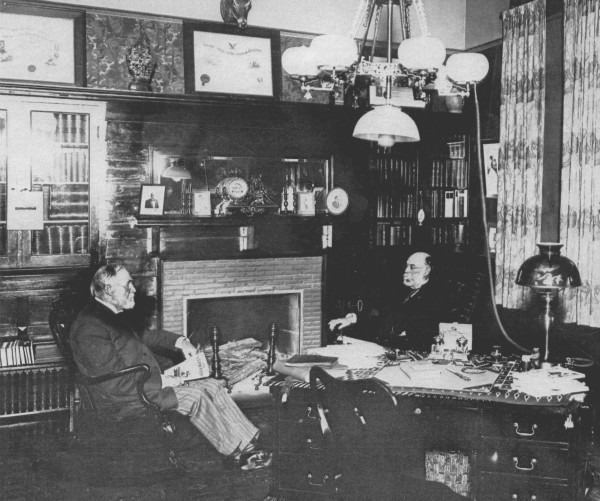
Major Ira H. Evans (at right) in his office at home in Austin, TX with his brother-in-law, Capt. Thomas A. Yale, planning the events for the 2nd Texas SAR Meeting in 1898. Maj. Evans’ SAR and Medal of Honor Certificates can be seen on the wall at the upper left. (source: Texas Society: Sons of American Revolution.)
From "Education for Liberation, The American Missionary Association and Aftrican Americans, 1890 to the Civil Rights Movement "by Joe M. Richardson and Maxine D. Jones, The University of Alabama Press, 2009, page 121.
"In the face of southern white hostility and dwindling missionary funds, H. Paul Douglass, who became AMA superintendent of education in 1906, encouraged the appointment of southern white and black men to AMA college boards of trustees. He hoped that southern white trustees would b come suffieiently interested in the schools to gather financial support and also act as buffers against those most actively opposed to black higher education. The results were mixed. Blacks were rightly suspicious of white appointees.with few exceptions, such as Vermont born, Union Army veteran Ira Hobart Evans at Tillotson, most early southern white trustees were strict segregationists and only tepidly supported liberal arts training for blacks. Evans served as president of the Tillotson board from 1909 to 1920 and donated at least $20,000 ofhis own funds to the school. On the other hand, another white Tillotson trustee and banker, under strong white pressure, resigned from the board and joined the Ku Klux Klan “because the risk did notjustify his service.” The only white citizen in Mississippi that Douglass could initially persuade to join the Tougaloo board of trustees was Bishop Charles B. Galloway, Methodist Episcopal Church, South, who had publicly declared blacks as men and brothers, eligible for any privileges and agencies that fitted them “for service in the Kingdom of God." Despite Callowayls refusal to share meals with black trustees, Douglass defended his appointment by saying, “because they are so sound on the main issue, it is possible for men of such views to accede to the popular practices of their section in nonessentials like formal racial recognition." When Galloway died, he was succeeded by another bishop Theodore D. Bratton. Douglas, an out-spoken defender of Black rights, temporarilty abandoned principlle in pursuit of the long-term goal of greater support for black colleges.
Entry from Texas Speakers of the House of Representatives
IRA HOBART EVANS
(1844–1922)
20th Speaker
(1870–1871)
Presided over
The 12th Legislature's provisional session, February 8 to February 24, 1870; the 12th Legislature's called session, April 26 to August 15, 1870; and part of the 12th Legislature's called session, January 10 to May 10, 1871.
Born in Piermont, New Hampshire, on April 11, 1844, Evans enlisted in the Vermont Volunteer Infantry in July 1862 to fight for the Union in the Civil War and reached the rank of brevet major by March 1865. Following Confederate General Robert E. Lee's surrender at Appomattox, Virginia the next month, Evans was dispatched to Texas to serve in Maj. Gen. Philip Henry Sheridan's occupation force.
Receiving his discharge in 1867, he established residence just north of Corpus Christi and started raising livestock, but his business went under because of a partner's dishonesty. Evans began his brief career with the Freedmen's Bureau, established by the United States Congress to assist former slaves adjusting to a new life of freedom. He was assigned to the Bureau's office in Wharton but resigned on January 31, 1868, angered by what he described as the incompetence of his superiors. He then worked for the Internal Revenue Service, but entered politics the following year.
The Republican Party, supported by freedman, former Democrats who had opposed secession, and new residents of the state who had arrived from the North after the Civil War, had already split into two factions by the late 1860s, labeled "Radical" and "Conservative." The so-called Radicals supported black civil rights more enthusiastically than the racial conservatives in the party. Radicals also backed invalidating all actions taken by the Texas government during the Civil War, including the incurring of debts. Conservatives generally favored railroad and manufacturing companies they saw as key to the state's economic future. As a result, they favored the recognition of state and local government actions taken between 1861 and 1868 that had not directly been in support of the Confederate war effort. A. J. Hamilton emerged as leader of the Conservatives and Edmund Davis headed the Radical faction. The ballot in the 1869 elections listed candidates as Radicals or Conservatives.
At the urging of Davis, the Radical candidate for governor, Evans successfully ran for a seat in the Texas House, representing the Western District of Texas. It was a good election for the Radicals. Hamilton received endorsements from leading Democrats, but this backfired, alienating some Conservative Republicans who moved into the Radical camp. Democrats in large numbers boycotted the election. With few Democrats voting, Radical candidates won most of the offices and took control of the state House and Senate. House members elected Evans speaker as the Legislature convened in 1870, making the New Hampshire native at age twenty-five the youngest person ever to hold that position and the first-ever Republican speaker.
Evans proved an enthusiastic supporter of railroad development in Texas. But he soon ran afoul of his own party in August 1870 when the Republican-dominated Legislature passed a new election law that delayed the next state elections for one year, to 1872. Evans saw the law as a violation of the 1869 Constitution and vigorously fought the bill. Evans won support for his position by all Democrats in both houses and by a faction of Republicans. A Republican Party caucus summoned Hobart and his legislative allies to the party gathering, where they denounced the speaker. The caucus voted to remove Evans from the speakership, although Evans continued his term as a House member. Upon adjournment of the Twelfth Legislature on December 2, 1871, Evans retired from politics.
Evans spent most of his post-speakership career as an executive with railroad companies. He also served as president (more likely president of the Board of Trustees) of Tillotson College, established for African Americans, from 1909 to 1920 and donated $10,000 to the college to teach students construction skills. Evans also donated another $10,000 to build an official residence for the college president. Located in Austin, that institution was later renamed Huston-Tillotson University after its merger with Samuel Huston College. He died in San Diego, California, on April 19, 1922.
Obituary from the Congregational Library and Archives, Boston, MA.
On the 10th of April 1922, the denomination lost one of its most loyal and devoted sons in the death of the Hon. Ira Hobart Evans, familiarly known to his friends as “Major,” at his home in San Diego, California.
Major Evans was born in Piermont, New Hampshire, April 11, 1844, a direct descendant of Rev. Peter Hobart, the first pastor (1835) of the First Church, Hingham, Mass. He was also a direct descendant of William Pynchon, first settler of Springfield, Mass. His maternal grandfather, Rev. James Hobart of Berlin, Vermont, was long known as “Father Hobart” all through Vermont and New Hampshire, where for more than 70 years he had preached, and where he had organized many churches, in fact, continuing to preach until within a month of his death at the ripe old age of 96 years.
Major Evans’ father was a physician who died when the boy was eight years of age. Soon after, his mother moved to Barre, Vermont, where he was educated in the schools and academy of the town. In July 1862, he enlisted as a private in Co. B, 10th Vermont Volunteer Infantry; later he was promoted to 1st Lieut., Captain and Brevet Major United States Volunteers. He received a medal of honor from Congress “for distinguished bravery at Hatcher’s Run, Va., April 2, 1865.” After the war, he still served for a year and a half with his command on the lower Rio Grande in Texas/ After the service, he settled in Texas and in 1870 was elected Speaker of the Texas House of Representatives at Austin, Texas.In 1872, he was elected General Manager of the Texas Land Co., interested in the development of the State. In 1886, he became president of the New York and Texas Land Co., holding that position for twenty-six years. He continued to reside in Texas until the Spring of 1921, when he removed to San Diego, Calif.
During all the years of his very active life in Texas, he was connected with a large number of strong and influential development companies. However, his business affairs did not monopolize all his time. He found great delight in the state and national activities of the church, as well as president of the State Sunday School Association of Texas : Moderator of the North Texas Congregational Assn., : First Asst. Moderator of the National Council of Congregational Churches at Worcester, Mass. In 1889 : Member from Texas of the International Sunday School Executive Committee : President of the Board of Trustees of the First Congregational Church of Austin, Texas, for over twelve years : Vice-President of the American Missionary Assn. for four years : President of the Board of Directors of Tillotson College, Austin, Texas, for the education of Colored youths : President of the Texas Society of the Sons of the American Revolution for six years, and First Vice-President General of National Sons of the American Revolution, 1903-4. He was also a member of many other State and National organizations.
Major Evans was married July 15, 1871, to Miss Frances A. Harlbut of Upper Alton, Illinois. Three sons were born to them, all of whom are now living. He was married again Oct 14, 1920, to Miss Jessie M. Stewart, daughter of John E. Stewart of Springfield, Mass., who survives.
He represented the Texas churches at the meeting of the National Congregational Council at Los Angeles, July, 1921, his last service of the kind, and was a prominent figure there. Major Evans was a man of remarkably strong Christian character and of great executive ability. His culture was exceptional, being enriched by much reading and constant study. He will be remembered for his many acts of Christian courtesy and kindness by those with whom he came into daily contact. His benevolences, both public and private, were most generous and always marked with a sympathetic personal interest. His great love for and service in the church will be a sweet memory and abiding influence for years to come. He kept ever abreast with the times, a marked leader all his life. He lived in a noble fashion as one of God’s great noblemen and always with an abiding sense of the reality of God and the life everlasting. (Transcribed by Lois Mallory.)