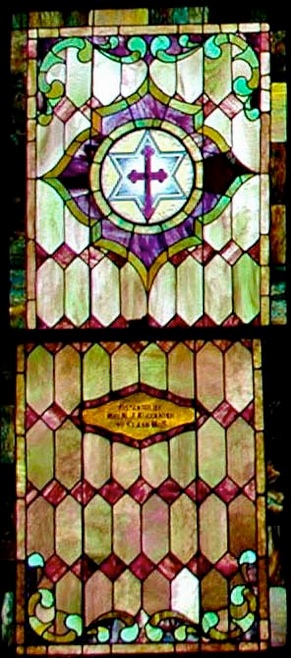
Mrs. N. J. Alexander Window
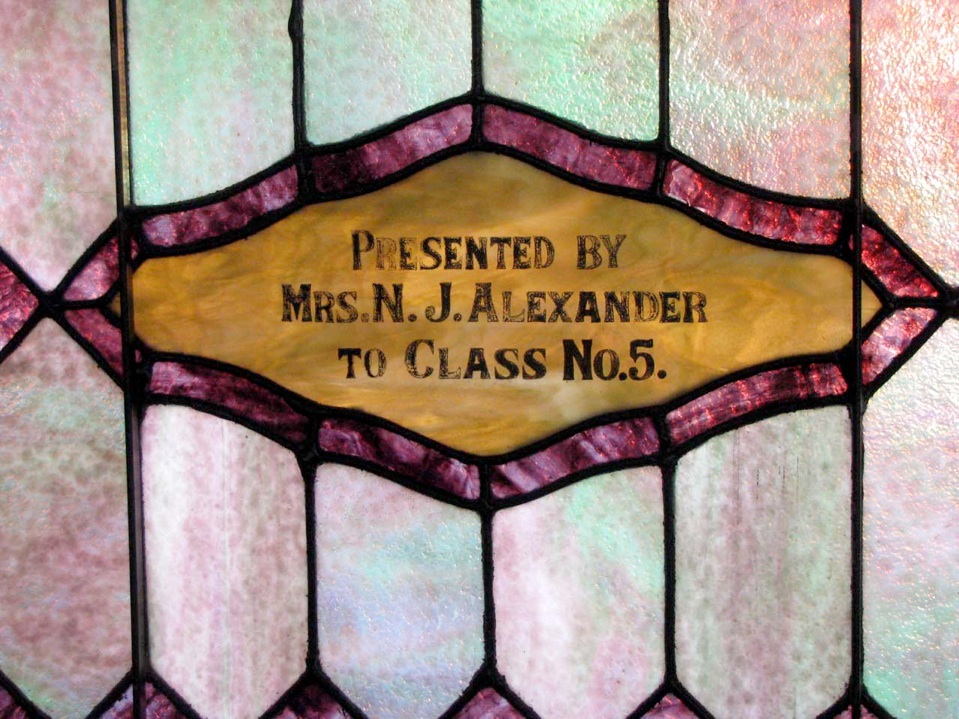
The Mrs. N. J. Alexander, Class No. 5 Window
The "Mrs. N. J. Alexander" in the church window is a second wife of Newton J. Alexander. Newton, recently divorced, married Lula May Rosengren in 1887. She was seventeen and he was forty-four.
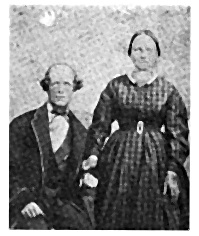
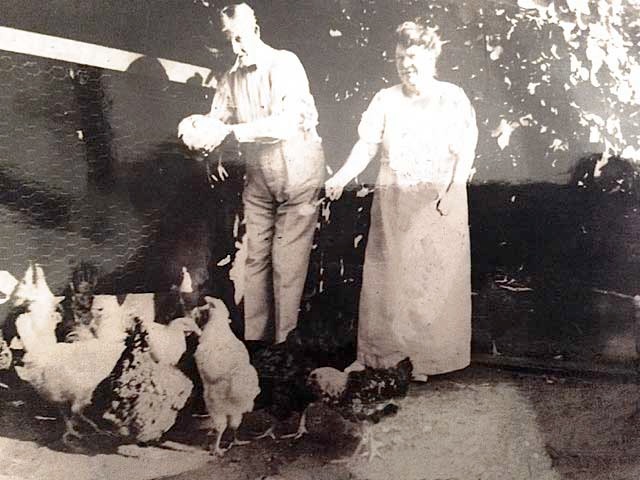
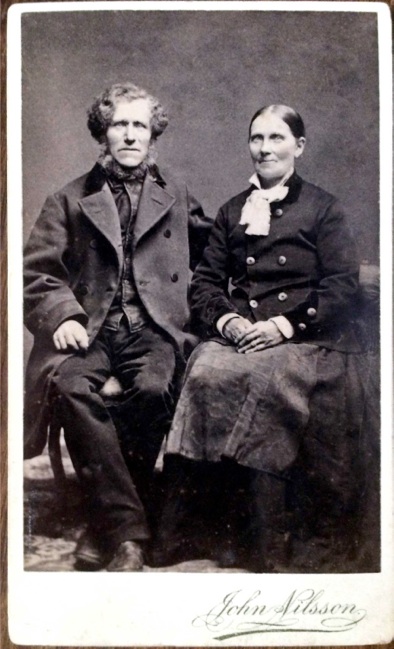 Lula’s parents were John and Hedvig “Hattie” Rosengren. They came to Austin from Öggestorp, Småland, Sweden, in the 1851. They arrived in New Orleans, having sailed from Gothenburg. John was a carpenter. Several pictures of John and Hattie are shown here. Daughter, Lula, was the youngest of seven children. Their son, Samuel Edward Rosengren, was one of Austin’s best-known businessmen and was the owner of the largest funeral homes in Texas. Born and raised in Austin, and with a good education, he started his business career as a clerk in Berryman’s Grocery Store. After a short time, he established a rental stable and funeral home under the name Weed & Rosengren, but he took over the entire operation after a few years.
Lula’s mother, Hattie, was one of the first members of the Swedish Methodist Congregation in Austin. Lula, married to Dr. N. J. Alexander, was the organist in the church for many years. Organized in 1873 by the Rev. Carl Charnquist, the Swedish Methodist Church built a sanctuary at Red River and 15th street. Led by the Rev. O. E. Olander, the congregation moved to this site in 1898 and occupied buildings of disbanded Central Methodist Church. The fellowship added "Central" to its name and later dropped "Swedish". Church property, then across from the Capitol grounds at Colorado and 13th street, was sold in 1956 for expansion of state offices. Renamed Memorial Methodist Church, the historic congregation moved to northeast Austin.
At some point, Lula chose to join the group of Methodists that decided to form an independent Methodist church over the issue of a literal hell. Dr. R. J. Briggs was the founder of this group, and they incorporated in 1901. In 1904, the decision was made to build a new church building at Ninth and Colorado Streets. They renamed the church, First Congregational Church of Austin, since a favorable loan was received from that denomination. The building was completed in 1906. It was this building in which Lula commission four windows. She dedicated four windows to the 5th Class. It is believed that the 5 denotes the years after the formation of the church in 1901.
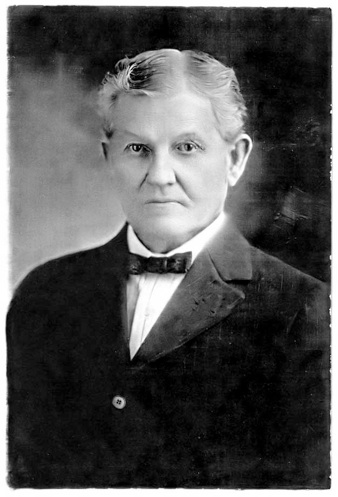 Newton J. was born August 31, 1843, in Caldwell Parish, Louisiana. His father, John T. Alexander (1807–78), a physician, was born in Louisiana or Mississippi. His mother was Millennium K. Jenkins (1816-55). She was born in Mississippi. His parents moved to Austin in 1852. Picture at left taken May 12, 1921.
The 1880 census has him married to Anna E. Alexander (1849–?). Children of this marriage include John E. (1868–?) and Charlotta (1870–?). Sister-in-law, Fiona Sherwood, was living with them in 1880. The 1874 February Austin Weekly Statesman included a review of a Shakespearean drama performed at the new Opera House. Anna and her sister, Sophronia Sherwood (1861–?), received favorable reviews for their roles in "Richelieu.” Of Anna, they wrote, "Mrs. Anna Alexander, as Marian de Lorina, came before the lights but two or three times, yet did so with excessive grace and ease. Her distinguished appearance and splendid costume was remarked by every one."
Newton is featured also in the October, 1874 edition of the Austin Weekly Statesman. "N. J. Alexander. We yesterday stepped into the drug establishment on the Avenue, just below the city clock corner, of Mr. N. J. Alexander, successor to Alexander & Son, and found him and his clerks busy unboxing and shelving goods just received fresh from the manufacturing establishments in the east. This house has been in existence some seven or eight years and its business, both wholesale and retail, has steadily increased from the very beginning until now it is shipping goods to towns and dealers in different portion of the State. Mr. Alexander's long experience in the drug business and general knowledge of drugs and medicine have enabled him to attract a very liberal trade from the country dealers, and he has just laid in a new stock of new goods to enable him to meet all demands this season. He not only keeps a good stock of drugs and medicines, but also a supply of fancy toilet articles of all descriptions of extracts, soaps, etc, as also combs, pens and ink, stationery, etc., to which we invite the attention of buyers generally." Apparently various family members are involved as the article not only mentions Alexander and Sons, but also, Alexander and Brothers.
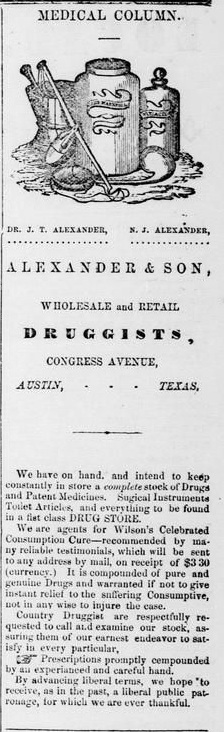
The company was found by Newton's father, Dr. J. T. Alexander. Dr. Alexander was a practicing physician in Austin. At right is an ad from the April 10, 1869, Georgetown Watchman listing Dr. Alexander and his son N. J.
It appears that Newton's wife, Anna, learned from her experience in retail sales. In 1884, now divorced, Anna and her sister, now listed as Fiona, opened a "metropolitan" style store selling novelties and millinery. Fiona traveled to New York City to buy stock for the store. Anna lived in Austin for the remainder of her life.
The Austin Weekly Statesman in 1874, reported, "Mr. N. J. Alexander of the drug firm of Alexander & Son, has shown us a beautiful flag of banner sold, with gold fringe and tassels. The flag was made in New York, and cost Mr. Alexander $35. It is intended for the Union Sunday School having the greatest increase of scholars since the first of last January. The public will await with some degree of impatience to see whether the Methodist, the Baptist, or the First Presbyterian Church Sunday School gets this beautiful banner, which bears the Bible quotation of "I love them that love me," and "Seek and you shall find."
In 1878, Newton received a patent in the U. S. and Canada for An Improvement on Paper Bags. It is dated August 19th and is good for five years. The bag enables powder to be placed on a flap at the end and poured into the bag. The Scientific American includes a description of the patent.
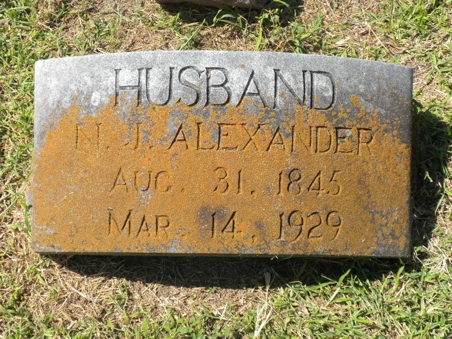
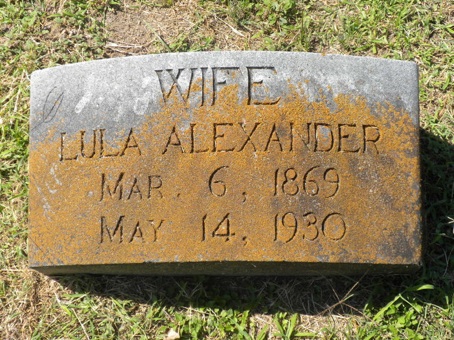
Newton died March 14, 1929, of influenza. Lula died May 14, 1930, at the age of 60, in the home of her niece and is buried next to Newton and her parents. They are in the Rosengren section in the Oakwood Cemetery in Austin, Texas. Lula’s funeral service was conducted by Rev. S. E. Frost of the Congregational Church of Austin. Her obituary states, “She is survived by one sister, Tille Lundbeck of Paso Robles, CA, and nephews and nieces, Mr. and Mrs. John Rosengren and Mr. and Mrs. Ed Rosengren of Austin, and Mrs. Mary Lee Nicholson of San Antonio.”
Below we show the complete Alexander window.
Newton and Lula May Rosengren Photos |
|
|---|---|
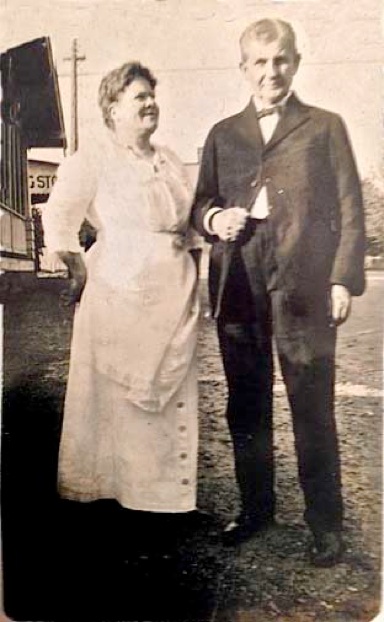
Lula and Newton Alexander, ca. 1910 |
|
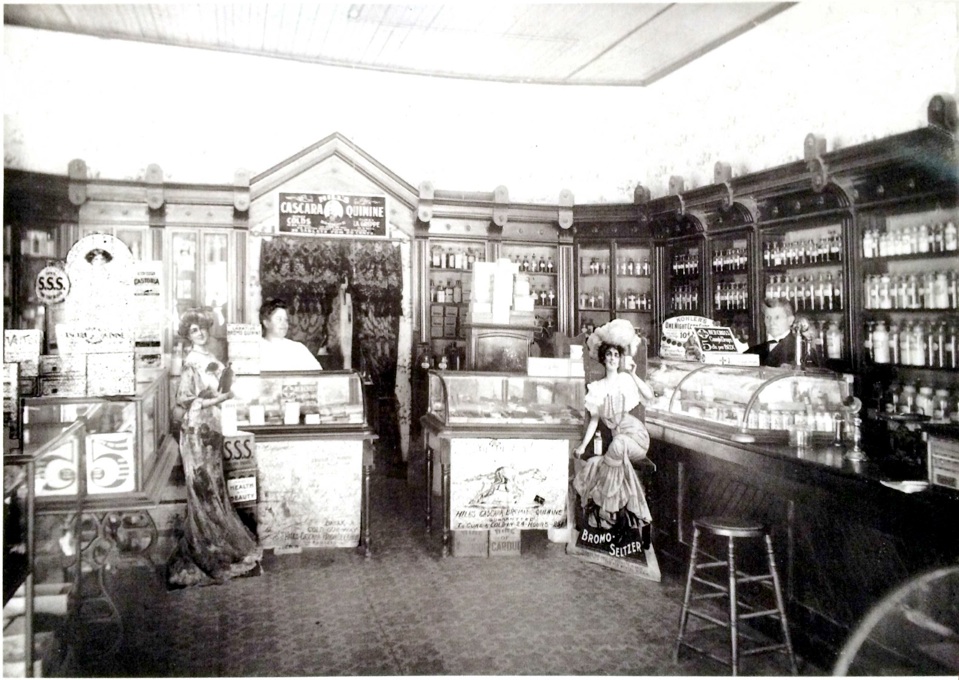
Lula and Newton in their drug store in Austin, probably around 1900. |
|
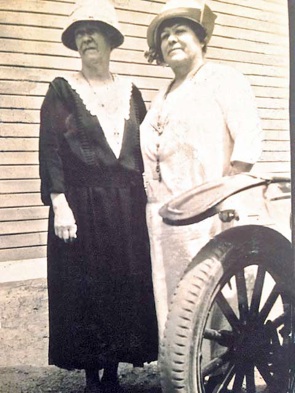
Lula, in white dress, and sister Hattie Mathilde Rosengren Lundbeck. Hattie married Frank J. Lundbeck, a blacksmith, and they moved to California in 1887. He developed a very successful blacksmith and machinery repair business. |
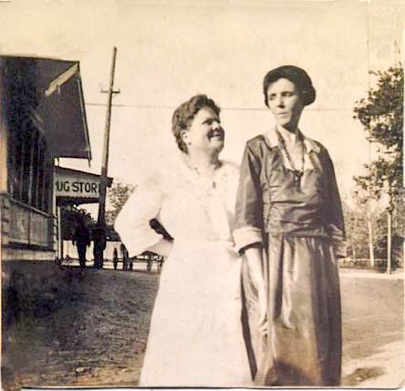
Lula, in white, with sister-in-law, Maggie Rosengren. Maggie married John A. Rosengen, Lula’s brother. |
|
|
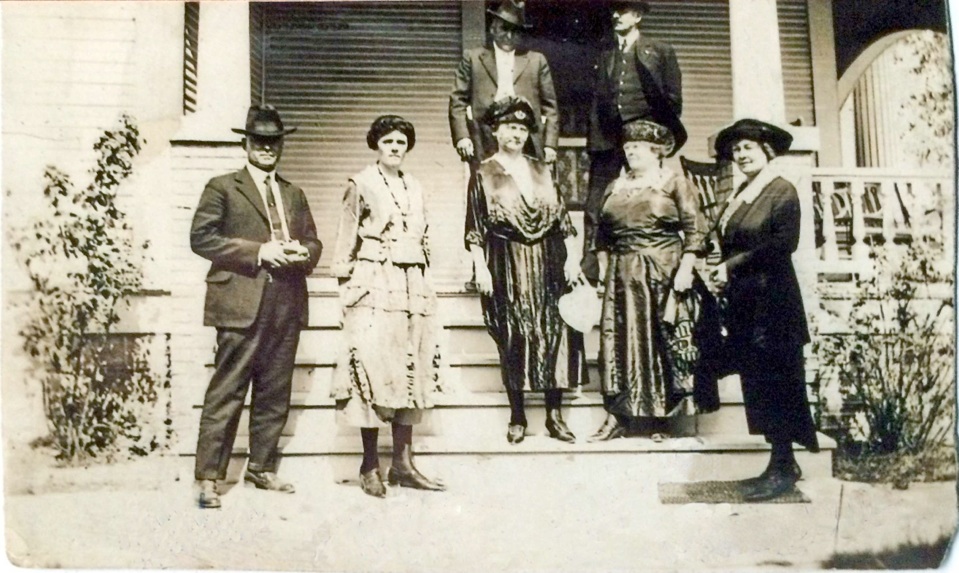
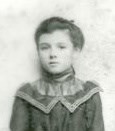 Left to right: John A. and Maggie McWorter Rosengren, Tomasons (him behind her), Lula May Rosengren Alexander on the steps, her brother, Samuel Edward “S. E.” Rosengren back of her, at right his wife, Prudence Hamilton Rosengren. Thumbnail of Maggie shown at right. Left to right: John A. and Maggie McWorter Rosengren, Tomasons (him behind her), Lula May Rosengren Alexander on the steps, her brother, Samuel Edward “S. E.” Rosengren back of her, at right his wife, Prudence Hamilton Rosengren. Thumbnail of Maggie shown at right. |
|
|
|
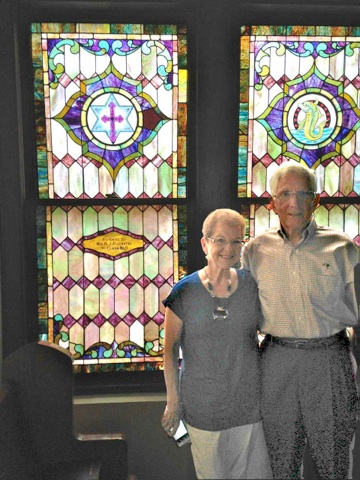 Acknowledgement: I was very fortunate to make contact with Lula’s grandnephew, Jim Lundbeck and his wife, Jan. They provided all the pictures here of Lula. They generously shared much additional information on the Rosengren family. Pat and I gave them a tour of the church windows. They are pictured at right. They were originally from California, but now live in Temple, Texas. They are pictured at right with one of his great-aunt’s windows.
I could not resist including this connection with the Alexander family. It is from an interview conducted in 1937.
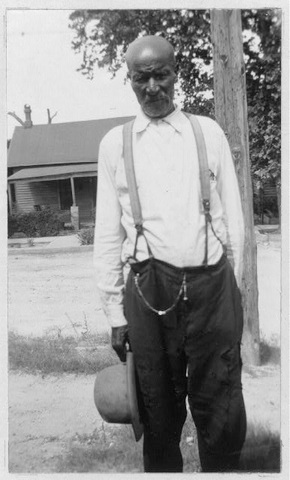 JAMES JACKSON, 87, was born a slave to the Alexander family, in Caddo Parish, La. When he was about two, his master moved to Travis County, Texas. A short time later, he and his two brothers, were stolen and sold to Dr. Duvall, in Bastrop Co., Texas. He worked around Austin untill he married, when he moved to Taylor and then to Kaufman. In 1929, he went to Fort Worth where he has lived ever since.
Jackson’s narrative was recorded in the spoken idiom by the interviewers.* I have converted it to to a more readable form.
“ I was born in Caddo Parish, that is in Louisiana, on the Doc Alexander plantation. My mother says I was born on the 18th day of December, in the year of 1850. I guess that is right, because I am 87 years old this coming December.
“Just about that time they started shipping the black people to Texas. My master moved to Travis County, Texas, and took all his slaves with him. I was too young to remember, but my mother told me about it.
“It wasn’t long after we were on Master Alexander’s new place in Travis County, until one night a man rode up on a horse and stole me and my two brothers and rode away with us. He took us to Bastrop County and sold us to Doctor Duvall. Master Duvall sold my brother right after he bought us, but me and John, we stayed with him until the slaves were freed.
"On Master Duvall's plantation the slaves all lived in log cabins back of the big house. There was one room, two room and three room cabins, depending on the size of the family. Most had dirt floors, but some of them had log slabs. We had this old wooden bed with a rope stretched across the bottom and a mattress of straw or cotton that the we got from the field. We had lots to eat, like biscuit, cornbread, meat and such stuff. Mostly, they made coffee out of parched cornmeal. We had gardens and raised most of the stuff to eat.
"I herded sheep and was houseboy most of the time. When I was old enough, I picked cotton. I was just learning when the slaves were freed. Master Duvall had over 500 acres in cotton, and he kept us in the fields all the time, except Saturday afternoon and Sunday.
"They had meetings and dances on Saturday nights. I was too young to remember just what the songs were, but they had a fiddle and played all night long. On every Sunday, the slaves went to church in the evening. They had a white preacher in the morning and a black preacher in the evening.
"Master Duvall would whip the slaves who were disobedient, and he would call them up and ask them what was the trouble, then he would whip them with a cowhide or a rope whip. We could go anywhere if we had a pass, but if we didn't the “paddlerollers” would catch us. They were like the policemen we have today.
"In slavery, they traded and sold slaves like they do horses and mules. They carry them to the court house and put them on the block and auction them off. Some sold for around $3,000. It was hard to sell one with scars on him because nobody wanted him. I saw them come by in droves, all chained together.
"When the slaves were freed, they were very happy. They all got together and had a kind of celebration. Master told them if they wanted to stay and help make the crop, he'd give them 50 cents a day and a place to stay. Some took him up on that and stayed, but a lot of them left there. My brother and I, we started walking to Austin. In Austin, we found our mother; she was working for Judge Paschal. She hired us out to one place and then another.
"Since receiving my freedom I have done most everything anybody could do. I have been a porter and a waiter in hotels and restaurants. I have been a factory hand, and worked for carpenters and in the roundhouse. I have picked cotton and worked on the farm.
"I have been married 61 years. I got married at home, like civilized folks do. I raised a big family, 12 children, but only five are alive today. I moved here in 1929 and looks like I will be here until I die.”
Texas Slavery Narratives
A Folk History of Slavery in the United States
From Interviews with Former Slaves
TYPEWRITTEN RECORDS PREPARED BY THE FEDERAL WRITERS' PROJECT
1936-1938
ASSEMBLED BY THE LIBRARY OF CONGRESS PROJECT WORK PROJECTS ADMINISTRATION
FOR THE DISTRICT OF COLUMBIA
SPONSORED BY THE LIBRARY OF CONGRESS
*A Note on the Language of the Narratives
The Slave Narrative Collection in the Manuscript Division at the Library of Congress consists of narrative texts derived from oral interviews. The narratives usually involve some attempt by the interviewers to reproduce in writing the spoken language of the people they interviewed, in accordance with instructions from the project's headquarters, the national office of the Federal Writers' Project in Washington, D.C.
The interviewers were writers, not professionals trained in the phonetic transcription of speech. And the instructions they received were not altogether clear. "I recommend that truth to idiom be paramount, and exact truth to pronunciation secondary," wrote the project's editor, John Lomax, in one letter to interviewers in sixteen states. Yet he also urged that "words that definitely have a notably different pronunciation from the usual should be recorded as heard," evidently assuming that "the usual" was self-evident.*
In fact, the situation was far more problematic than the instructions from project leaders recognized. All the informants were, of course, black, most interviewers were white, and, by the 1930s, when the interviews took place, white representations of black speech already had an ugly history of entrenched stereotype dating back at least to the early nineteenth century. What most interviewers assumed to be "the usual" patterns of their informants' speech was unavoidably influenced by preconceptions and stereotypes.
The result, as the historian Lawrence W. Levine has written, "is a mélange of accuracy and fantasy, of sensitivity and stereotype, of empathy and racism" that may sometimes be offensive to today's readers. Yet, whatever else they may be, the representations of speech in the narratives are a pervasive and forceful reminder that these documents are not only a record of a time that was already history when they were created; they are themselves irreducibly historical, the products of a particular time and particular places in the long and troubled mediation of African-American culture by other Americans.