From the Austin American Statesman, Sunday, October 4, 2020
People’s Community Clinic celebrates 50 years of bringing dignity to care
By Nicole Villalpando
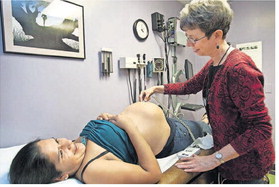
prenatal visit with patient Leticia Martinez
in the Women’s Health department at People’s
CommunityClinic in 2011.
Picture a medical clinic with a handful of longhaired doctors, nurses and a social worker in a church basement. Mattresses on the floor served as the waiting room chairs; sheets hanging from the ceiling delineated the different exam rooms. A card tableserved as the front desk.
The staff members put in their own money to buy the supplies or rounded up free samples to start what was then called the People’s Free Clinic in 1970.
They opened up the clinic one night a week for ahandful of hours. That first night, the accounts differ, but Davis thinks they had about 27 people come through the basement clinic they set up at Congregational Church off 23rd Street near the University of Texas.
The staff went out for beers afterward and compared notes on the people they saw, vowing to do it again the next week.
“We were off and running,” Davis says.
Each week, more people came and more doctors and nurses volunteered — all by word of mouth.
Now, on its 50th anniversary, the People’s Community Clinic serves 20,000 people a year on a $26.3 million annual budget, including $6.3 million in grants and $1.2 million in charitable giving. It takes federal programs like Medicaid and Children’s Health Insurance Program (CHIP), but about a third of its patients are uninsured and pay on a sliding scale.
People’s Community Clinic has been recognized as a Gold Tier Health Center Quality Leader by the U.S. Health Resources & Service Administration, which makes it in the top 10% of all clinics the administration rates. It’s also now a federally qualified health center, which means it qualifies to receive federal funding because of the number of people it serves in a population of people who are typically underserved for medical care.
“It’s always been the best health care home for low-income people,” says Earl Maxwell, the retired former head of St. David’s Foundation, whose first grant was to People’s Community Clinic in 1996. “They have played this incredible role throughout the years. They’ve grown, and St. David’s Foundation funding grew with them.”
When Maxwell would feel discouraged in his previous job, all he had to do was drive up the Interstate 35 access road and step into the waiting room at People’s Community Clinic, he says. There he would see (before the coronavirus pandemic) a packed waiting room with families and individuals accessing care they wouldn’t otherwise receive.
“You’ll come away with an understanding of the work,” he says.
The size of People’s Community Clinic might have changed since that first night, but the mission remains the same.
It’s about the importance of the relationships, says Regina Rogoff, who has been the chief executive officer of the clinic since 2003 but began her work there as a volunteer in 1974. “We treat our patients with dignity and respect.”
That’s the message that gets repeated again and again and is part of the mission statement of the clinic.
“We want this to be their medical home, that this would be a place to bring their children, that an expectant mom would take her baby to,” Rogoff says.
A clinic for the people
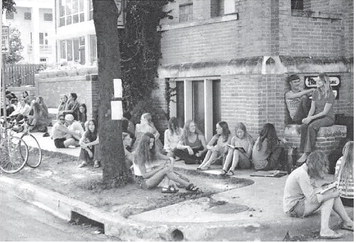
at Congregational Church. People would line
up outside for hours to receive medical care.
“I don’t know what I envisioned,” Davis says. “I wasn’t a big planner; it was more like, ’Let’s do this.’” Most of those first people who came to the clinic were “street people” in their late teens, 20s and 30s. It was a time of the threat of the Vietnam War draft, free love, drugs used for enlightenment and people coming to Austin for its cool, antiestablishment vibe. Many of them, especially the ones who were minors, didn’t have access to medical care.
Davis had been volunteering with an earlier program in the basement of Congregational Church, one that housed a lot of the kids who were running away from home during this time.
“I would frequently get calls for medical emergencies,” she says, but here was the dilemma: they were minors but didn’t have their parents to give medical consent. If that program took these kids to the public health hospital at the time, Brackenridge, the staff there wouldn’t treat them without parental approval or unless a doctor approved their care. Davis, a social worker, often used her connections to local psychiatrists to sign off on their care.
It started with Davis and her then-husband Paul, a lawyer at the time, and their friendship with Dr. Jack Whitaker, an internal medicine doctor at the time, and his wife, a nurse. Dr. Richard Alexander, a psychiatrist, joined them.
Davis says she and her husband had visited free clinics in their travels in northern New Mexico. She told Alexander about how great it would be if they could start a free clinic here.
Power to the people
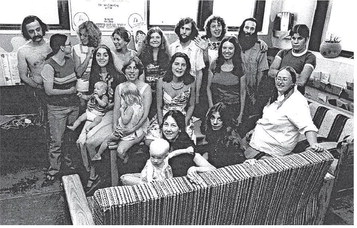
gather in the basement.
It was a family atmosphere.
People “passed the can” at local venues and held a music telethon carried by radio station KUT with 15 different musical acts. They raised $5,000 dollars, about half of which came from the “street people” the clinic served, Mansfield wrote, and the clinic was back in business.
By 1971, they were also asking people to give 50 cents at the door to help offset the cost, but if someone couldn’t give, “it’s no sweat — we don’t turn anyone away,“ Mansfield quotes Ray Mediano, one of the doctors during the night she visited, as saying.
Once the clinic was established, staff members began to see an expansion in who they were serving, from street people to UT students who couldn’t get contraception from the university health clinic to a population of people who couldn’t otherwise afford medical care.
Becky Beaver, who now serves on the foundation board for People’s Community Clinic and has served on the clinic’s board as well, was a patient of the clinic in the early 1970s when she was a UT student.
She says she and her peers went there “for all those things you didn’t want your parents to know you are getting treatment for.”
She heard about it from fellow students as well as through word of mouth at places like the Armadillo World Headquarters and Shoal Creek Saloon.
“You had to stand in line for a long time,” she says, but “they were compassionate and respectful even then.”
The lines would wrap around the block and people would bring their dinner, settling in for a long night of waiting. A team would triage people in line to make sure they saw the most dire cases first.
“We would promise that everyone would be seen,” says Alicia Jarry, who became a clinic volunteer in 1972 after working for the Peace Corps. “At a certain point, we would tell them they were going to wait three hours.” Often, they stayed anyway.
People first
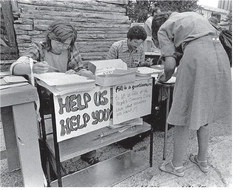
Jarry says a couple of the reasons the clinicsurvived was that the church supported it by providing the space, and they also relied on doctors at Brackenridge to encourage their residents to volunteer at the clinic as part of their training.
“Everybody was young and healthy and motivated to get good health care,” Jarry says. ”It was so different than the sick people at the hospital.“ UT students often volunteered there, and some even switched their majors to premed after their experience in the clinic.
These doctors and students saw the work the clinic was doing toward making patients involved in their own care, Jarry says. “We will not tell a patient what to do. Together we all decided one of the best things we can do is start a patient advocacy program.”
That meant that the patients would be assigned a patient advocate during the triage portion who provided them with health education materials as well as followed up to make sure the treatment was right.
It freed up doctors’ time, Jarry says, but it also improved the quality of care.
This concept of patient advocacy and integrated holistic health care continues to be considered cutting-edge and is one of the things Dell Medical School and its UT Health Austin clinic have been touting to distinguish its program.
“This is what the the People's Free Clinic started 50 years ago,” Jarry says.
Professionalizing People’s
Key to its survival, Jarry says, was hiring a clinical director, nurse Sophie Weiss, and a medical director, Dr. Greg Maksymowicz.
Weiss was able to write grants. Its first grant came in 1972, a federal grant for women’s health and family planning services.
When the clinic got its first grant, there was discussion on whether to accept it, Davis says. “Does this mean the government will have control over us? We were paranoid about the establishment,” she says.
The clinic started getting more support from the government, including the city of Austin and Travis County. By 1974, it had changed the name from People’s Free Clinic to People’s Community Clinic.
It wasn’t supposed to be “free” as in don’t pay, Jarry says. It was supposed to be “free” as in free from the establishment, free love, etc.
It also supported the training of its staff, including getting midwives trained as certified nurse midwives and nurses as nurse practitioners, including Jarry.
People’s Community Clinic kept adding services. By 1982, it had increased to four evenings a week, but it wasn’t until 1985 that it had a full-time medical director and increased from 20 hours a week of service to 40 hours a week.
It added HIV counseling and testing programs in 1985.
A whole health center
In the 1990s, it again began focusing on adolescent health by establishing a clinic for this population in 1993 and creating an off-site clinic for homeless teens the following year. In 1997, it created a teen prenatal clinic. Today People’s Community Clinic is housed in two main buildings. The People’s Center for Women’s Health is off Interstate 35 and across from St. David’s Medical Center. The clinic was able to buy that facility and renovate it in 1993, but after it outgrew that building, it bought and renovated a bigger facility at Interstate 35 and U.S. 290, the main People’s Community Clinic.
Before COVID-19 hit, the clinic was able to use its main building for hosting farmers markets, cooking classes, Zumba classes and parenting and young child development programs.
“We’re interested in doing creative things that are responsive to the needs of the patients,” Rogoff says. “We’re not so big that we can’t be agile. We’re resourceful.”
It also has clinics that serve the Manor Independent School District and SAFE Austin’s children’s shelter.
What’s important to Rogoff is that all its clinics are creating relationships. “We go back to the mission. ... ” she says. “The bond a patient forms with someone; it could be the physician, it could be the front desk.”
There isn’t a hierarchy of doctors being put on a pedestal, says Dr. Melinda Lopez, the director of women’s health. That’s been part of the fabric of the clinic since the beginning.
The patients Lopez sees typically have bounced from clinic to clinic before they found their way to People’s. There are many barriers to them getting prenatal care, but her goal is for patients to stay.
“It’s humbling to see how resilient people can be,” she says. “It can be humbling to think about the amount of barriers our patients see on a day-to-day basis and they are able to show up at their appointments. ... We don’t take that lightly.”
The patients the clinic sees have experienced a lot of trauma and have complex lives, Rogoff says. “They may not know where they are sleeping that night,” she says.
It’s not just about their medical care. There are social workers and a legal team that is there to work with them on access to federal, state and local programs. The clinic has tried to remove the barriers its patients face.
Often that has meant advocating for more than one patient. For example, it worked with the city on a paid sick leave ordinance.
“It’s the idea of, what do we really want for our community?” Rogoff says. “We want kids to be thriving, we want them to be healthy, to perform at age level, to be in families that are healthy and stable.”
Creating access to care
Today, about a third of People’s patients have Medicaid, a third have CHIP, and a third are uninsured. It serves children, adolescents and adults and provides women’s health care, including prenatal care. One of the reasons the need continues to be there for the clinic is because Texas did not expand Medicaid, leaving a gap of many people not poor enough to qualify for Medicaid and not making enough for Obamacare assistance with insurance premiums. Many of the clinic’s patients are undocumented. Many cannot afford the health insurance through their employers.
“The need is greater than ever in terms of access to care,” says Dr. Louis Appel, who serves as the clinic’s chief medical officer and People’s Community Clinic director of pediatrics. He has been at the clinic since 1999.
“I wanted a place where it felt like human dignity was part of their ethos,” he says. “That’s the thing that got me to People’s and why I stayed.”
“It’s a place where treating people with respect and dignity is built into the DNA,” he says.
One of the things that’s different in the work he does here instead of another clinic is each medical decision has to be with this thought: Can the patient afford the test he needs? If not, how can we find a way to get the patient that access?
That might mean that Appel and his team are calling around, calling in favors with other doctors or looking for programs for their patients.
One thing that has helped is that in 2012, People’s Community Clinic became a Federally Qualified Health Clinic, which allows it to get reimbursed at higher rates from Medicaid. This allows it to be able to afford to see more uninsured patients.
Fred Blackman, the current board chair, was one of those uninsured patients. In 2013, he became paralyzed from the waist down after having back pains. It took five months and five surgeries to get the feeling back in his legs, and he developed an infection.
Then out of work, St. David’s hospital staff members recommended he get follow-up care at People’s. He needed weekly monitoring of the infection, but, he says, one of the great things about People’s is that his primary care doctor recognized his depression and kept pushing for him to see one of the clinic’s behavioral health specialists.
“Without People’s Community Clinic and all around services they have, I would not have made it,” he says.
Those services included nutrition and acupuncture as well as his counselor and medical doctor.
“It’s that kind of teamwork, that kind of group effort that has carried us,” he says.
Continuing the care
People’s Community Clinic “is an essential resource in Austin,” Beaver says. “It provides health care with dignity. ... It’s not hard to sell people on People’s when they know what it does.”
It has a loyal following, Maxwell says. “When you are in the service business and you build that kind of reputation and the kind of brand that people's community clinic has, people want to support you,” he says.
The clinic is continuing to expand its programs. Last year, it started a dental program, a vision that it had early on but was not able to fulfill until now. The program is housed in mobile clinic on the site of the main clinic.
“We have cases where improving their oral health has given us the ability to improve their diabetes,” says Dr. Carlos Diaz, the head of the dental program at the clinic. In its first year, it saw almost 500 patients.
In other cases, the dental program has been able to fix problems to allow patients to eat healthier food rather than processed foods.
The clinic has been able to participate in research programs through its informal partnership with Dell Medical School since that school opened in 2016.
In the next 50 years, Beaver says she’d like to see the clinic serving twice as many people.
Blackman envisions People’s Community Clinic locations throughout the city as well as in Hays County and a bigger presence in the Manor/Elgin area. Blackman thinks today is not unlike the way it was in 1970.
“They had a vision of providing a service to people who need it,” Blackman says. “That vision just continued to grow. As they attained one goal, 10 new goals appeared.”
Appel wants the clinic “to continue to provide care to people with respect and dignity,” he says, as well as to work on the social determinates that are barriers to health such as poverty, racial discrimination and lack of education.
His big hope is that People’s continues to make “Austin the healthiest community we can be.”