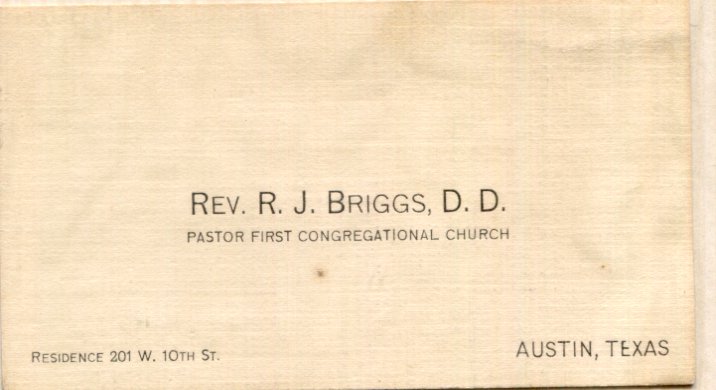
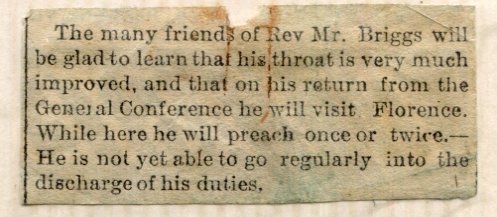
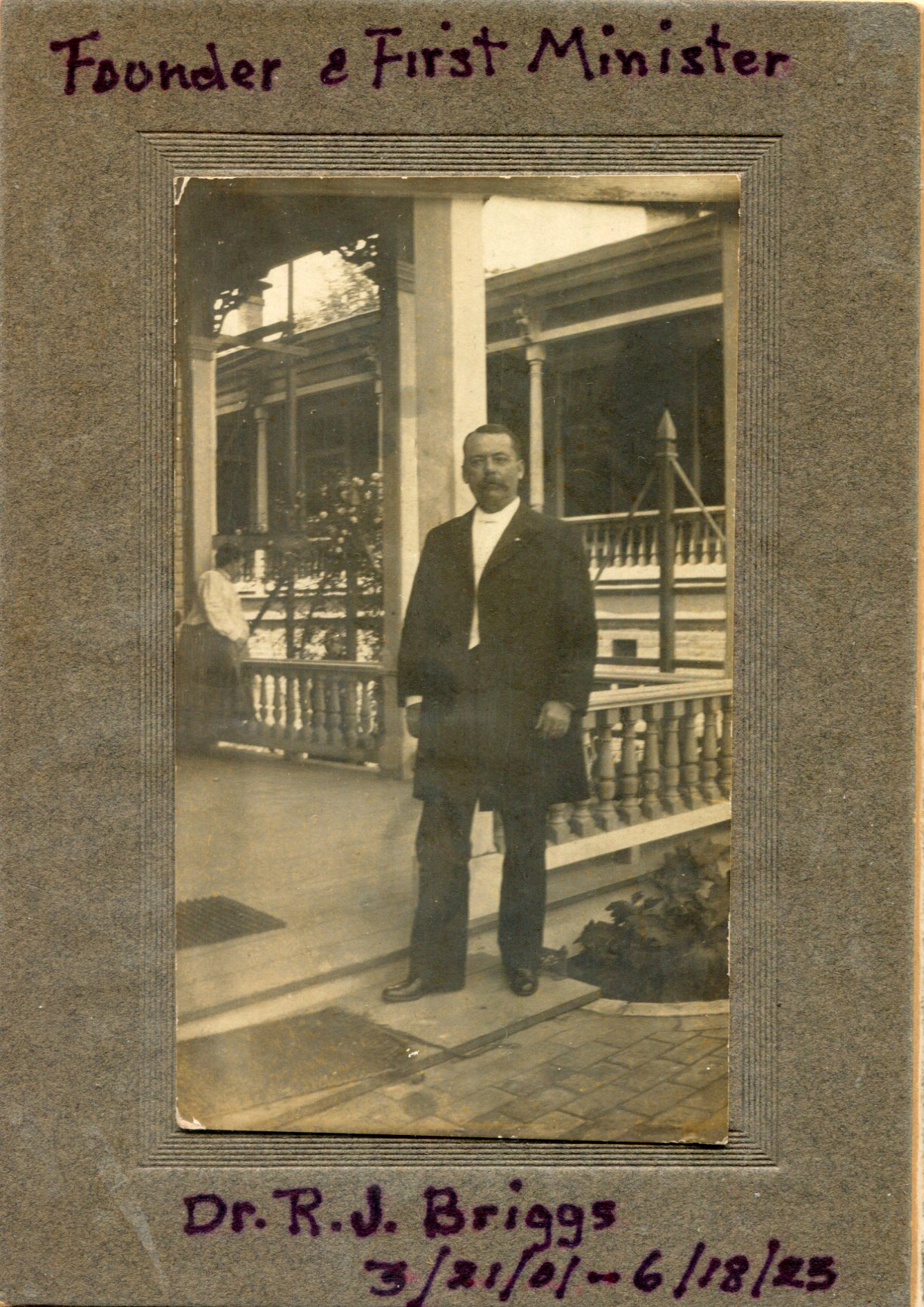
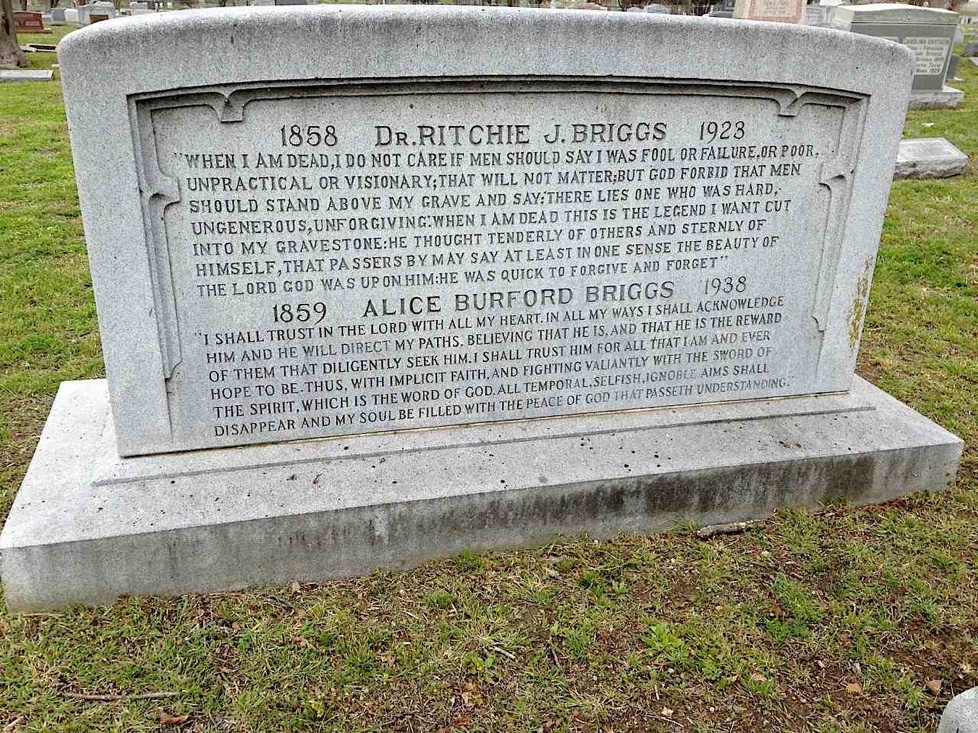
Dr. Ritchie Jones Briggs
1858-1923
Early Life and Family
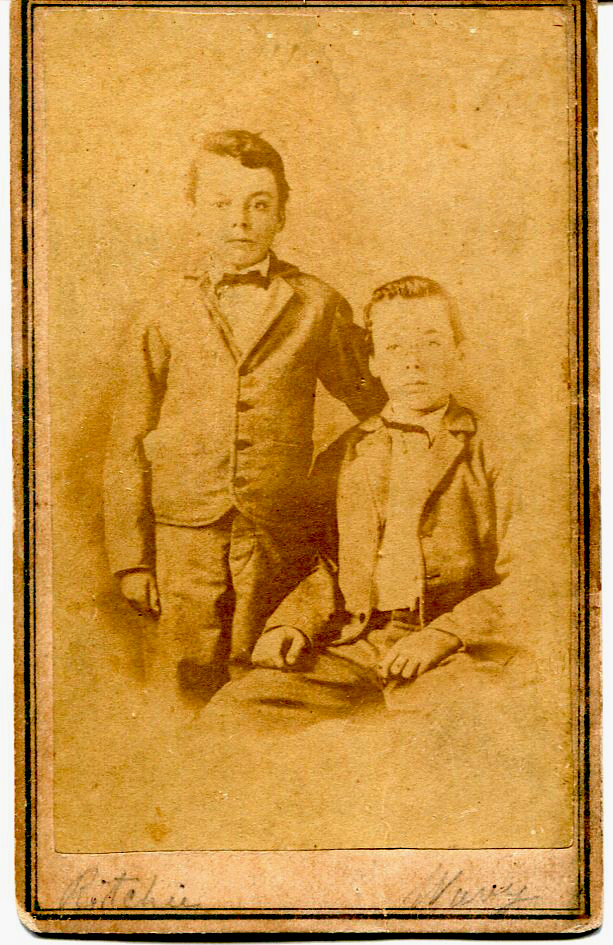
Ritchie Jones Briggs’ tombstone says he was born November 25, 1858, in Aberdeen, MS, where his father was completing his pastorate of a station of the Methodist Episcopal Church South. This date is highly questionable. Three US Census give his birth year as 1854. As we shall see he is reported to have graduated from college in 1874 and was ordained the same year, highly unlikely for a 16-year- old. The 1858 year seems to appear as he moves to California to head a church. Not the first time a California move led to a shaving a few years from one’s resumé.
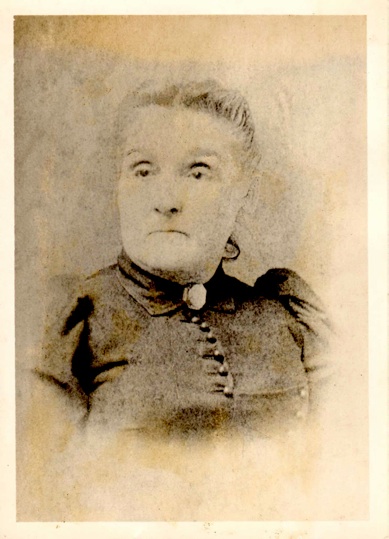
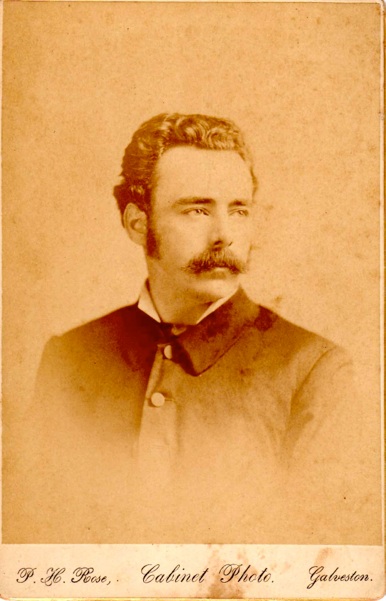
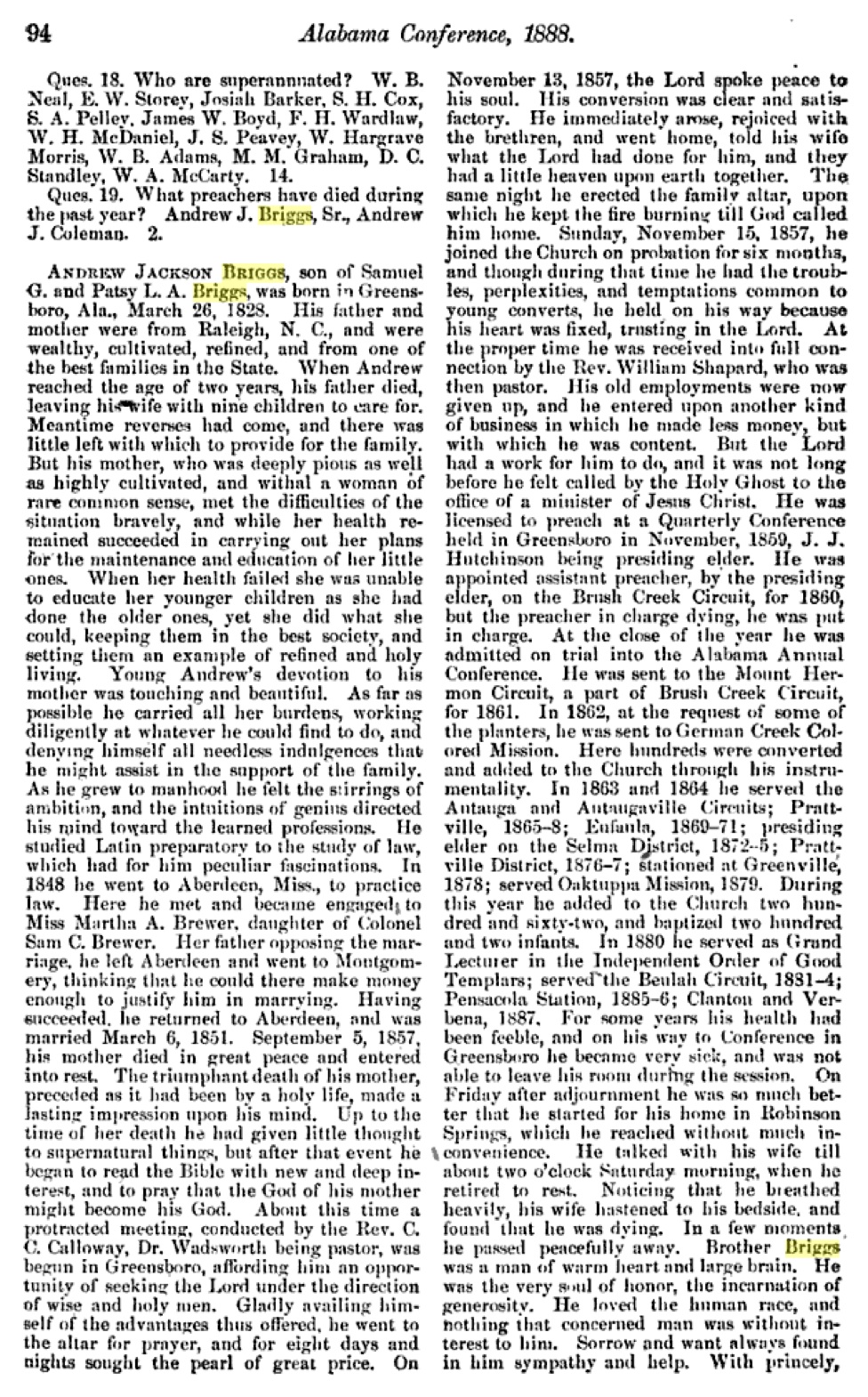
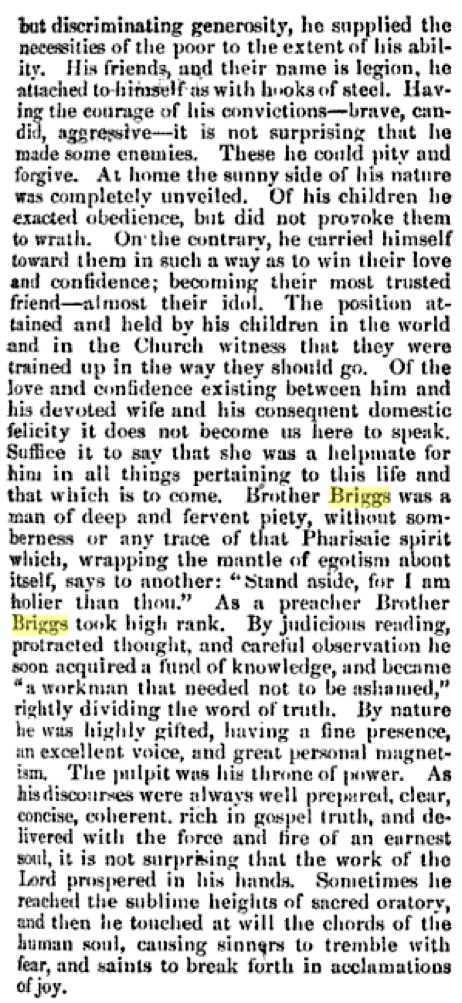
He was the second son of Andrew Jackson (1828-87) and Martha Ann “Sweet Mama” Brewer Briggs (1832-1921). Martha Ann is shown at right. Andrew was born in Alabama, however, his parents had come from North Carolina. Martha was born in Virginia, as were her parents. Andrew first studied law and moved to Aberdeen, MS to practice. There he met Martha; however, her father opposed the marriage. Andrew returned to Montgomery, AL, practiced law and returned to successfully win the approval of her father, Colonel Sam Brewer. Andrew J. and Martha Brewer were married March 6, 1851, in Monroe county Alabama. As a result of a revival following the death of his mother, he was moved to become a minister. He became a Methodist clergyman. More information can be found about Andrew at the end of this page. Ritchie’s siblings included brothers, Andrew Jackson Jr (1865-1900) and George Waverly (Dec. 1853-91). George was named for his uncle. The sisters included Orlene L.“Daisy” (1860-?), Willie Bennett (1863-97), Mattie (1867-?) and Minnie (1871-?).
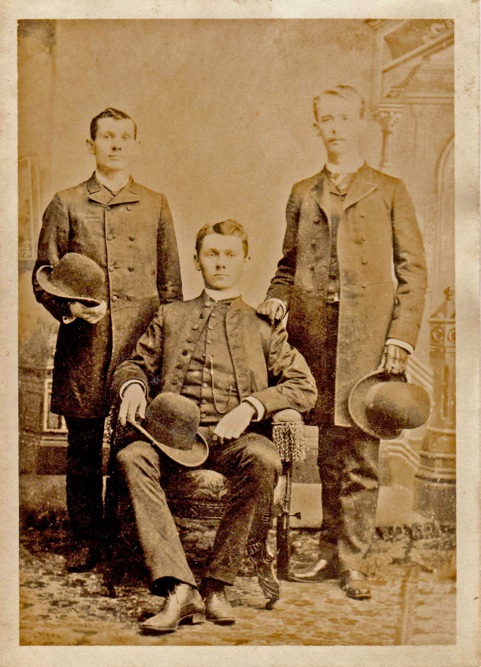
The three brothers, tentatively identified below by a descendent are, left to right: Andrew Jackson Briggs Jr., Ritchie J. Briggs and George Waverly Briggs. Clothing and high heels suggest the photo is likely from 1880-85, making George around 28+, Ritchie is 26 and Andrew 15+. Difficult to make those ages work with this photo.
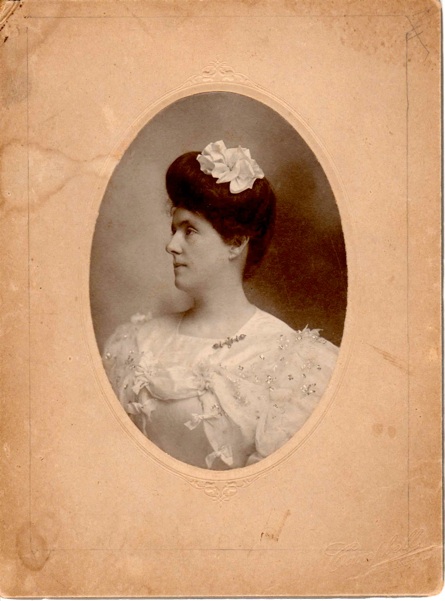
Another problem exists with the assignment of George. Examining a later picture of George below, we see he has more hair, it is darker and his face is fuller. In the group picture, George’s left hand appears bandaged. George might have been recovering from an illness which would account for his appearance. Ritchie married in 1880; while no wedding ring is seen here, it was not the custom for men to wear them. In favor of the ID of George are his eyes and ears. The photo came from the Briggs family and is an important mystery. The family photographs were generously provided by Lisa Kirch, great granddaughter of Minnie Briggs Hall, sister of the three brothers. Minnie is pictured below right. Willie, Ritchie’s sister, married John M. Alston in 1883.
| Briggs Photos | |
|---|---|
|
|
|
|

|

|
(Photo courtesy of Dolph Brisco Center for American History) | |
|
|
Education
Ritchie Briggs was baptized in the Methodist parsonage at Autaugaville, Alabama, by the Reverend William Shapard. Ritchie Briggs attended Southern University, Greensboro, AL. In a 1923 alumni register of the school, he is listed as a non-graduate but having attended in 1877. His brother graduated in 1873. The compilers caution that the Non-Graduates List could have errors. Southern was a Methodist University. Ralph Bickler, in his brief history of the church, states that Briggs had a B. A. degree, however his tombstone which lists his degrees does not include that degree. It states his degrees were D.D., M.D. and LLB. He was ordained to the ministry by the Methodist Church on September 13, 1874. He preached his first sermon in November at Malone’s Chapel near Greensboro. Rev. Briggs’ son, G. W. Briggs, says he finished his B. A. course at Southern University at Greensboro in mid-summer of 1878; was admitted to the Alabama Conference “on trial" at its session held in Opelika, Alabama the following December, and Bishop Marvin appointed him to the Orrville Circuit over which his father, the Reverend A. J. Briggs, was serving as Presiding Elder.
In The Semi-centennial History of the Southern University, 1856-1906, by Daniel Pinkney Christenberry, George W. Briggs, brother of R. J. Briggs, is listed as graduated in 1873 from Southern with a B. P. degree. He was concurrently a minister in Louisville, KY. Curiously, R. J. Briggs is not listed among the graduates however, the history states, “The departments of law, medicine and theology were opened (1870), but were of short duration. ... There were several graduates in theology and medicine. Some completed the law course, but none graduated. A. H. Moore, and Wm. Murrah, now president of Millsaps College, studied law. F. M. Peterson took the degree of B. D. in theology. Richie Briggs, it was said, could repeat Rawlston by heart. This was a reference to Elements of Divinity or A Course of Lectures Comprising A Clear and Concise View of the System of Theology as Taught in the Holy Scriptures with Appropriate Question Appended to Each Lecture by Rev. Thomas N Ralston, A. M., published by E. Stevenson, Louisville, KY, 1851. It appears that Dr. Briggs was one of the non-graduates in theology and medicine, explaining his attendance in 1877. He could also be one of the students completing the law course but not graduating. This could account for his later receiving the honorary law degree noted by Ralph Bickler.
A book entitled, The People of His Pasture: A History of the Methodist Church in Demopolis, Alabama, by Winston Smith, 1990, contains an entry that reports that Pastor R. J. Briggs of Uniontown, AL, at the invitation of his brother, Pastor George Waverly Briggs, attended several “protracted meetings” with three other ministers in the fall of 1877. The purpose of the meetings was to promote interest in the church and recruit new members. Several members were added to the church. The pastor also may have needed help smoothing over the dissension in the church following the ladies of the church posting a warning in the Morengo News-Journal, “For the information of tobacco-chewers we will state that the Methodist Church is supplied with spittoons. The ladies through many difficulties and at great trouble and expense have just finished fitting up the church in elegant style; and they are seriously and justly indignant with those who smear the floors with filthy tobacco juice.” (Information from the Winston Smith book was kindly supplied by Lucy Trant.)
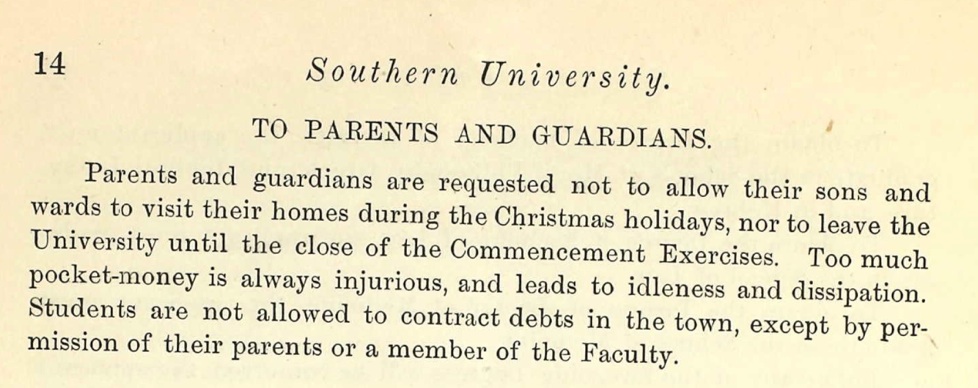
Below is an admonition for parents of Southern University students:
Early Career in Ministry
Son George states, “After two years on the Orville Circuit, he was ordained deacon by the Methodist Episcopal Church South in Greensboro, Alabama, on December 10, 1876 by Bishop Paine and stationed at Uniontown for 1877. Bishop Kavanaugh ordained him elder in 1878 and for that year and 1879 and 1880 sent him to Camden and Oaklawn Circuit.” This is not consistent with earlier statement that he was appointed to the circuit in 1878.
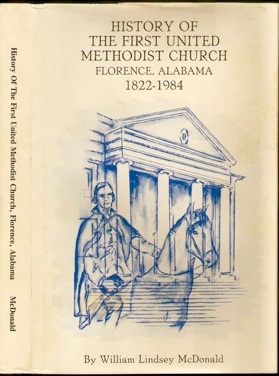 Several references to Rev. Briggs are found in the book, History of the First United Methodist Church, Florence, AL, 1822-1984. The first states, “Richie [sic] Jones Briggs was assigned a Florence Church pastor in 1880 by Bishop McTyeire. Briggs was a son of the distinguished Methodist minister, A. J. Briggs. He was admitted to the North Alabama Conference in 1874. His stay at the Florence Church was short, only until September 4, 1881. He withdrew from the ministry as a result of a loss of the vigor in his voice and entered Collge of Physicians and Surgeons (Johns Hopkins), Baltimore, MD, graduating in 1883.
He had accepted a transfer to the Baltimore conference. Old-timers remembered that Richie [sic] Briggs has a remarkable memory and rarely used notes in his sermons. Richie [sic] Briggs’ brother, George Briggs, became pastor of the Florence Church in 1889 and served two years.” Another entry stated, “ ... George Waverly Briggs was appointed to the Florence Church. Waverly was a brother to Richie [sic] Jones Briggs who had served as pastor at Florence in 1880. The Briggs family was well known in Methodist circles; altogether there were three brothers in the ministry, all sons of the Reverend A. J. Briggs. Waverly Briggs joined the Alabama Conference at Selma in 1873. In 1877, he transferred to Texas and later to North Alabama.
The reference above to Ritchie Briggs’ transferring to Baltimore is consistent with him having received an MD at the College of Physicians and Surgeons of Baltimore, in 1883. In 1884 following graduation he practiced medicine in Houston, Texas and later in Robinson Springs, AL. In 1886, he is listed in the Medical Association of Alabama, Transactions. Following the return of his voice he re-entered the ministry,. serving pastorates in Alabama, California and Texas.
Marriage to Alice Rebecca Burford Dumas
Following his appointment as pastor of the Florence church in September, Rev. Briggs married Alice Rebecca Burford Dumas in Mobile, AL, December 13, 1880. Alice had previously been married to Clement Marshall Dumas, a postmaster. Clement and Alice were married October 12, 1876. Clement, born August 30, 1847, in Anson County, NC, had died in Waukesha, Wisconsin, June 18, 1879. His tombstone, located in the Burford Cemetery, indicates the affection Alice had for her husband. On back of marker: "Farewell oh darling one farewell Thou hast left me lonely in the world of pains Oh! May we meet in heavenly bliss to dwell at God's right hand no more to part again." Following Clement’s death, Alice lived with her parents until she married Rev. Briggs. Waukesha was noted for it healing water springs; whether Clement was there seeking a cure for some health issue is not known.
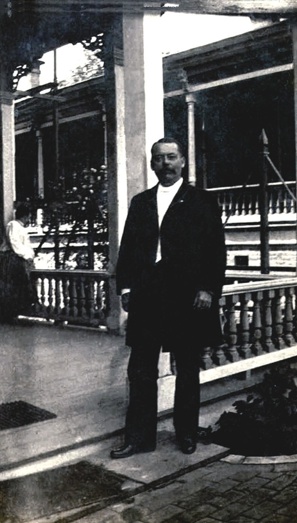
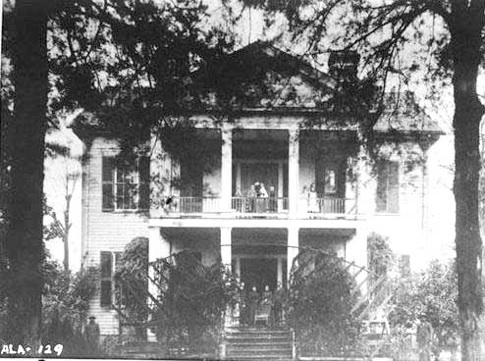 Alice came from an established family. The Burford family resided in Camden, Wilcox County, Alabama from 1830 to the turn of the century. Leonard Mitchell Burford was born on January 25, 1805 in Jones County, Georgia. He and his wife, Rebekah D. Wornum Burford, relocated to Conecuh County sometime in the late 1820s. By 1830, the Burfords established a cotton farm outside Camden, referred to as Burford's Landing, where they raised eleven children. Leonard Burford died at his home in Camden on July 2, 1862. His son, Peyton Daniel Burford (1829-1879), took over the family farm after his father's death. He and his wife, Martha Mobley Crum (1832-1915), had four children: Betty Corinne (born 1859), Mary Emma (1856-1940), Alice (1854 or 1856-1938) and William Peyton (1861-1939). The three-story Burford home in Possum Bend, Wilcox County, AL where Alice Briggs grew up is shown at right (no longer standing). Since date of photo is not known, one can only speculate that one of the adults on the front porch is Alice.
Further Career Information
From son George’s account, “While at the church in Florence, he suffered a throat infection which threatened the permanent loss of his voice and occasioned his temporary retirement from the itinerancy. In September of that year, he entered the old College of Physicians and Surgeons (now the Medical Department of Johns Hopkins University in Baltimore); he was graduated in medicine from that institution on March 1, 1883, and moved to and practiced his new profession in Houston, where his elder brother, George Waverley Briggs, was filling a Methodist pastorate in the Texas Conference.
“Finding that the climate was not good for his throat, he returned to Alabama, and practiced medicine at Robinson Springs in 1885 and part of 1886. During this period, a noted throat specialist encountered at a medical convention expressed the belief that if he would go to California, he would recover his voice.” This account states he applied to the Pacific Conference and was admitted in 1886. This contradicts information on the First United Methodist Church’s website. From that church’s history, “Around 1886, Rev. Briggs accepted the pastorship of the Tenth Street Methodist Church in Austin, TX. As pastor, Rev. Briggs was very successful. It was in 1892, during his pastorate that the church reached its peak 19th-century membership of 675. For a time, the church was called Central Church, South; later it was referred to as Tenth Street Church until 1902, when it was officially called First Methodist Church. However, the term “Tenth Street Church” remained in common use until 1923.” Briggs’ son’s biography has no reference to this appointment. It is likely the church’s website date is incorrect and should have been 1896.
Reverend Briggs in California
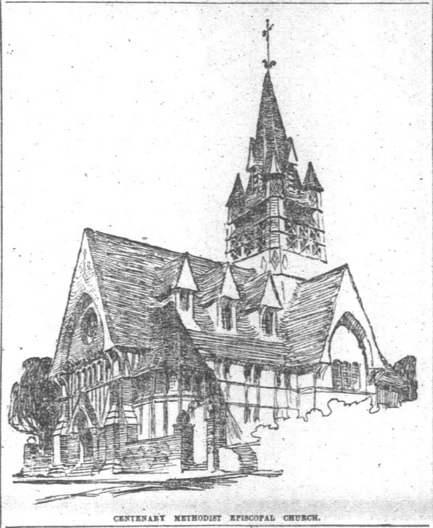 In 1892, Rev. Briggs was in Colusa County, CA. In the California Voter Register for Colusa County he is listed as 34, 5 ft 9 1/2 inches tall, dark complexion, brown eyes, brown hair, clergyman born in Mississippi. Briggs’ son says “he was admitted to the Pacific Conference in October 1886, and was appointed by Bishop Keener to Princeton Circuit, Colusa County. He was removed by Bishop Hargrove from Princeton, CA and stationed in Lakeport in Lake County in 1887; from Lakeport by Bishop Galloway and stationed at Stockton in 1888; and was returned to Stockton by Bishop Hargrove in 1889. He was removed from Stockton by Bishop Fitzgerald and stationed at Colusag in 1890 and was returned to that pastorate by Bishop Haygood in 1891. While serving there, he preached the commencement sermon for Pacific Methodist College at Santa Rosa in the spring of 1892, and received from that institution the honorary degree of Doctor of Divinity. His fourth degree, that of Doctor of Laws, came to him from the Central Normal College of Kentucky in 1897. In the fall of 1892, he was removed from Colusa by Bishop Haygood and stationed at Centenary Church in San Francisco. He was returned to that station by Bishop Fitzgerald in 1893; and by Bishop Wilson in 1895.” The Centenary Church had burned on July 4, 1891. Reverend Briggs preached the sermon at the opening of its new building February 25, 1893. The building was constructed on the site of the old chapel, Bush St, between Gough and Octavia Streets.
By 1894, articles discussing Rev. Briggs’ sermons were appearing in San Francisco newspaper. He was praised as an outstanding speaker and theologian. A long article appeared in the September 9, 1895 issue of the San Francisco Call. The introduction is quoted below:
“AGNOSTICISM OF TODAY."
Rev. R. J. Briggs' Address on Some of Its Mistakes.
"MYSTERIES OF THE BIBLE."
"The Doctrines Advanced by Colonel Robert Ingersoll Placed Under Fire.'
"At the regular Sunday afternoon service at the Young Men's Christian Association yesterday, Rev. Dr. R. J. Briggs of the Centenary M. E. Church South, spoke upon the mistakes of modern agnosticism as represented by the teachings of Colonel Robert G. Ingersoll. Dr. Briggs had Ingersoll's book of lectures with him on the platform, and he also had the Bible, and, in the course of his remarks, he quoted first from one and then the other, comparing the statements of the two and assailing the doctrines advanced in Ingersoll's writings with arguments taken from the Scriptures. Dr. Briggs began by commenting upon the agnostic tendency of thought in this nineteenth century. The absorbing interest taken in material things in this day, the race for money and for power,' he said, 'is binding men's thoughts to this world. It is more and more making man a law unto himself and is shutting God from out our minds and our lives. Infidelity is everywhere,' he continued, 'and men have to brace their faith and marshall all the forces of their souls to live unscathed amid the infection.'”
Rev Briggs’ sermons, at this time, often were related to societal and political issues. In 1892, he was invited to give a lecture at the Stanford University Chapel. His talk was entitled, “The Greatness and Destiny of Humanity.” However, in 1896, he was accused by a parishioner of involvement with his wife. Following the accusation, Rev. Briggs asked to be transferred to the Texas Conference. He returned to San Francisco to defend himself against the charges. Alice publicly supported him. The annual conference of the Methodist Episcopal Church South formed a committee to try Rev. Briggs. After much testimony, most of which appeared in the San Francisco paper, the conference jury, found in an 8-5 decision, that he was not guilty of immorality, but was guilty of registering in San Francisco under an assumed name. His traveling minister privileges were revoked, however, as the newspaper pointed out, this was inconsequential since he was no longer in the conference. However, this was not true as we see below.
Briggs Returns to Texas
According to his son, in the fall of 1896 (maybe 1897 based on entry in “San Francisco Call” newspaper Sept 28, 1897), the four-year limitation on pastorates then prevailing, Bishop Hargrove removed Briggs to Salinas, whence, after a few weeks of ministry there, he was transferred by Bishop Hendrix from the Pacific to the Texas Conference, and,--upon request of representatives of the congregation, stationed at Austin at First (or as then popularly better known as Tenth Street) Methodist Church, a pastorate which, but recently, had been vacated by the transfer of his elder brother to the Kentucky Conference. As we have seen, this transfer was at the request of Briggs as a result of allegations by a parishioner.
Reverend Briggs’ first sermon back in Texas was given on December 28, 1896. It was reported with much approval by the Austin Statesman. For the next year and a half, he was distracted with the church trial in California. From December 2-7, 1897, a The National Prison Association of the United States held its Annual Congress in Austin, Texas. Dr. Briggs presented a sermon as part of the proceedings. It was very well received. The sermon was from the text, “What is the cause that former days are better than these,” Eccl. 7:10. The sermon is reproduced at the end of this page. Interesting to note that his son, George, also was interested in prison reform.
Following his acquittal in California and return to Austin, he preached a “Great Sermon” to an overflowing crowd at the Tenth Street Church. It is reported in detail by the Austin American Statesman, October 17, 1898. The paper also reports that the California conference “localized” him, preventing him from serving as a permanent pastor of the Tenth Street Church. According to his son, Briggs evangelized in the conference from 1899 to 1900 and then retired from the Methodist ministry.
In January, 1901, upon the invitation of a group who share his tolerant views regarding controversial dogmas, he accepted the leadership of a movement which materialized into the First Congregational Church of Austin. From comments made in his initial sermon to the new “Methodist Church”, one can conclude that a group of members appealed to the Texas Conference regarding acceptance of “Briggs’ dogmas”, e. g., the nonexistence of a literal hell. Denied, they founded a new church. Dr. Briggs’ first sermon makes for interesting reading and provides some founding principles fo the Congregational Church of Austin. The sermon can be read here: First Sermon.
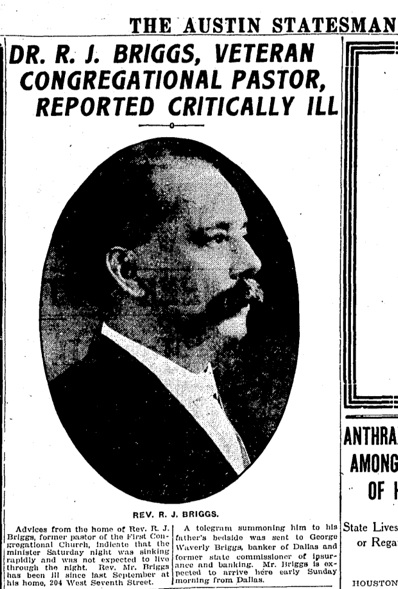 Dr. Brigg's health began to decline in 1912. Doctors in Austin operated, but concluded there was nothing to be done. The following year, he went to the Mayo Clinic in Rochester, Minnesota for a second opinion. They concluded that he suffered from liver cancer and would not operate. They gave him only six months to live. This proved to be a gross underestimate. Due to his declining health, he was unable to perform his pastoral duties and rarely preached after 1915. This required the church to hire assistants. Since the church continued to pay his salary and he apparently chose not to formally retire, the budget was very difficult to meet. With approval of the Congregational Society for Ministerial Relief, he was permitted to retain the Pastor Emeritus title and qualify for aid. This arrangement made it difficult to recruit assistants, and the church went through a number them before Dr. Briggs died.
Quoting his son, “He served this pastorate actively for twenty years. The congregation grew in Christian grace and zeal, and built two church edifices to accommodate its expanding numbers.
“In this service his most effective labors were performed and his most eloquent and persuasive appeals were made for Christ and His Kingdom; in it, the forces of a lifetime of study and thought and prayer and zealous quest for truth matured and culminated in their fullest powers and in their richest fruits. In it, as Pastor Emeritus, he died on June 18, 1923.”
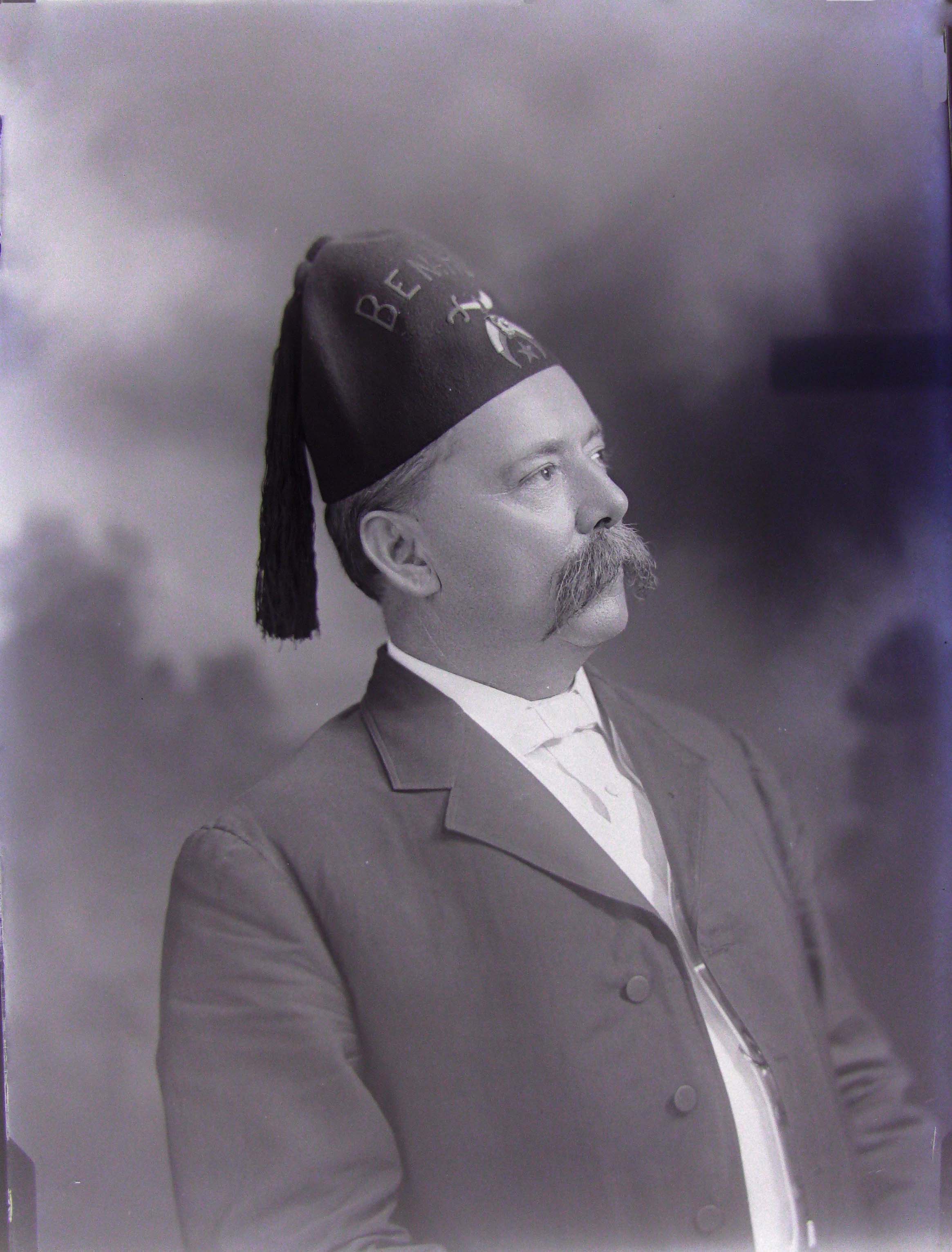
Rev. Dr. Briggs was a brilliant orator and beloved leader of the total community. He ministered to many persons who were rejected by other ministers. Briggs was made a Knights Commander of the Court of Honor of the Scottish Rite, Masonic Order in Austin about 1906. He became ill in 1914 and had to have assistants to aid him.
The Standard Blue Book of Texas 1914-15 has the following entry.
“Briggs, Ritchie J., Physician and Surgeon, and Clergyman, Austin, Texas. Born in Mississippi, November 28, 1858. Is descended from
the Briggses of Situate, Massachusetts. Educated at Greensboro and Baltimore. Holds degrees of M. A., M. D., D. D., L. L. D., A. A. O. N. and M. S. Member, Masons and Elks. Married December 13, 1880, to Miss Alice R. Burford, who receives on Thursdays, and who is a member of the King's Daughters and Daughters of Isis. Resides at 204 West Seventh Street, Austin, Texas. Phone 587.”
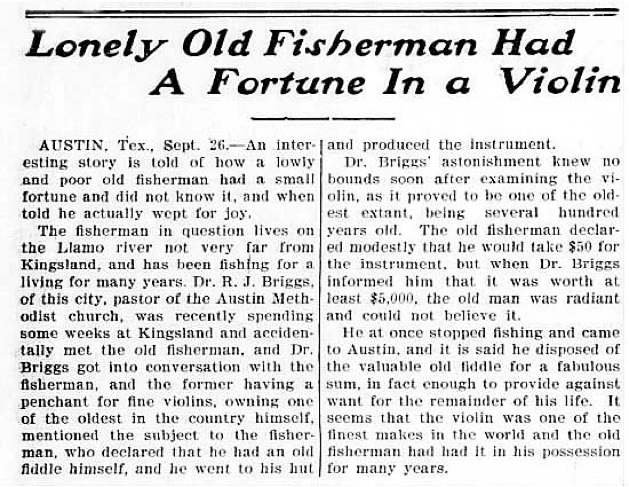
An interesting story that appeared in the September 26, 1903, El Paso Herald, suggests that Rev. Briggs played the violin.
George Waverly Briggs
The Briggses had a son named for Ritchie’s brother, George Waverly Briggs. He graduated from UT in 1904. The picture at right is from 1918 UT Cactus yearbook featuring outstanding alumni. His career demonstrates the concern for social justice present in his family's home. An article in the Handbook of Texas History has the following entry:
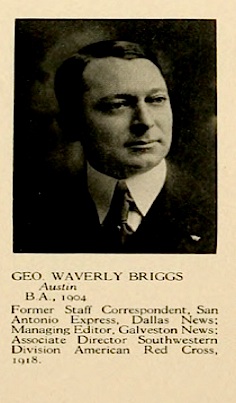 “BRIGGS, GEORGE WAVERLEY (1883–1957). George Waverley Briggs, journalist and banker, was born at Burford's Landing, near Camden, Alabama, on February 27, 1883, son of Alice (Burford) and Ritchie Jones Briggs, a Methodist, and later Congregationalist, minister. He attended public and private schools and the academy of Jacob Bickler in Austin. After studying at the University of Texas, Briggs became a reporter on the Austin Tribune (1905–06). At later times he held the positions of staff correspondent of the San Antonio Express (1906–10) and Dallas Morning News (1911–13) and managing editor of the Austin Statesman (1910–11) and the Galveston News (1913–18). For the San Antonio Express he wrote a series of articles that became, in book form, The Texas Penitentiary (1909). As a result, he was appointed a penitentiary commissioner of Texas. His work on the Dallas Morning News included a study of city and state housing, resulting in The Housing Problem in Texas (1911). Governor W. P. Hobby appointed Briggs commissioner of insurance and banking, 1918–20. Briggs later became vice president and trust officer of the City National Bank and its successor, the First National Bank, Dallas. He wrote the Digest of Texas Insurance and Banking Laws. Briggs was responsible for three major legislative acts: the Texas Trust Act, the Common Trust Fund act, and the Texas Probate Code. He held office in many organizations: the American Red Cross, national and Dallas chambers of commerce, National Committee on Prisons and Prison Labor, Texas Tax League, Southwestern Legal Foundation, Texas Centennial Exposition, Dallas Historical Society, and the Philosophical Society of Texas. He was awarded, by George VI, the King's Medal for civilian service to the Allies in World War II. At the time of his death, he was director of the Dallas Morning News. In 1912, Briggs married Lorena May Foster, for many years a member of the board of regents of Texas State College for Women, Denton (now Texas Woman's University). Briggs died in Dallas on July 16, 1957, and was buried in Oakwood Cemetery, Austin.”
Lorena May Foster Briggs was born in Oak Grove, Missouri on December 5, 1887. She died in Dallas, Texas on December 17, 1976.
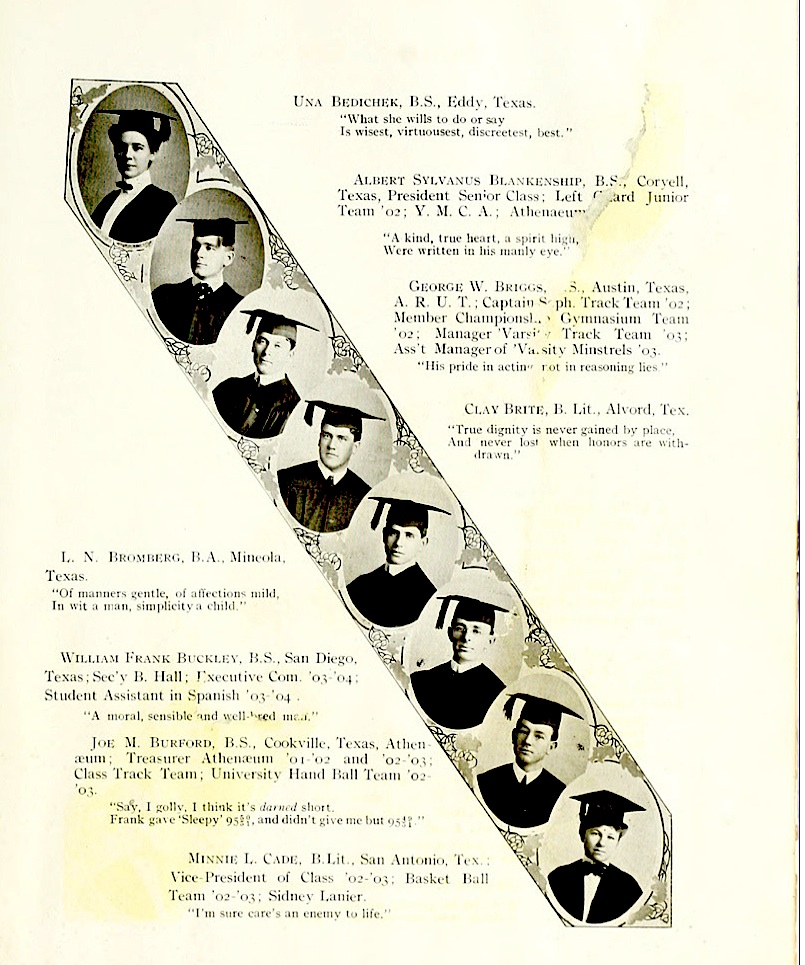
George Waverly Briggs, son of R. J. and Alice Briggs. 1904 Cactus Yearbook, University of Texas.
More Informations and a Sermon by Reverend R. J. Briggs
From R. J. Briggs Texas certificate of death
Name: Rev. Ritchie Jones Briggs
Death Date: 18 Jun 1923
Death Place: 204 West 7th St., Austin, Travis, Texas
Gender: Male
Race: White
Death Age: 64 years
Birth Date: 28 Nov 1858
Birthplace: Aberdeen, Miss.
Marital Status: Married
Father's Name: Andrew Jackson Briggs
Father's Occupation: Clergyman
Mother's Name: Miss Martha Brewer
Brother: George Waverly Briggs (1851-)
Sister Daisy Briggs (1860-)
Brother: Willie Brigs (1862-)
Brother: Andrew Briggs (1865-)
Sister: Mattie Briggs (1867-)
Occupation: Minister of Gospel
Cemetery: Oakwood Cemetery
Burial Date: 19 Jun 1923
Informant: Waverly Briggs, Dallas, Tex.
Home in 1870: Eufaula, Barbour, Alabama
Info Courtesy of:
BeNotForgot (#46974545)
Family links:
Spouse:
Alice Burford Briggs (1859 - 1938)*
Children:
George Waverley Briggs (1883 - 1957)*
*Calculated relationship
Burial:
Oakwood Cemetery Annex
Austin
Travis County
Texas, USA
Plot: Section E
R.J. Briggs Timeline
1858 Born Aberdeen, MS
1874 Graduated from Southern University, Alabama
1880 Sept 4, Pastor of First Methodist Church of Florence, AL
1880 Dec 13, Married Alice Burford Dumas in Mobile, AL
1881-83 College of Physicians and Surgeons, Baltimore, MD
1883 Son, George Waverly Briggs born at Burford’s Landing, near Camden AL. Burford was mother’s maiden name.
1886 Practicing medicine in Robinson Springs, AL
1892 Colusa County, CA
1896-98 Pastor of Tenth Street Methodist Church of Austin, TX
1901 Pastor of The Methodist Church of Austin
1904 Pastor of renamed First Congregational Church of Austin
1904-23 Pastor of First Congregational Church of Austin
1923 Died in Austin, TX
Mrs. Alice Burford Briggs Timeline
1856 July 28 Born in Alabama
1876 Oct 12, Married C. M. Dumas in Wilcox, AL
1880 Census listed her as widowed.
1880 Dec 13, married Ritchie Jones Briggs in Mobile, AL
1883 Son, George Waverly Briggs, born
1938 Died in Austin, TX, Living at 2815 Salado Street, Austin
SUNDAY MORNING SESSION of the Annual Congress of the National Prison Association, December 2-7, 1897.
The Congress assembled in the Tenth Street Methodist Episcopal Church at 10.30. When the annual sermon was preached by Rev. R. J. Briggs, D. D., the pastor of the church, from the text "What is the cause that former days are better than these." Eccl. 7 : 10.
SERMON.
If we should attempt to trace the National Prison Association, now holding its annual Congress in our city, back to its primary source, we would not find it arising in any of the ancient schools of philosophy, nor springing from any germ thought uttered in the temples of Greece or Rome, but we would be carried back directly to Bethlehem, the birthplace of Him who first taught the world the true doctrine of human brotherhood. It is a testimony to His spirit and influence.
This Congress does not meet here for social pleasure, or personal aggrandizement; it is distinctively Christian, therefore, unselfish: To mitigate the rigors and horrors of prison life and promote the personal and religious well-being of that unfortunate class of our fellowmen.
Whence comes this sympathy with the fallen, the guilty and the miserable, this perception of dignity amid disgrace, of beauty amid deformity, and well-nigh infinite worth amid moral and social ruin? It comes to us directly from the words and example of Jesus Christ. The glorious impulse which he gave to the souls of men, the sweet spirit of charity which he breathed into the hearts of men. That spirit has defied the power of time to tell upon it, the power of age to bronze it over weakness and decay, the power of our materialized civilization to wrest it from the heart and bury it out of sight; and it is, today, manifesting itself more and more in new and more splendid efforts of philanthropy for the redemption of the lost and the salvation of every class of men from every form of evil.
We bless God that we have been born under its empire and baptized into its disinterestedness and compassion. Brethren of the National Prison Association, we welcome you to our city and to our hearts in the name and spirit of our common Lord.
In directing your thoughts this morning, I do not feel called, nor do I feel competent, to discuss your plans and methods, or the means by which the object of the Association may be best promoted.
You observe that the text which I have read asks a plain question. In applying it to our time (of which it may be wisely asked), the fact is assumed that the former days were better than these, and the cause is demanded. This question is well-worth our study, for it is not always that men are alive to the influences of their own time. It is easy for them to lose sight of the present, either in recurring to the busy scenes of the past, or looking forward to the bright possibilities of the future.
While we are young, it is the future that absorbs us. We turn toward it with wistful and eager faces. We believe that on it shines a brighter sun than falls upon today. God has mercifully drawn a cloud over its events, and we press onward into it, as the gold hunter crosses the desert and threads the wilderness expecting fabulous wealth at the end. At last, we near the end, we see looming before us the barrier that arrests all human hope and progress, we see the grave. And as we can no longer look forward very buoyantly, we begin to look backward.
Memory, courtier-like, softens down the rough places, smoothes out the wrinkles, throws the glamour of idealism over all the shocks and surprises of the past, and makes a retrospect pleasant to contemplate, out of experiences that tried our very souls. The young look forward, the old look backward, and in the indulgence of these dispositions, we often lose sight of the present, of terrible evils which are knocking with skeleton hand at our own doors.
Today we are to look at our own time in contrast with the past. In choosing this interrogatory sentence for a text, we assume that the former time was better than our time, or, to reverse that statement, that our time is worse than the former time. What are the characteristics of our time that justify that statement?
1. Superficialness I do not mean as regards modern material progress. Human research, in our day, has opened almost every doorway of the world; opened up its sources of capital in a way that would have astonished the Babylonian and Tyrian capitalists; opened up its hidden forces in a way that would have astonished the greatest scientists of the past. The force of intellect and of inventive talent that has been delivered upon the world is bewildering. But all this has tended to hide the higher horizons of human thought and interest from the eyes of many, to obscure God and the solemn fact of responsibility to Him. See the superficial estimate our age has of sin the one essential evil.
It is hardly more than an inconvenience to this age. Men dread it only as it threatens them with outward shame and social confusion. What estimate does our age hold of God?
The cause, the reason of things, if not an abstraction, hardly more than an impersonal center about which things may be grouped. Men have brought Him down to the bar of their own wisdom, and set about Him their bounds; and when they are reminded of His will, as revealed in His word, they shrug their shoulders and smile as if to say, " O, you are far behind the times."
2. Again ours is an unstable age, restless and unsettled. Any one can see this. It is agitated like the waves of the sea. Creed after creed, theory after theory, issue after issue, chasing each other over the surface of society as the waves chase each other over the surface of the sea. Hence, the sensationalism of our modern pulpits, the sensationalism of our modern literature, the changing beliefs and careless opinions of men.
3. Then our age is worse than the former age in degeneracy. This is the saddest characteristic of all. We have good people all around us lamenting the degeneracy of our day. They say it is an age of sham and shoddy. Look at the appalling increase of crime and, especially, the one crime of murder in this country in the last ten years. According to the Chicago Tribune the murders committed in the United States from 1886 to 1896 have multiplied almost ten fold. From 1,449 in 1886 the statistics of this one crime have increased to the enormous total of 10,500 in 1895.
Says the San Francisco Examiner, commenting upon these statistics," It is a record that cannot be matched out of Armenia or the brutalized regions of 'Darkest Africa.' There is no part of the civilized world in which human life is so little regarded and the taking of it so lightly condoned as in the United States of America."
Now, there must be some cause for all this. There is something lying behind the restlessness, and desperate recklessness of our time. Many causes have been mentioned in the able papers and addresses to which we have listened during this Congress, but there is one which I have not heard mentioned and which I regard as the most active and potent factor in the moral degeneracy of their age—materialism.
The spirit of infidelity that has dominated the thought of our age, and, also, the poison of infidelity that has saturated the sentiment of this age. Here we have one of the chief factors that have generated a criminal-producing atmosphere. We all know that no one leaps into criminal hardihood in a moment, as Minerva is fabled to have sprung from the brain of Jupiter, full-grown, full-armed and equipped.
A criminal is not a special monstrosity, predoomed and predamned to preternatural wickedness, and adeption in crime from his birth. He is the product of an atmosphere; a specimen of the fruitfulness of a certain soil. Just as the miasmatic atmosphere that swathes our Brazos bottoms is productive of pestilence and death, so the saturation of society with certain sentiments and opinions is just as certainly productive of crime.
In saying this, I am not ignoring the fact of personal responsibility but indicating the obvious fact that we cannot defy our moral, any more than our material environment, altogether. Look into those noisome quarters of our great cities, where vice, famine and fever hold their ghastly carnival, the dismal depth of man's neglect and inhumanity to man; what fair and hopeful growth can arise from such a soil? What germ of better things could survive in such an atmosphere? It is the verdict of history and experience that man is largely the outcome of the influences amid which he lives, moves and has his being. And for him to breathe a vitiated moral atmosphere from his birth is for him to become warped, degraded and criminalized almost in spite of himself. It might be well for our judges and juries to remember this in their judgments touching crime and its punishments.
It might be well for the governors, wardens and directors of our prisons to remember it in their efforts to bring out the " innate dignity and perfectibility of human nature," in the morally deformed committed to their care; well for them to be certain that it is always human; that it has not been transformed by the very atmosphere it has been compelled to breathe from its very birth into a nature more degraded than was that of the once proud King of Babylon, when the heart of a man was taken out and that of a beast put in its place.
Now we all know, from our own personal consciousness, what a tremendous incentive to right-living, good citizenship, belief in God and immortality is. When a man once realizes that this life is but the first stage of an endless existence which shall correspond substantially with the moral qualities of life here, he has within him one of the greatest incentives to right living, and the influence of which touches his whole nature, mind, heart and soul, strengthening the will, inspiring the heart, giving this life a dignity and sublimity, solemnity and awe, by showing how the smallest act here may reappear in eternity, transfigured in consequences at which angels wonder or rejoice, and which work the ruin on salvation of a soul. This being true, you can easily judge of the results in human life and conduct of the utter extinction of that belief.
All the loftiest and most regal prerogatives of human nature disappear with it, and human life sinks to the level of mere animalism– an animalism differing from that of the brute creation only in greater capacity for evil, and superior ability to look out for number one. Then when a man makes up his mind that he is self-contained, all his actions are wrought at his own pleasure. No judge above him, no account beyond him, his idea of duty and morality is immediately and finally mentally changed. And though he may see that honesty is the best policy as far as this life is concerned, he will never be inspired thereby to honesty when he sees that great personal gain may attend the methods of dishonesty and no unpleasant reminders of it to be met in the world to come. This repudiation of the future life with its sanctions of reward and punishment has been spreading like a pestilence throughout our country and the world.
The progress it is making and the influence it is exerting are seen not only in the fact that it is quickly seized upon by the lowest classes and worst elements of society, but also in that some of the most brilliant and popular writers and lecturers of the day are either most boldly and grossly declaring it, or giving it surer foothold, perhaps, and more subtle and certain blight by those dilettante methods that,
"Damn with faint praise,
Assent with civil leer,
And without sneering,
Teach the world to sneer."
The logical result of this negation is license, and crimes of every hue and degree spring up in its fertile soil. If death ends all, and the issues of life terminate forever in the grave, then life is at once shorn of its value, it is not worth living. But the logical conclusion is since it has been thrust upon me, whether I would or not, with all its vast capacities for pleasure and pain, then dum vivamus, while we live let us live. Moral and social restraints are but impudent imposts upon our rightful gratification, unwarranted interferences with our liberty. Selfishness, personal gratification becomes the dominant motive or instinct in the heart of man, as in the heart of the brute.
Then why should one hesitate to remove with pistol or poison the man who dares to oppress him or who stands between him and his most coveted end? He has naught but the human law to fear, and there are a thousand ways of evading that; and, even at the worst, the human law could only put him beyond the reach of cold and hunger, and a thousand forms of suffering and of ill.
Anyone can see the tremendous power for evil there is in this repudiation of the future life with its solemnities of recompense and destiny.
A careful investigation of the murders and great felonies committed in this country during the last decade will show that they were chiefly perpetrated by infidels and agnostics, in head, or heart, or both. One of the most notorious outlaws known to the criminal annals of the West, boastfully cried out to a number of ladies and gentlemen, whom curiosity had, for a moment, gathered about his cell," I'm a Bob Ingersoll man, I am." No one doubted it in the least. It was not necessary for him to make any such confession of faith, or no faith, he was a legitimate product of the celebrated agnostic's teaching. The great spiritual trait that underlies the moral life and rectitude of this world is that of man's direct responsible relation to God, that every human life unfolds under the direct eye of God, that the individual is not a mere vibration, a conglomerate of clear cool water, salts and gasses, but a personal soul, active and powerful, whose every volition is invested with a solemn weight of grandeur since it affects his destiny forever. That is a tremendous view of human life. It invests each life with a solemnity and value not to be measured in human speech. It makes each man and woman sacred, and every form of injustice, oppression and wrong becomes a capital crime against the majesty of an immortal spirit. Now, I say, men have been drifting further and further away from that faith; its hold upon the heart and conscience of the nations; and as men ignore or deny their responsibility to God, we may be sure that they will pay little heed to their responsibility to one another.
And so we see that selfishness, covetousness, oppression, misrule and anarchy keep pace with the decadence of a vital faith in God and in divine and human relationship. That is the chief secret of the trouble that racks the world's breast today. It is the explanation of all these forms of political and social oppression that have filled the world with anarchists, nihilists, labor agitators of every degree of vindictiveness and violence. The rights and dignity of the individual is no longer the watchword of our modern civilization. Selfishness is at the helm, and, therefore, that which brings most power in the world is most coveted. Hence, money becomes the summum bonun, the ideal of all. Money is here, its power is here and there is no gate, though fastened with triple bolts of brass, that does not swing wide open before its magic and all powerful open sesame.
The rights of men, the sufferings of men are as nothing before the all-absorbing lust of accumulation and greed of gain that marks the spirit of our age.
" Get money, money is the cry,
Honestly, if you can;
If not, no matter how you lie,
'
Tis money makes the man."
Everything is measured by the one standard, money. The richest man is the greatest man, and if there is one richer than the richest, he is the ideal man, and the world has well-nigh gone mad in its passionate and insatiable quest of gain. What wonder that confusion reigns, and falsehood walks the earth "in silk attire!" What wonder that conscience has been dethroned from its imperial seat and its sacred rule, and virtue led captive and in chains!
Here is what a wise observer, and one not given to exaggeration, has to say of the public spirit and sentiment of their age: "Men known to be unprincipled are honored for their bank accounts." Men of money, and men who control the influences that command money, feel themselves too safe to need vindication when charged with the most infamous crimes.
People are no longer startled though fitness for the highest offices in the land is measured by gold rather than by brains, virtue and patriotic service. People are no longer shocked that the whiskey bottle enters as an essential factor into many elections and not a little legislation. Rich men make combinations that crush all weaker rivals, organize trusts that rob the people, and are called Napoleons of finance; while, in ravenous greed, they are the sharks of the business world, and as far as conscience is concerned, they are the direct successors of the Barbary pirates who scourged the Mediterranean some generations ago.
Now, here we have a glimpse of the ideas and ideals that are at work in our modern society. Who can wonder that business and honesty, politics and purity, government and justice have all parted company where God and conscience have been banished from the thoughts of men and money enthroned in their stead! Here are the conditions of anarchy and ruin, the elements of death and decay for any nation. If ever there was on earth a harvest reaped from just such seed, it was the French Revolution. It required many generations for those seed to germinate, but at last, the harvest came in a tremendous upheaval that demolished the political and social program that had stood for a thousand years. And these seeds left to ripen to the harvest cannot bring forth other fruit in their land. And now, Brethren, the question arises: How are we related to this condition of things? We, who stand as representatives of better things, better ideas and better principles, representatives of the Christ idea and the Christ life, are we entirely free from all responsibility touching this spirit and tendency of our age? Have our lives been living denunciations of these things?
Have we on all occasions lifted our voices in stern and energetic protest against the popular sins and ruinous fallacies, the shallow negations and bitter ironies that have been eating into the very heart and poisoning the life blood of our modern society? To us this question comes full of solemn emphasis and the menace of a reckoning bye and bye. "To him that knoweth to do good, and doeth it not, to him it is a sin." To have the opportunity of doing good, and not to do it, is to be responsible for all the evil that may result from the neglect. Yea, more, to witness evil and fail to rebuke it is to share its guilt. That is God's legislation, not mine. He has thus decreed, and terrible are the tragedies in history, all reminding us that man perishes not alone in his iniquity. If we would escape blameworthy entanglement in other men's sins we must witness against them. To be silent when conscience bids us speak is as evil as to speak when conscience bids us keep silent. To be tongue-tied by cowardice or reasons of personal interest and expediency in the presence of a great wrong is just as evil as to endorse the wrong or to lend our voices to celebrate the coronation of unrighteousness and crime. There was a man who for many years was a distiller, as a consequence not only he, himself, but his sons also, as they grew to manhood, became habitual drunkards. One day, one of the boys, while in a state of intoxication, in a mere spirit of bravado, tried to ride his horse across the river and was drowned. After many days' agonizing search, his body was found, but in such a stage of advanced decay, and so mutilated by the ravenous denizens of the stream, that it could scarcely be recognized as human.
As the father gazed down upon the harrowing spectacle, and his hard, guilty heart broke within him, he cried, "Oh, what murdered my boy?" And for the first time in his life, the voice of conscience awoke and in words that were like peals from the trump of doom cried, "Thou art the man!" Murderer of his own son? Why not? He had never warned him against the fatal and accursed poison, but by his own silence and example, had become an accomplice in the death of his own son.
Brethren, who is responsible for the ever-accumulating catalogue of tragic crimes and horrors born of the liquor traffic? The men who make it, and the men who sell it, and the men who drink it and become fiends. Yes, of course; but will God hold guiltless the men who make the laws, permit of the license, and endorse the business, by word or ballot or silence? Nay, verily. If it be within the power of the better element of this country to throttle and crush this evil, will God hold that element guiltless if it refuses to do it? How can He and, at the same time, maintain the principle upon which His very government rests? Does not this nation call itself Christian? Is not the name of God written in its constitution and stamped upon its coin, and does it not make at least some pretense of believing in Him and worshiping Him?
Then when by its divorce courts, it sets aside, upon any plea and every plea, the sacred law of marriage as established by God, and written in the letter of His Gospel; when through a spirit of indifference and irreverence it ignores His own solemn ordinance touching the sanctity of His Sabbaths; when through the greed of gain it gives license to whiskey shops and murder mills, and gambling dens, and walks upon the fragments of the broken table of the law; can the nation hope to escape the consequences of its sin?" Be not deceived; God is not mocked, for “whatsoever a man (nation) soweth that shall he (it) also reap."
This nation of ours has forgotten God, has been looking upon merchandise and wealth and money as the only good. Men have boasted of their bank accounts and proudly pointed to their ships whitening all the seas with their sails. Yet not all the merchandise of Tyre, nor the riches of Sodom, nor the might of Gomorrah, nor the pomp of Rome, the palaces of Greece, the splendor of Assyria, the grotesque greatness and fabulous wealth of Egypt, could keep those nations from going down into the dust. It is not the extent of territory, the number of the people, the vastness of wealth that make a nation great, and that insures it against decay and overthrow, but justice, righteousness and truth; heart life, home life, Church life, holy, pure and divine. These alone can make great and permanent a nation. If this land of ours did but learn that lesson, how it would arise and shine! How it would begin to vindicate in earnest the wisdom of the Creator in preparing such a country and the wisdom of Providence in first settling it with English-speaking Christian men and women! "Righteousness exalteth a nation, but sin is a reproach to any people." Our greatest need today is a return of conscience and of God to our country. First, the return of conscience. God cannot enter the heart of the individual, or of the nation, save through the conscience. It is only through the conscience His voice can be heard. Your neighbor touches the doorbell and you are thus warned of his presence. So it is with the conscience; it is a sensitive cord that connects the souls of men with the throne of God.
When, in its normal state, God can speak at the altar's end and send His voice across the reaches of the soul, in crashes of insufferable thunder or in tones of sweetest music. But when that cord is severed, however God may speak, His voice does not reach the soul. What we need today is a restoration of the interrupted continuity of that divine telephone wire. More conscience and conscience more supreme in all the relations of life. There needs to be quickened such a conscience in every man, that whether he be rich or poor, whether he labor with hand or brain, whether the pen or sword or plow be his, he shall be backed by solid essential verities, and not by such shallow sophisms as we often hear put forward in justification of the degeneracy and lawlessness of our time. It is a conscience void of offense toward God and man that brings lasting prosperity and peace.
Stern uncompromising devotion to duty, the resolute sacrifice of cherished advantage to the uncompromising claims of principle, though Athens banish or Jerusalem crucify. May God quicken conscience and multiply righteousness throughout our borders, that true order may prevail. Genuine freedom may flourish and a substantial and abiding prosperity succeed to the long reign of confusion, enslavement and disaster.
Then, other nations shall render us their unbroken homage as a nation great, glorious and free. Then shall we make good the Almighty's word concerning us, that we shall be a people chosen of Him forever.
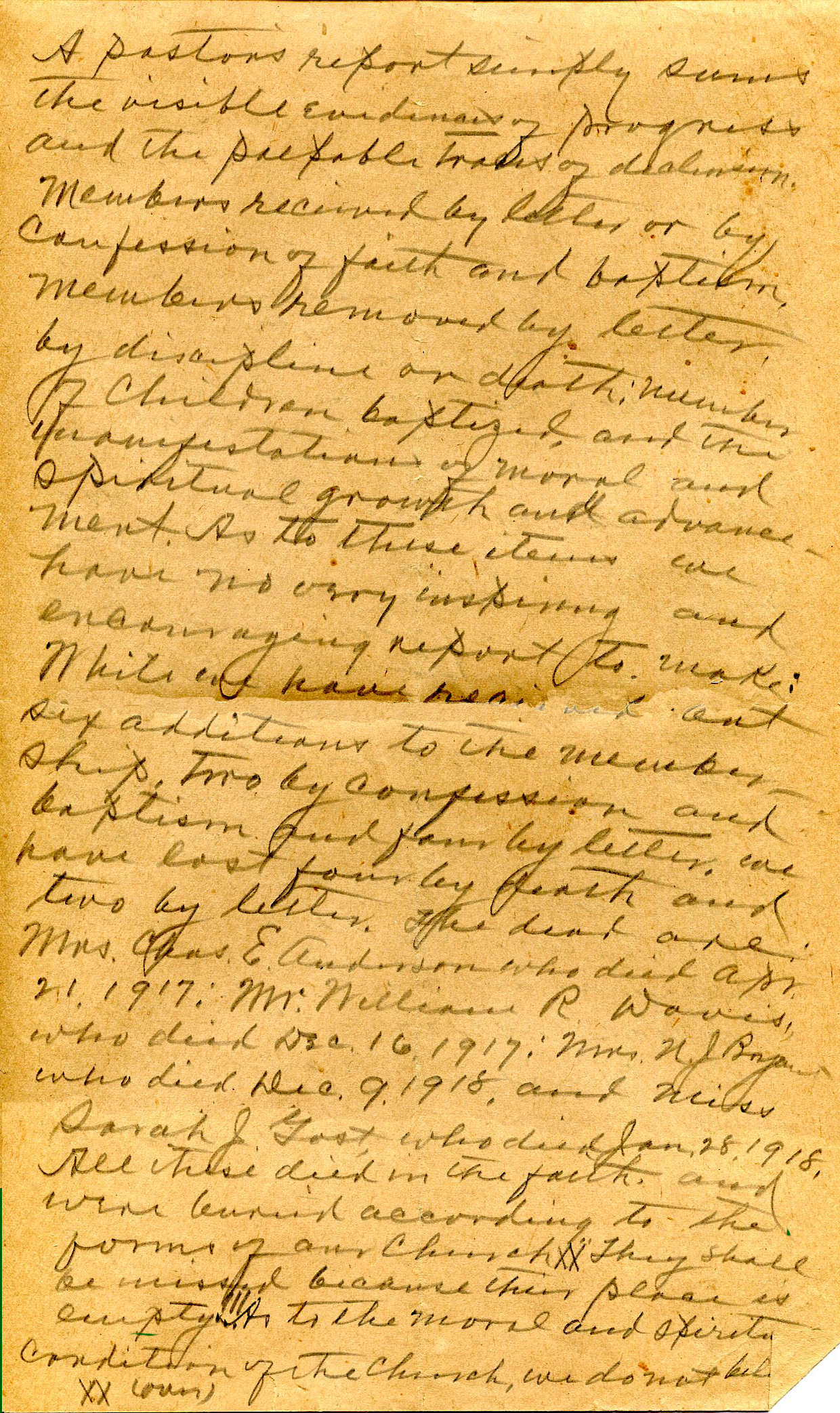
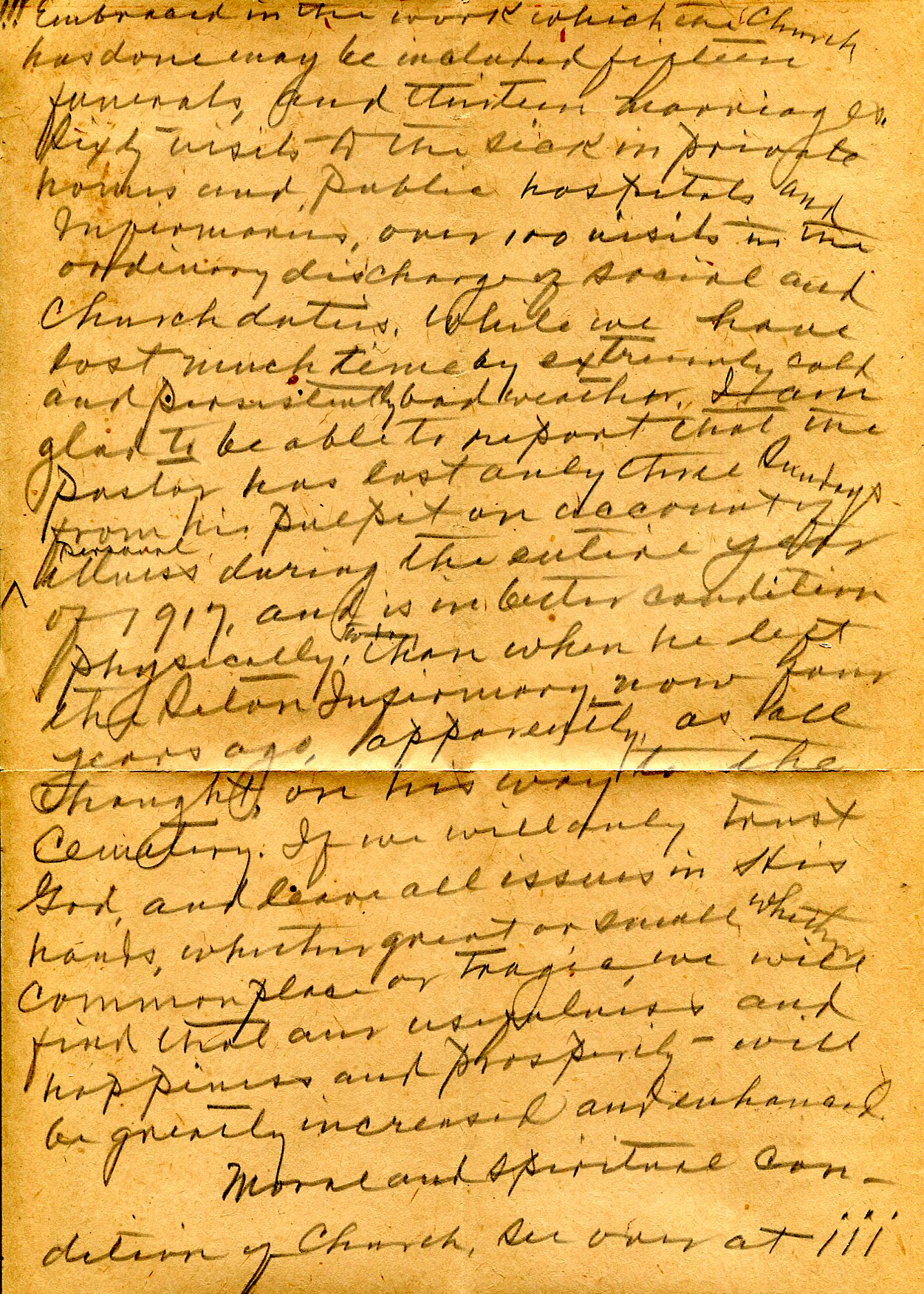
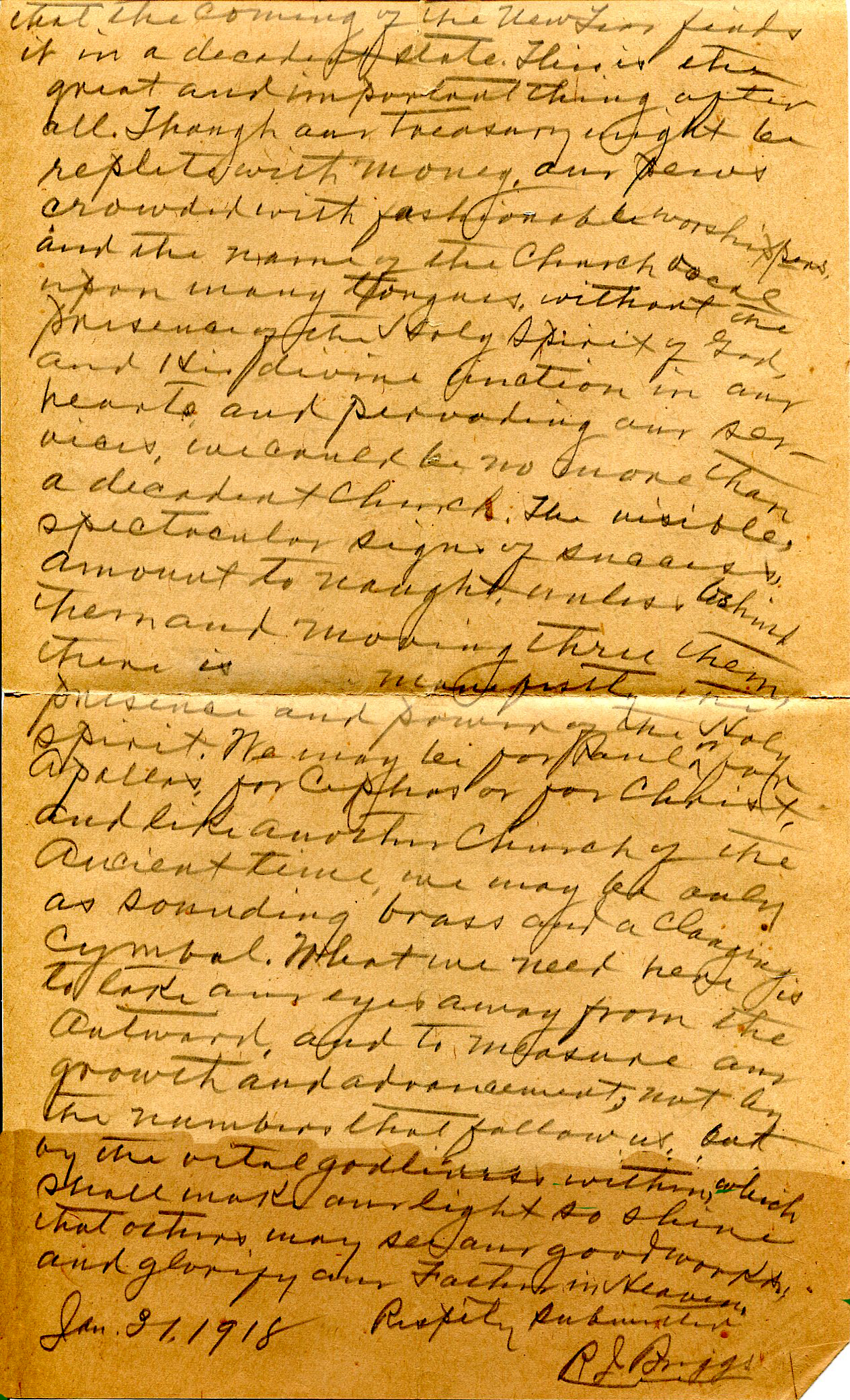
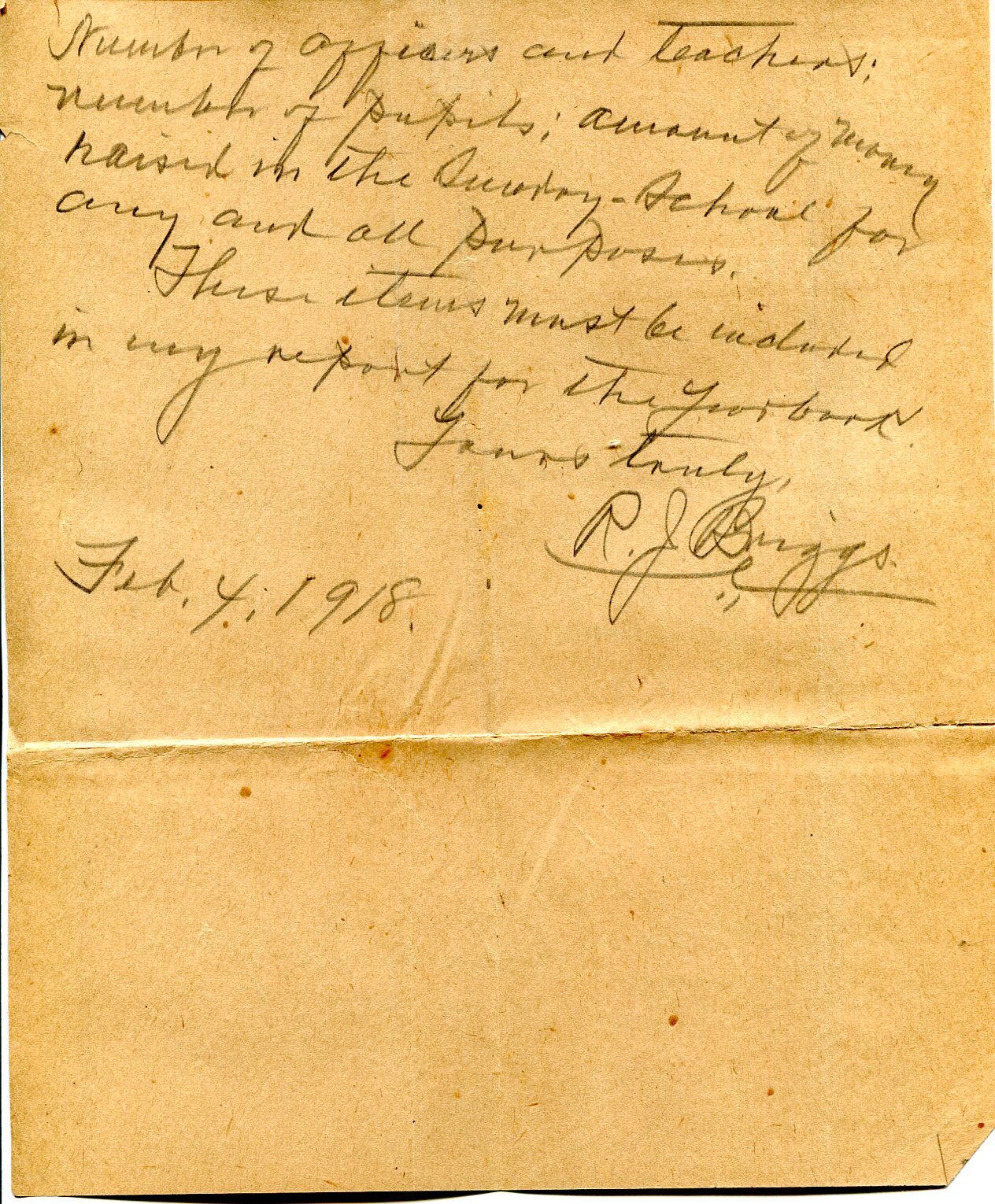
Rev. R. J. Briggs Pastors Report January 27, 1918
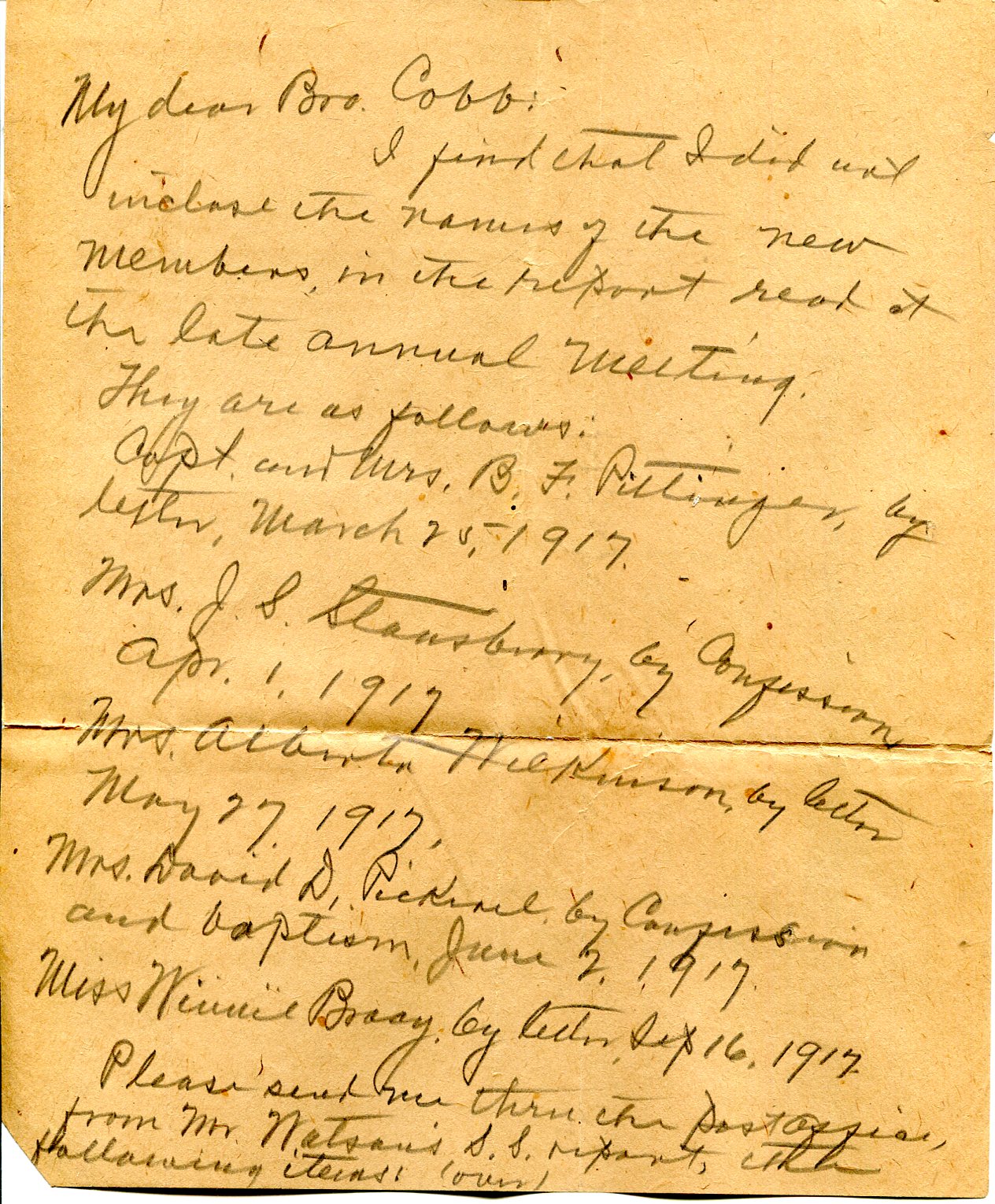
Amendment to Pastor's Report, February 4, 1918
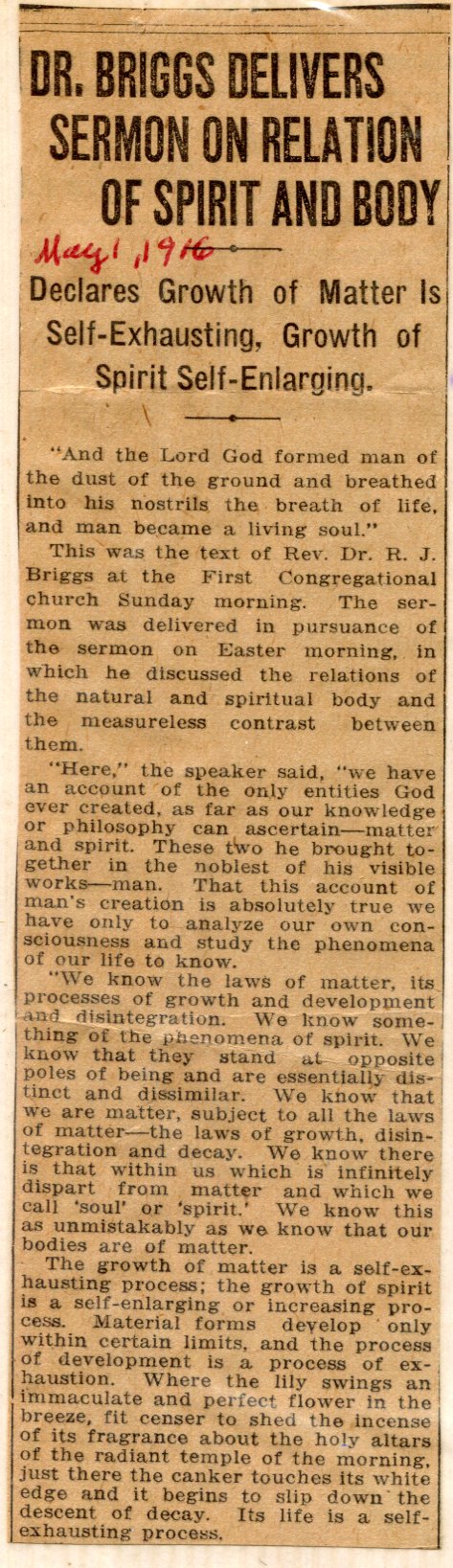
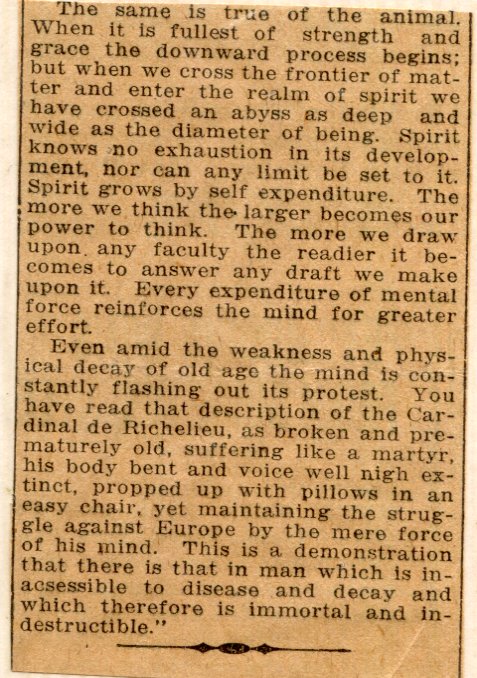
Rev Brigg's 1916 Sermon