Charles and Theresa Weber Balmer
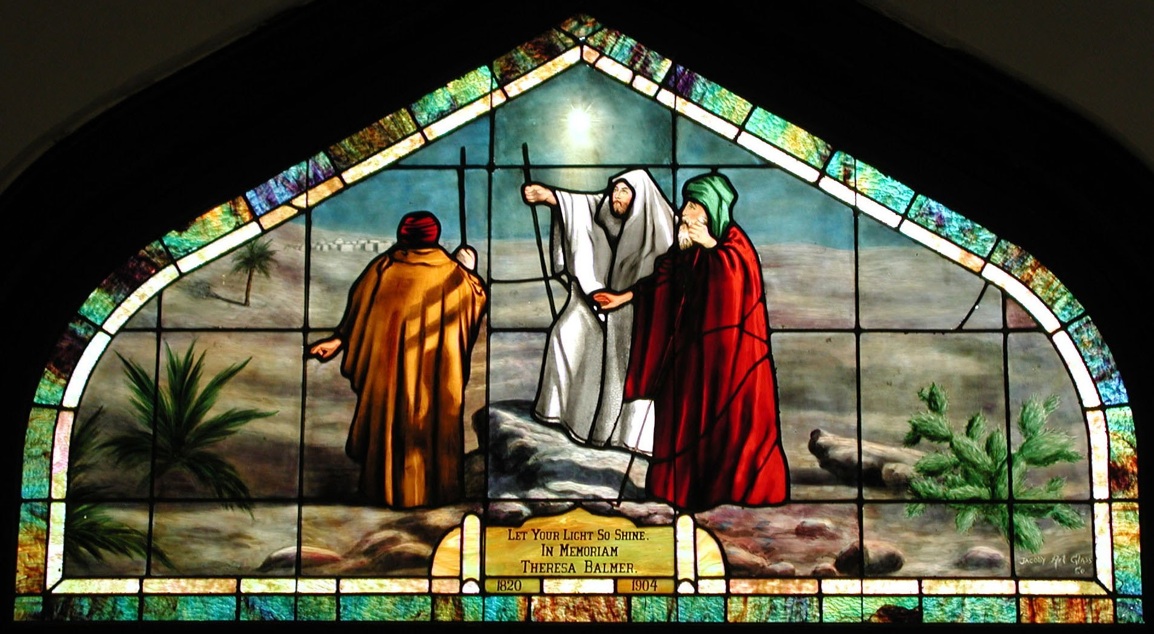
The Theresa Balmer Window
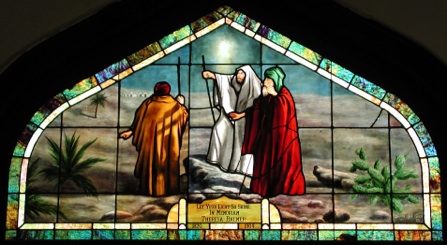
This window with the inscription, “Let Your Light So Shine, In Memoriam, Theresa Balmer (1820–1904)”, is on your left as you enter the sanctuary. The hand-painted and kiln-fired window depicts the shepherds approaching Bethlehem as told in Luke 2:8-20. The quote however, is from Matthew 5:16. Your writer has sat near this window for over 45 years and often wondered about the identity of Theresa Balmer. As a physicist, I imagined she might be connected in some way to Johann Jakob Balmer (1825–98), celebrated Swiss mathematical physicist, responsible for an important empirical formula for the visible spectral lines in hydrogen. Alas, this was not to be the case, however the facts, as we shall see, are no less interesting.
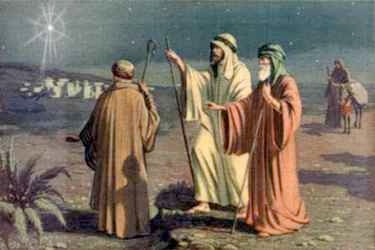
Here is a depiction of the shepherds in a painting found by David W. Ross, church member, as you can see, the painting was possibly inspired by this window or vice versa. The period of the painting is not currently known to me.
The Shepherd Story
From Luke 2:8-20 (King James Version)
8 And there were in the same country shepherds abiding in the field, keeping watch over their flock by night.
9 And, lo, the angel of the Lord came upon them, and the glory of the Lord shone round about them: and they were sore afraid.
10 And the angel said unto them, Fear not: for, behold, I bring you good tidings of great joy, which shall be to all people.
11 For unto you is born this day in the city of David a Saviour, which is Christ the Lord.
12 And this shall be a sign unto you; Ye shall find the babe wrapped in swaddling clothes, lying in a manger.
13 And suddenly there was with the angel a multitude of the heavenly host praising God, and saying,
14 Glory to God in the highest, and on earth peace, good will toward men.
15 And it came to pass, as the angels were gone away from them into heaven, the shepherds said one to another, Let us now go even unto Bethlehem, and see this thing which is come to pass, which the Lord hath made known unto us.
16 And they came with haste, and found Mary, and Joseph, and the babe lying in a manger.
17 And when they had seen it, they made known abroad the saying which was told them concerning this child.
18 And all they that heard it wondered at those things which were told them by the shepherds.
19 But Mary kept all these things, and pondered them in her heart.
20 And the shepherds returned, glorifying and praising God for all the things that they had heard and seen, as it was told unto them.
Commentaries on the Shepherd’s Story
John Calvin (1509–64): "It would have been to no purpose that Christ was born in Bethlehem, if it had not been made known to the world. But the method of doing so, which is described by Luke, appears to the view of men very unsuitable. First, Christ is revealed but to a few witnesses, and that, too, amidst the darkness of night. Again, though God had, at his command, many honorable and distinguished witnesses, he passed by them, and chose shepherds, persons of humble rank, and of no account among men. "
Matthew Henry (1622–1714): "Angels were heralds of the new-born Saviour, but they were only sent to some poor, humble, pious, industrious shepherds, who were in the business of their calling, keeping watch over their flock. We are not out of the way of Divine visits when we are employed in an honest calling and abide with God in it."
Jirair Tashjian,: "The joyous event was not announced to dignitaries in palaces but to lowly shepherds working the night shift. This is in keeping with what Mary says in Luke 1:52, that God “has brought down rulers from their thrones but has lifted up the humble.”
Quote in window is from Matthew 5:16, "Let your light so shine before men, that they may see your good works, and glorify your Father which is in heaven."
Introduction to Balmer Family Search
Census searches for Balmers in Austin and Texas yielded no candidates for our Theresa Balmer. However, by including the entire US, a name appeared with the correct birth and death years. The next step was to connect her with Austin. The information below tells the full story of my research.
Census records revealed that Theresa Balmer was married to Charles Balmer and they lived in St. Louis, MO. Because Charles and Theresa were celebrated musicians, multiple sources revealed Theresa’s maiden name as Weber. Both families immigrated from Germany as described in the entry below:
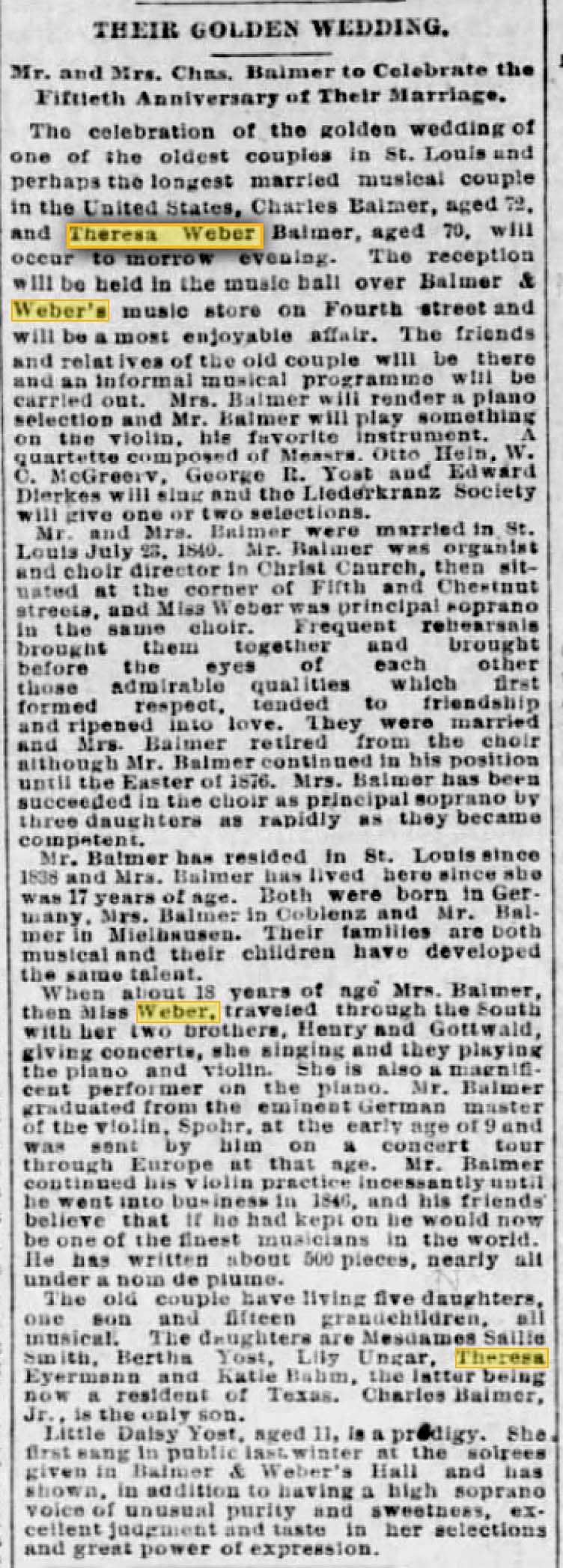
The following excerpt from Music Publishing in St. Louis by Ernst Christopher Krohn, 1988, gives us some background on the Balmer family. Additional material from History of St. Louis City and County: From Earliest Periods to the Present Day by John Thomas Scharf, 1883 annotates this excerpt.
“Johann Heinrich Weber, Geheiner Hofrath, at Coblenz on the Rhine, married lda Rosalie Banda. a lady of Jewish extraction. Such an alliance was frowned upon by the royal court at Coblenz, and Weber eventually found it advisable to leave Germany. He came to America in 1834 and settled in St. Louis on the Missouri River with his wife and family of five. His daughter, Theresa, became a fine soprano and a talented pianist. His son, Carl Heinrich, became an excellent cellist, and another son, Carl Gottwalt, an expert double-bass player.
"At about the same time, Gottfried Balmer left his comfortable home in Mühlhausen and came to the United States. He went to Philadelphia and then to St. Louis sometime in 1836. His son, Charles, left the family at Philadelphia and went to New Orleans, hoping to see more of the country. Charles, born 1818, had been a child prodigy who, before his tenth year, had learned to play the piano, organ, violin, and clarinet. At sixteen he was assistant conductor of the orchestra at the Göttingen Conservatory of Music. While a student at the conservatory he made copies of many chamber compositions that he possibly could not afford to buy.
"Arriving in New Orleans, he met the concert singer, Madame Caradori-Allan, who engaged him as her accompanist. In the course of one of their tours, they reached St. Louis and Charles decided to make St. Louis his home. This was in 1839.
"In 1839, Charles Balmer came to St. Louis. That year Professor Wilhelm Robyo of the University of St. Louis organized and led a brass band; he wrote and organized all the music himself. Balmer was pianist at a concert given by the band for benefit of a new hall, and, among the artists who assisted and performed, was soprano, Miss Theresa Weber. Miss Weber and her brother, Henry, were members of the “immortal” Weber family of musicians in Germany. They were related to the Mendelssohn family.
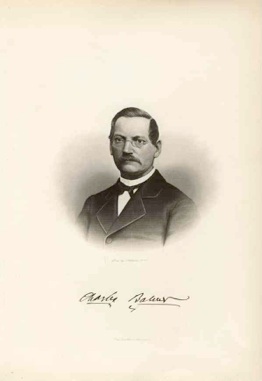
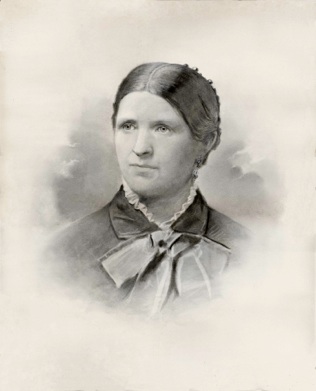 "On May 1, 1840, (Official records give June 23, 1840, interestingly, the entry preceding theirs, shows a May 1, 1840, likely, the author noted wrong date.) Charles Balmer married Therese Weber, and their home at 160 South Fourth Street became the center of musical life in St. Louis. Visiting artists were entertained there as a matter of course. Musicians of the stature of Henri Vieuxtemps, Ole Bull, and Louis Moreau Gottschalk became part of the family. In 1848, in partnership with his brother-in-law, Henry Weber, Charles Balmer opened a music store at 141 Market Street. (Picture of Charles at left was provided by of Gerald Stutts). (Picture of Theresa, at right, provided by Marilyn Kay. Some restoration of Theresa’s picture done by Mel Oakes)
"Balmer had begun to compose when he settled in St, Louis. He wrote many songs and piano pieces that were published by William Cummings Peters at Lexington, Kentucky. In 1842, he published his "Saint Louis Firemen's Parade March” at his own expense. A popular piece was his "Concert Hall Cotillion." This was copyrighted by Balmer & Weber in 1848."
Charles Balmer was born in Mühlhausen, Germany on September 21, 1817. He died December 15, 1892, his obituary appeared in the New York Times:
 “Charles Balmer, head of the well-known music house of Balmer & Weber, at St. Louis, died yesterday, age seventy-five years. He was the most prolific as well as one of the greatest of American composers and writers. He arranged, during his lifetime, fully 6,000 pieces. For thirty-nine year, he was organist of Christ Church Cathedral and the president of the Philharmonic Society. He acted as musical director at the funeral of Abraham Lincoln, at which a band of 100 pieces and a chorus of 300 voices were employed. He was selected for this honor from more that 100 competitors.
"He was associated with Jenny Lind during her stay in this country, and was one of her warmest friends. He afterward visited her at her home in Europe and was gladly received, though many years had intervened since he had seen her.
"Mr. Balmer was well known to every musician of note in the country. Indeed, his fame was international. He was born at Mühlhausen, in the mountains of Saxony, but came to this country while quite young, settling first at Atlanta, GA. He married a Miss Weber, with whose brother he was associated in business. He leaves a large estate.”
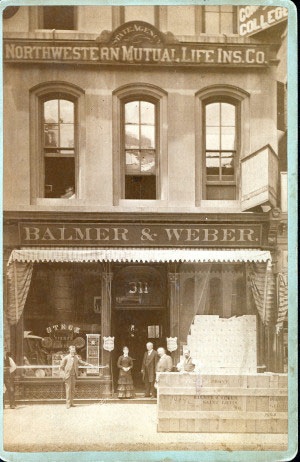
The picture at right is the Balmer & Weber Music Store at 311 North Fifth Street. Likely the two older gentlemen in front are Charles Balmer and Henry Weber. This building no longer exists (The St. Louis Arch is there.), however, their building on Locust Street survives and is on the National Register.
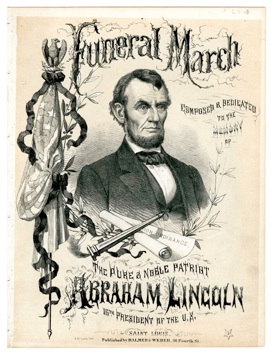 At left, is the sheet music cover of Lincoln’s Funeral March, written by E. C. Davis and published by Balmer and Weber. It is part of the Lincoln Financial Foundation Collection in St. Louis, MO.
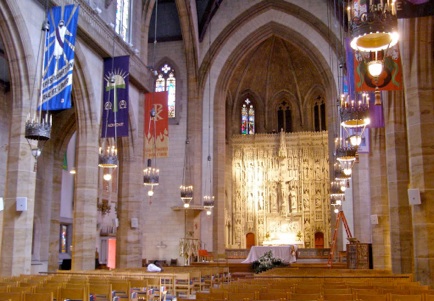
Charles and Theresa attended Christ Church Cathedral, St. Louis, MO, shown below. Charles was organist at the cathedral for 39 years.
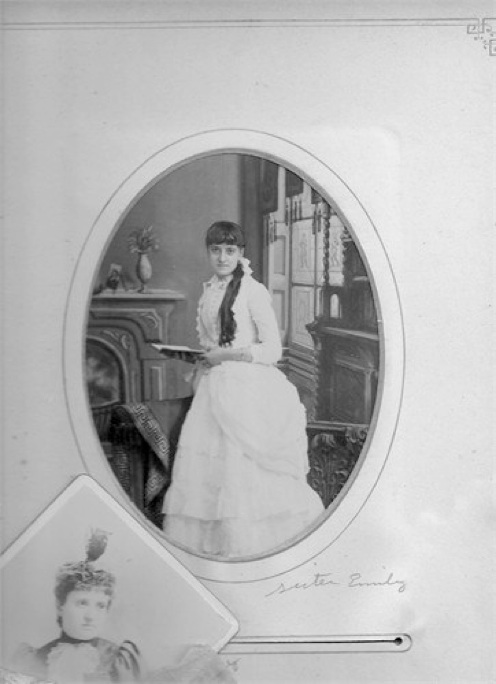
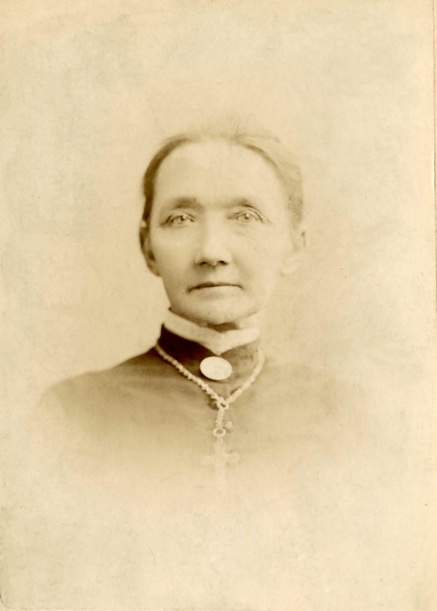
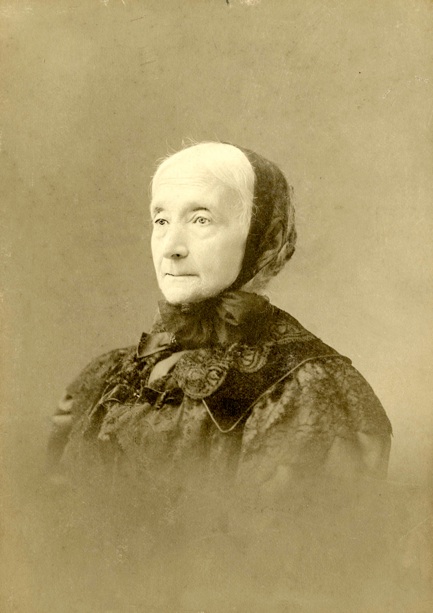
Theresa Weber Balmer was born in Schloss Ehrenbreitstein, Germany, May 11, 1820. Charles and Theresa Balmer were married June 23, 1840. At the time, Theresa was considered the best pianist of St. Louis. She and Charles will always be identified with the development of all aspects of music in St. Louis. Their contribution is well chronicled in “The German Element in St. Louis” by Ernst D. Kargau, published 1893. Below, are two beautiful pictures of Theresa provided by Marilyn Kay, a descendent.
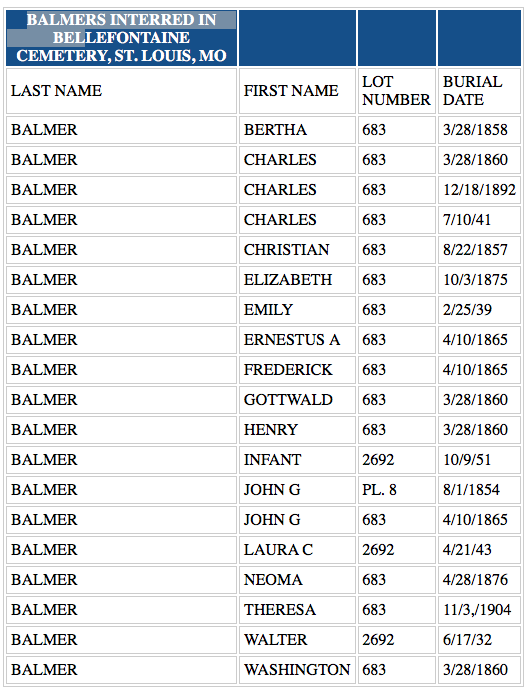
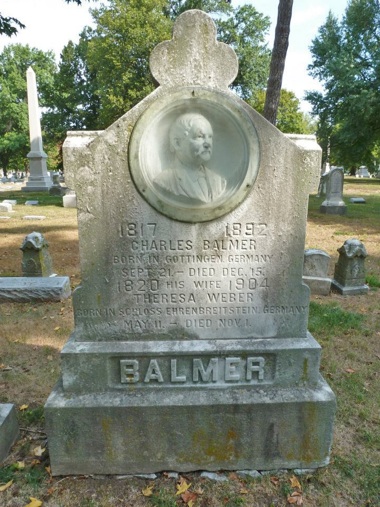
Theresa died November 1, 1904. Charles and Theresa are buried in Bellefontaine Cemetery in St. Louis, MO. Their gravestone is shown below, along with her obituary from The St. Louis Republic newspaper: Thursday, November 3, 1904.
Here, we present several pictures of Theresa:
Death Comes To Mrs. T. W. Balmer
 Long and Valuable Life Ends by Peacefully Passing Away
NOTED FOR WORKS OF CHARITY
Wife of the Founder of Well-Known Music House in Which She Was a Partner
Who died Tuesday, at the age of 84 years. Mrs. Teresa (sic) Weber Balmer, 84 years old, who was noted in St Louis for her charity work, died at noon yesterday, at her residence. No. 4023 West Pine Boulevard. Death was due to the infirmities of advanced age.
Mrs. Balmer, up to the time of her death, had always maintained good health
for one of her age, and she passed from a peaceful sleep into death.
She was born in Coblenz, Germany, her father at that time being connected with
the German court, and who emigrated to this country in 1836. Her father first bought a farm on the lower banks of the Missouri River, but a change in the course of the stream completely ruined the ground, and he moved to St Louis in 1830.
Some time after she took up her residence here, she married Charles Balmer, who was one of the most conspicuous music dealers of the West.
Mr. Balmer, in 1840, started the Balmer Weber Music Company, which is still in existence on Olive Street, taking Mrs. Balmer's brother as a partner.
She, until her death, had taken a great interest in this firm, her grandson-in-law,
Charles Allen Cale, being the present manager.
Mrs. Balmer, in her youth, was considered to have an exceptionally fine soprano voice, and some of the older residents of the city can remember the time when she sang in concerts here for charitable benefits.
Mrs. Balmer is survived by five daughters and one son, all of her daughters having married men who are in some way connected with the music business.
Her son is Charles Balmer; her daughters are Mrs. Rosalie Smith, Mrs. George R. Yost, Mrs. Theresa Eyerman, Mrs. G.A. Bahn and Mrs. Charles F. Unger.
The funeral service will take place at the residence this afternoon at 2 o'clock, the Reverend J. S. Jonas, pastor of the Independent Evangelical Protestant Church, officiating.
The burial will take place in Bellefontaine Cemetery, the pallbearers being Charles Unger, Malcolm Robb, Frank Unger, Herman Eyerman, A. A. Brown and C. A. Cale.
Source of the Balmer window: Gustav and Katie Balmer Bahn
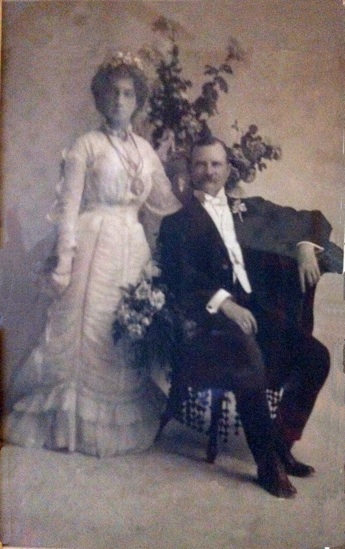 The information below suggests that Gustav Bahn and his wife, Katie Balmer Bahn, daughter of Theresa Balmer, arranged for the purchase of the window as a memorial for Katie’s mother. Theresa had died in 1904, and the church windows were installed in 1906.
Charles and Theresa’s six children included, Rosalie (Smith) (1875–1958), Charles Jr. (1865–1941), Theresa (Eyermann) (1851–1924), Bertha (Yost), Katie (Baum) (1857–1923), and Lillian (Unger) (1861–1958). Daughter Rosalie Balmer Smith Cale was a concert pianist and composer. The 1880 census and her death certificate lists daughter, Katie, as born in Aix-la-Chapelle, Prussia, presumably this was during a family visit to Europe. Katie worked as a cashier in St. Louis. In 1884, Katie married Gustav “Gus” Adolph Bahn of Austin, TX in St. Louis.. They had a son, Adolph, who at the age of eight, entered the Bickler School in Austin Texas. This school was founded by Jacob Bickler, Bickler also has a window dedicated to him in the church. Adolph was at the school 1893–95, 97 and 1900. Gustav and Katie are shown at right.
Gustav Bahn was born in Austin, Texas on April 16, 1860. He was the son of Prussian-born parents, Ferdinand S. Adolph and Malvina Bahn. F. S. A. Bahn was born in Wettringen, Prussia on May 3, 1823. He immigrated in 1850 and applied for citizenship in December 15, 1855. Ferdinand was a prosperous dealer in watches, jewelry and silver.
Shown below is a picture of his shop. “A. Bahn & C Silversmith” at corner of Congress and Bois d’ Arc (7th Street) in about 1872, next to the Sampson & Henricks Store (Photograph from Austin, Texas Then and Now, by Jeffrey Kerr, 2004) An advertisement from that period promises “watches and jewelry repaired at the shortest notice and at moderate prices.” Sometime before 1889, Adolph dies and Gustav inherited the business.
In 1880, at the age of 20, Gustav returned from Hamburg after a visit, presumably with relatives; ship's records listed him as a watchmaker. On March 8, 1897, Gus, with $30,000, incorporates G. A. Bahn Optical and Diamond Co. at 612 Congress, upstairs. He was president. The building shown below is at that address next to the much larger Sampson and Henricks's Building. Their residence was 1607 Colorado.
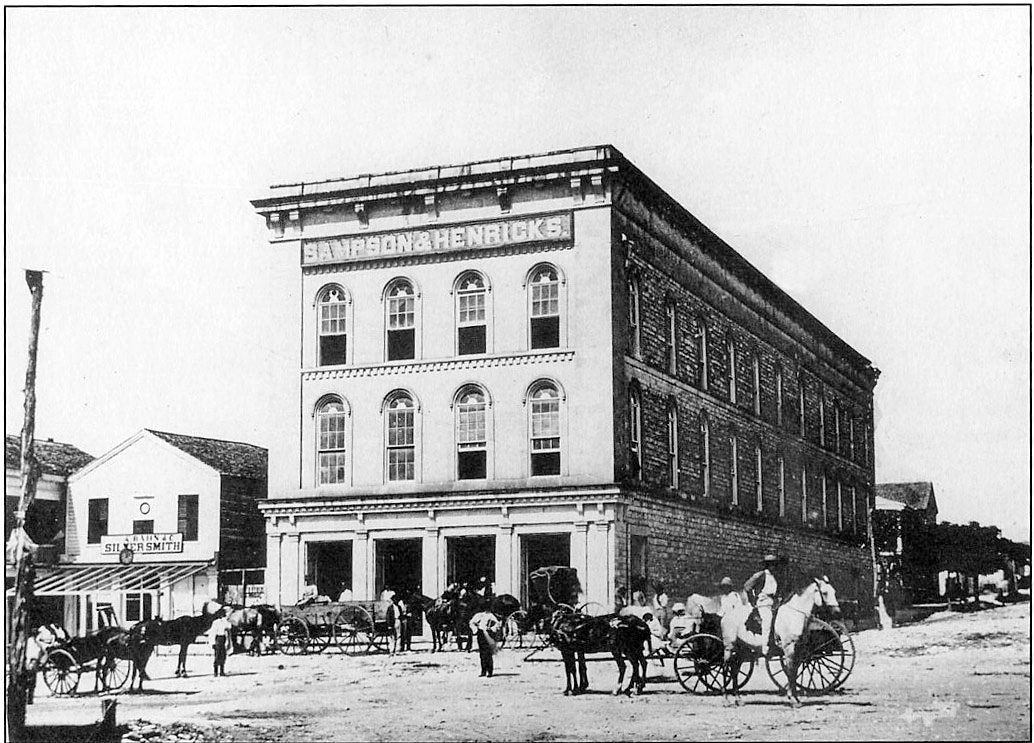
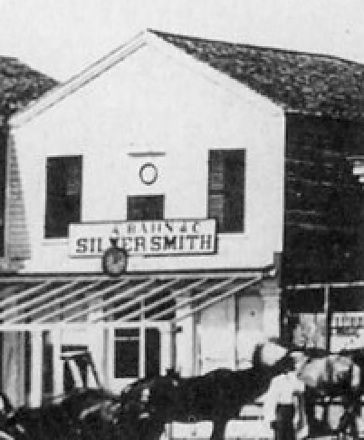 Zoomed version of the Bahn Silversmith building seen in the larger photo above.
Given their financial success, it is apparent that Gus and Katie could have commissioned the Balmer window to honor Katie’s mother, Theresa. Katie would have been doubly proud of the fact that the window was designed and created in St. Louis, her mother’s hometown.
Zoomed version of the Bahn Silversmith building seen in the larger photo above.
Given their financial success, it is apparent that Gus and Katie could have commissioned the Balmer window to honor Katie’s mother, Theresa. Katie would have been doubly proud of the fact that the window was designed and created in St. Louis, her mother’s hometown.
Katie and Gustav were at the cultural center of Austin. The photo below illustrates their involvement with music in the city.
Catherine "Katie" Balmer Bahn died on August 22, 1923 in Austin, Texas. of appendicitis and Brights disease, according to death certificate, she refused an operation. She is buried in Bellefontaine Cemetery in St. Louis, MO.
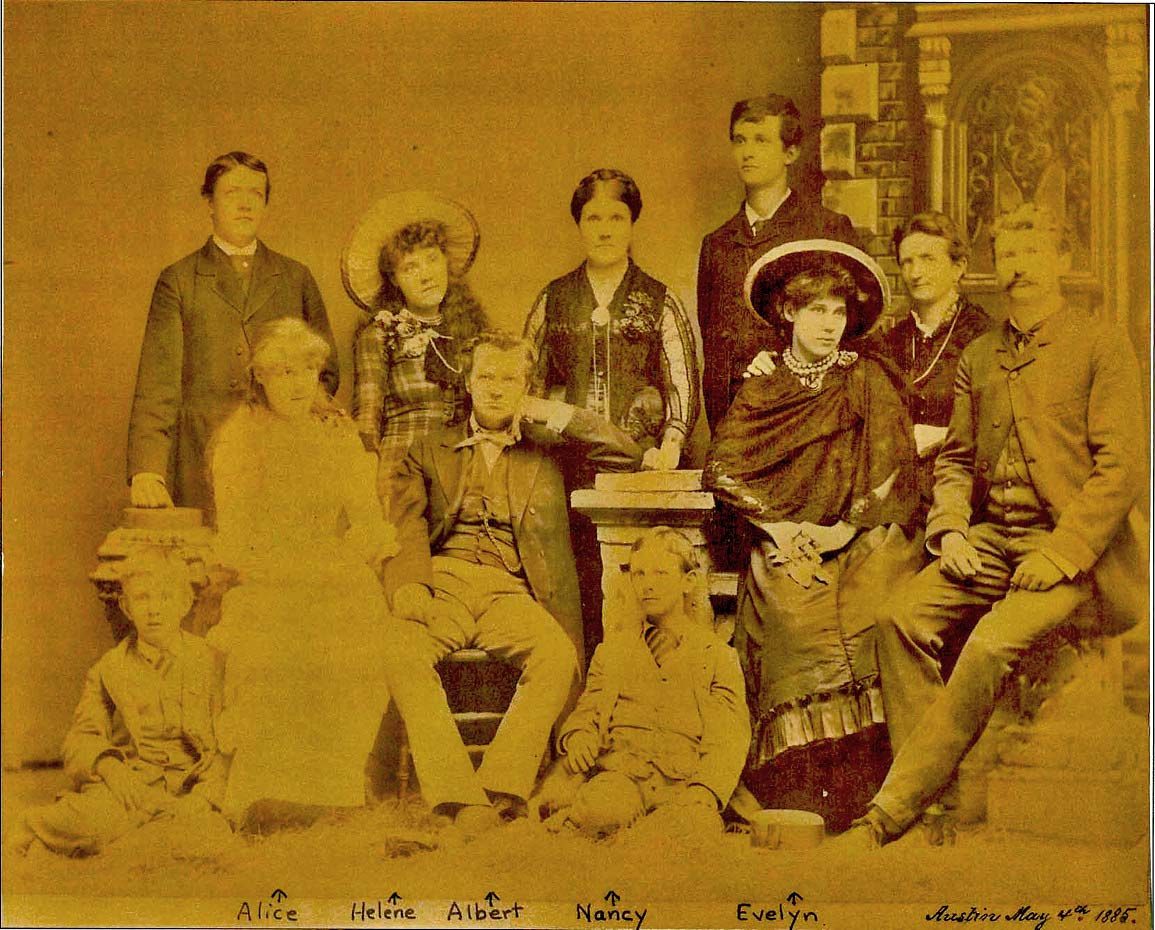
Pieczonka and Bahn Family, Austin May 4th 1885
L to R: Alice (1859–1908) violinist (in white), Helene(1864–1896) cellist (in plaid), Albert Emil Theodor Pieczonka(182–-1912) pianist-studied with Franz Lizt and Anton Rubenstein, Nancy Wohlgeboren Pieczonka (1836–1916) wife & pianist, Evelyn (1867–1908) violinist (in hat), Katie Bahn (second from right), Gustav Bahn (extreme right). Picture likely taken in Scholz Garten. They were in Austin for a concert and were likely hosted by the Bahns. None of the boys identified.©The Pieczonka family. Used with permission
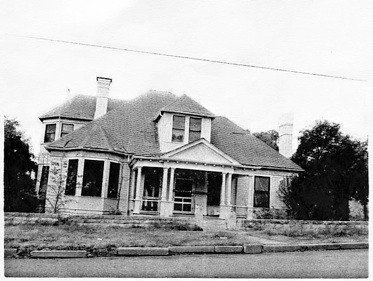 Gus continued his father’s profession until sometime after 1909, when he become a real estate broker. The company continued, but he was not one of the officers. He and Katie were quite successful financially, evidence by their two live-in servants in 1900 and their new posh address, 908 West Avenue, within walking distance from the first church. The house is show at right. Sadly, it no longer exists.
Gus donated the silver trophy given at the University of Texas Annual Invitational Tennis Tournament. He also provided a silver watch fob for the winning debaters at University of Texas.
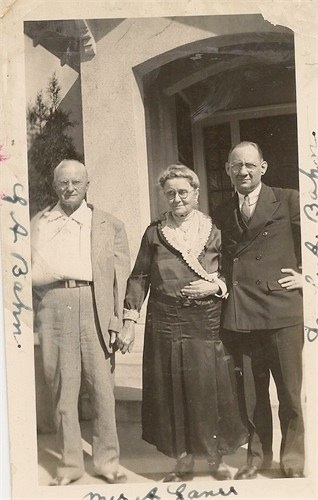
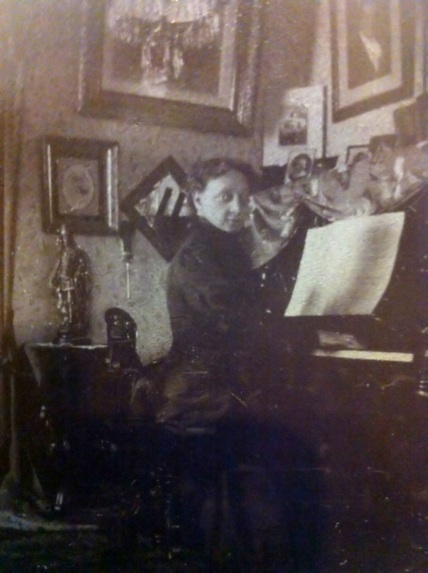
Gus is shown below, at left, with his sister, Pauline “Lena” (Mrs. A. Ganss); he is on the right. Man on left has inscription , “F. A. Bahn” or S. A. Bahn. (Picture provided by Joseph David Crawford family) At right below, we see Katie at the piano, following in the tradition of the Balmers and Webers.
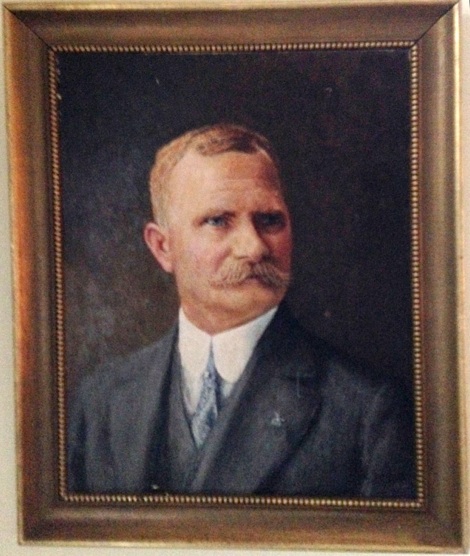
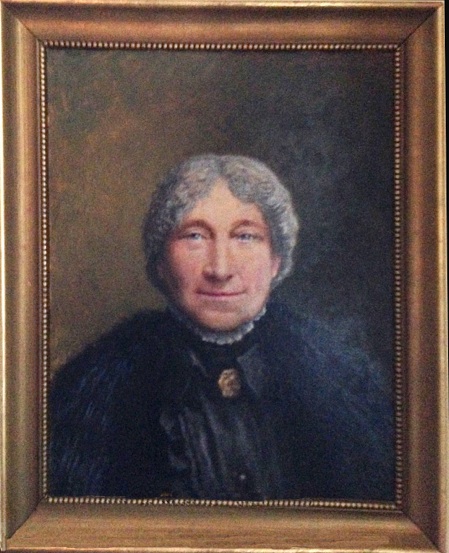
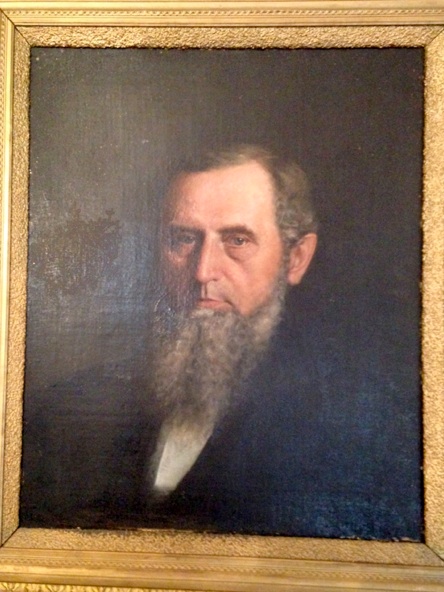
Below are painting of Gus and Katie Bahn, along with a painting of Gus’ father, Ferdinand S. Adolph Bahn. These were generously provided by Charles Bahn, great-grandson of Gus and Katie.
From Austin American April 27, 1938.
Bahn Was Last Of Survivors In Actress' Party
With Other Austinites Helped Bring Famed Dramatist to City
Death Thursday of G. A. Bahn in New Orleans marked the passing of the last survivor of a small group of Austin people who, in the spring of 1906, furnished a dramatic chapter to the history of the Capital City on the occasion of the visit of the great french actress, Sarah Bernhardt.
Mr. Bahn, then a Congress Avenue jeweler and watchmaker, was a member of the committee of citizens who persuaded the late George Walker, then manager of the Hancock theater, to allow Bernhardt to give her performance of "Camille" on that stage, rather than under a tent on the lot where the old temporary capitol had stood and where the performance was originally schedule.
Cloudburst Hit Town
A Texas cloudburst had converted the lot into a pond and the tent into a mass of soggy canvas.
Mr. Bahn and his companions, on the afternoon of the Bernhardt performance, visited Mr. Walker, and after a conference of several hours, convinced him that the Hancock should house the "greatest living actress of her time."
Mr. Bahn, who, having spent many years studying in Europe (Switzerland), was a linguist, entertained the actress during her stay here, conversing in her native French. (Mr. Bahn, one of the few citizens who could speak French, who took the comparable actress on a tour of the city and to win over the members of the legislature. Tickets for the permanence were sold at the jewelry store on Congress Avenue then owned by Mr. Bahn.)
Among the souvenirs of that memorable visit that Mr. Bahn valued, was photograph of Bernhardt and Lou Tellegen, her leading man, autographed to him by Bernhardt herself.
The death of Mr. Bahn Thursday in the home of his only son, Dr. Charles A. Bahn (noted eye specialist) in New Orleans, came after ill health of the past three months. The veteran Austin merchant and realtor went to New Orleans April 5, to spend his 78th birthday with his son. Death came only 12 days after that birthday.
Mr. Bahn's father came to Texas in the 1850s from his home in Breslau, Germany. On the same boat with the elder Bahn, was the late August Naschke.
A boy was born to each of these two immigrants—G. A. Bahn and Charles Naschke—in Austin, and these two boys remained fast friends through boyhood and adulthood, both sharing in their later years at the same hobby, horticulture.
(Past Exalted Ruler of the Elks, Mr. Bahn was interested in fraternal orders. He had been a 32nd degree Mason for many years and was a member of The Shriners.)
Sold Business
G. A. Bahn stayed in Europe six to eight years completing his education, returning to Austin a skilled jeweler and watchmaker as well as an accomplished linguist.
About 20 years ago (about 1910) Mr. Bahn sold his business to Stelfox Company in order to go into the real estate business. The business had been established by the elder Bahn about 1876.
Survivors are his son and two sisters, Mrs. A. Ganss of Austin and Mrs. Ehardt of Bastrop. His wife, Katie Balmer Bahn, died in 1922.
Acknowledgements
Many thanks to Balmer relatives, Gerald Stutts, Marilyn Kay, Mary Ann Bouas for information and pictures used in this article. Marilyn and Mary Ann are the great-great-granddaughters of Charles and Theresa Balmer. Also, help from Dave Ross, Pat Oakes and Susan Kelley Clarke is appreciated. I am grateful for the kindness of Cynthia Millar, subject specialist at the Saint Louis Public Library. Her willingness to collect material and mail it to me, exceeded anything I might have expected. Also thanks to Charles Bahn and Deborah Bahn Haglund, great-grandchildren of Gustav and Katie, for their generously providing Bahn paintings, pictures and help with family information.
Additional information on Charles and Theresa Weber Balmer and their son Charles.
From St. Louis Post-Dispatch, May 26, 1895
MRS. BALMER AT SEVENTY-FIVE
One of the Remarkable Women of This Century
Last Friday evening, the beautiful suburban home of Mr. an Mrs. C. E. Illsley, North Taylor and Ashland Avenues was brilliant with light, and gaily decked with flowers in honor of one whose life has been closely identified with the musical development of St. Louis. The occasion was the seventy-fifth birthday of Mrs. Theresa Balmer, widow of the late Charles Balmer, whose music house was known to almost every St. Louisan for many years past.
The rooms and the lawn were thronged with friends of the little old lady, who, in spite of her years, was one of the brightest and spriteliest among a host of congratulates, the central figure around who clusters a wealth of interesting reminiscences.
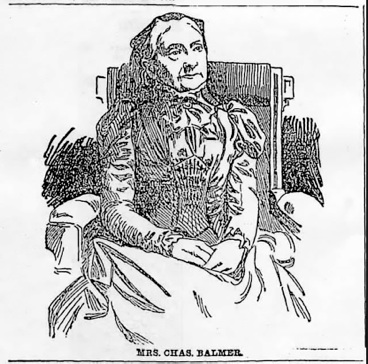 Theresa Weber, the object of this sketch was born at Ehrenbreitstein not far from beautiful "Bingen on the Rhine" on May 24, 1820. Her father, Heinrich Weber, was Privy Councilor at the Court of Frederick William, King of Prussia. He was a most scholarly gentleman, who spoke, with fluency, nine different languages, and was a thorough musician. In this atmosphere of culture and refinement, Theresa and her sisters and brothers grew up. By birth and family ties, she is related to some of the celebrated musicians of the age. Bernhard Anselm Weber, the composer of "Der Gang Zum Eisenhammer," a musical setting of Schiller's famous poem, was her uncle, and the great Mendelsohn, a favorite cousin.
As a child of four, Theresa took up the study of music, and it has accompanied her through seventy-one years, a solace in times of sorrow, a joy, when all was glad. When 14 years of age, her father removed to America with his family and ultimately settled on a farm in Bonhomme Township, thirty-four miles from St. Louis. He brought with him credentials to prominent Washingtonians and St. Louisans, and Mrs Balmer recalls with pride their arrival and reception in St. Louis, their sojourn at the old Missouri Hotel, and the brilliant entertainments given in the honor by Mayor Johnson, Mrs. Chouteau, the Countess Shomberg, a lovely singer, Mr. and Mrs. Christi and Miss Phillipson, a highly-accomplished pianist.
When the family had settle in their new domicile, a log house such as was common among the early settlers of Missouri, the father resumed the education of his daughters and devoted himself especially to Theresa's magnificent musical talent.
The walls of that primitive abode were lined with bookcases filled with priceless literary treasures, and the first grand piano that ever crossed the Mississippi River was set up in its one large room. In 1838, Miss Weber met her future husband, the then-promising young organist of Christ Church. Their courtship began almost with their first meeting at rehearsals for concerts given to provide money for the organ of that church.
The fashionable ladies who had met the Weber family upon their arrival in St. Louis bethought themselves of the the little German fraulein and her brilliant musical attainments. Her father was besieged to allow his daughter to come to St. Louis to sing the principal solo parts in the concerts arranged by young Mr. Balmer, and, afterwards, she was engaged to sing in the choir of the church. Her parents, not wishing to be separated from their young daughter, moved to St. Louis and rented the old Mullanphy homestead on Third Street, between Market and Walnut Streets, for their residence. On May 1,1840, the church was dedicated, and the evening closed with the betrothal festivity of the young choirmaster, Charles Balmer, and the charming singer, Theresa Weber.
Two month later they were married at the Weber residence of Squire Kretsenmar, father of the artist.
The young couple went to housekeeping on Fourth Street, then a fashionable resident portion. Their hospitable house was headquarters for all the musical people of this country and Europe when they is visited St. Louis.
Leopold De Meyer, Sigismond Thalberg, Henri Vieuxtemps, the great French violinist and composer; Mme. Anna Bishop, the celebrated harpist; Jenny Lind, Maurice Strakosch, Alfred Jaeli and Camilia Urso, Adelina Patti and Ole Bull, all held rehearsals at this house and were accompanied in their concerts by Mr. Balmer.
Hundreds of deserving aspirants for musical honors have received their first encouragement and substantial help from this charming couple, who lived for each other, their children and friends, and the advancement of music in their adopted country.
All the music published by the husband passed through the hands of his accomplished wife, who translated the texts of German, French, Italian and Spanish songs into exquisite English.
Even to this day, the mind of this remarkable woman is still active and bright, and the most rhythmical adaptions of foreign texts to songs published in this country are from her versatile pen.
Her home is a treasure trove of reminders of the past, photographs of many years ago of musical celebrities, busts and paintings of the great masters, and shelves filled with their works.
Only a few days ago, she exclaimed with enthusiasm that she was glad that God had permitted her to live throughout the Wagnerian opera festival. She attended every opera during that week and is never to tired to entertain her friends with her impressions of the music of the future.
Mr. Balmer died a few years ago, but she has borne even this, the greatest blow of her live, with that submission and equanimity which are the attributes of a thoroughly refined soul.
Cheerful and light-hearted as a girl, she casts a spell of fascination over friends and strangers alike, for such as she make one feel that old age can be made beautiful in the eyes of others, when accompanied by the qualities of Theresa Balmer.
Charles Balmer,
Encyclopedia of History of St. Louis, (1899) Vol 1, p 72
Balmer, Charles, professor of music, composer and artist, was born in Muehlhausen, Province of Thueringen. Germany, September 21, 1817, and died in St. Louis, December 15, 1892. He was the eldest son of Gottfried and Eva (Heyse) Balmer, and his father was a gentleman of means and culture, whose homestead was in the suburbs of Muehlhausen. When the son was six years of age, he showed such remarkable talents for music that his father concluded to begin his systematic education by sending him to the conservatory at Göttingen. The director of the conservatory at first refused to take so young a pupil, but after witnessing his accomplishments consented to take him into his own family and give him the benefit of special instruction.
Under this tutorage he learned to play on the piano, organ, clarionette and violin—the last named being his favorite instrument—making such rapid progress that, at nine years of age, he received a prize medal from Louis Spohr for playing one of that great maestro's compositions in concert. At ten years of age, he began playing first violin in the orchestra at the conservatory, and two years later, an episode occurred in this connection which he remembered to the end of his life. He was playing in the orchestra, when Kullack, the noted composer and pianist, came to Göttingen to give a concert. The orchestra was engaged to accompany him in the production of one of his own compositions, and the preliminary rehearsal passed off satisfactorily. At the public performance, however, the pianist had the misfortune to lose his place, and a clash between the piano and the orchestra was imminent, when the young Balmer, who was at the head of the violins, but who was a good pianist, as well, shot a quick glance at the piano music, and, pointing with his bow, to the place, prevented the threatened fiasco, no one but the leader of the orchestra noticing the act. While he had saved the pianist from humiliation, he had committed a breach of discipline for which he was called to account and punished by the leader after the performance; but the punishment was deprived of its sting by Kullack, who embraced the little fellow and presented him with a fine gold piece as a token of his appreciation of the service rendered him. Years of close study and hard work followed this event, and when he was sixteen years old, he was made assistant conductor of the orchestra.
In 1836, his father emigrated to the United States with his family, and upon their arrival in this country they came, at once, to St. Louis. Here they purchased a large lot on the old Bellefontaine Road and established a beautiful homestead, which continued to be the family residence until the death of Mrs. Balmer in 1875—her husband having passed awav in 1846. When they moved into their new home, it was isolated in its situation on the prairie; now the grounds then connected with it are a part of the city, and the gardens, rustic bridges, artificial lakes and other attractions of the place have been blotted out of existence by the growth of the metropolis.
Charles Balmer did not come at once to St. Louis, but stopped first for a time with friends at New Orleans, who wished him to utilize his musical knowledge in that city. Later, he visited Mobile, Ala., and Augusta Ga., and spent two years in those cities. In 1838, he was called to New Orleans to assist Madame Caradori-Allen, a celebrated vocalist, as violin and piano artist, and traveled with her through the States, visiting all of the principal cities of the country. On this concert tour, he came to St. Louis, and here visited his family for the first time since he had parted with them immediately after their arrival in this country. He came to St. Louis at a time when various charitable institution and other public buildings were being erected, and, to add to the funds needed to forward some of these enterprises, he was solicited to remain here and arrange a series of benefit concerts. He consented to do this, and thus became identified with the musical history of St. Louis, of which he was thereafter so large a part. He engaged in teaching, gave concerts, organized choruses and quartettes, and soon created an orchestra, to which the first citizens of St. Louis were proud to be admitted as members and patrons.
The romance of his life may be said to have begun in this connection. In order to produce great works like Haydn's "Creation," Newton's "Saul and David, " Handel's "Messiah," and other oratorios, he summoned to his assistance Miss Therese Weber to sing the soprano parts at these concerts. Miss Weber was also an accomplished pianist, and there was a little rivalry between them from time to time. Mr. Balmer playing the accompaniments to Miss Weber's vocal solos, and she the accompaniments to his violin solos. Each of them had their ardent admirers and champions, and it was finally proposed that their respective merits should be put to the test on a piano duet on two pianos. This is said to have been the first piano duo ever played in St. Louis, and to have been played on the only two grand piano then in existence in the city.
The concerts given under Professor Balmer's direction contributed to the advancement of various church, charitable and other enterprises, and Christ Church, the second Presbyterian Church, the Orphan Asylum and the Mercantile Library were each his debtors in that connection. In 1840,—May 1st—Christ Church was dedicated, and a fine musical program was rendered on that occasion. Miss Weber sang two of the solos on the program, and sang for the last time, that night, as Miss Weber. It was after the concert that Professor Balmer proposed to her, and, in July following, they were married.
In 1846, he purchased the business of Sheppard & Phillipps, and associating with him his brother-in-law, Henry Weber, founded the music emporium which, at the end of more than half a century, is still in existence, and is still conducted by the Balmer & Weber Music Company. Thereafter, as before, he continued to be a conspicuous figure in the conduct of charity concerts, and in all the musical functions of the city. Foreign artists who came to the city called on him for advice and assistance, and many of the most famous were from time to time, his guests. Herr Vieuxtemps enjoyed his hospitality in 1843, and Ole Bull was visitor at his home in 1844. On the occasion of Ole Bull's visit to the city, Professor Balmer played his accompaniments on the piano, and being obliged to transpose one of his compositions, did it so well that the great violinist presented him with a handsome ruby ring, and embraced him affectionately in token of his appreciation of the service. This ring, a cherished memento of the greatest violinist of his day, is now in possession of Professor Balmer’s daughter, Mrs. Therese Balmer Smith.
In 1845, Professor Balmer organized the first male chorus in St. Louis, and in 1846, the Oratorio Society, of which he became conductor. The same year, in company with Leopold de Meier, and later with other notable musical artists, he gave memorable performances in St. Louis. When President Lincoln was buried at Springfield, Ill., in 1865, he was called upon to conduct the music at his funeral, and the baton used on that occasion is still cherished by the family as an interesting relic of a memorable occasion.
For forty-six years, he held the position of organist at Christ Church, and during all that time he was one of the most devoted and helpful friends of the church. His business partner retired from the firm in 1851, but Professor Balmer retained the old firm name in honor of his former partner, his wife and father-in-law. His father-in-law was Henry Weber, formerly counselor at the Court of Frederick William III, King of Prussia, a gentleman of great learning, a noted linguist and a correspondent and friend of such distinguished men as Goethe, Humboldt, Raumer and Longfellow. Mr. Weber, who translated Longfellow’s poems into the German language in the rhythm of the original, was also a fine musician, and composed masses, songs and organ offertories. On his deathbed, he composed his own funeral hymn, prepared it for a male quartette and copied it in a clear, firm hand. It was sung at his funeral, and the words, as printed, were cut on his monument in Bellefontaine Cemetery. He died at St. Charles, at the age of eighty-nine years.
One of the great musical societies organized by Professor Balmer was the Philharmonic Society, which began its existence in 1859, and was composed of the remnants of former societies. He was chosen president of this society, and held that position for many years. After it ceased to exist as a regular organization on account of the dishonest practices of one of its officials, the members were held together in a social way, and during the war period, at the summons of Professor Balmer, gave the opera “Martha” for the benefit of sick and wounded soldiers, which proved a great success financially, and received unstinted praise on account of its artistic merits.
So much a part of the musical life of St. Louis was Professor Balmer, that he greatly endeared himself to people of all classes with whom he was brought into contact. He lived a long and useful life, and on the occasion of the celebration of his golden wedding anniversary, in 1890, messages and letters of congratulation came to him from all parts of the world. His remains now rest in Bellefontaine Cemetery, and his last resting place is marked by a magnificent monument, erected by his wife, and crowned with a bust of the distinguished composer and artist, remarkably life-like in appearance.
In 1958, fire damaged the 120 year old Balmer home, 3143 North Eleventh Street, once surrounded by gardens with small artificial lakes and rustic bridges. It was razed for the Mark Twain Expressway route.
From July 8, 1941, St. Louis Post-Dispatch.
Charles Balmer, Son of Charles and Theresa Balmer, Dies
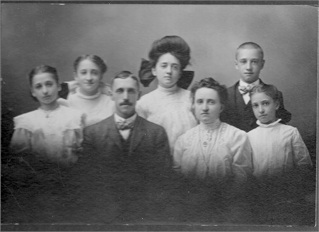 Old-Time composer Charles Balmer, composer of old-time popular songs, including The Coliseum Grand March and Skirt Dance, died yesterday of pneumonia at his home, 1026 South Thirteenth street. He was 75.
Mr. Balmer was a son of Charles C. Balmer, one of the founders of the old Balmer- Weber Music House, and was prominent in musical circles for his popular compositions and for his efforts in bringing outstanding artists and orchestras here for concerts. Celebrities he brought here included Theodore Thomas, Hans von Beulow and Nellie Melba. Many of the greats of the musical world stopped at the home of Balmer's father when they visited St. Louis for concerts at the old St. Louis Opera House.
Born in St. Louis, Mr. Balmer was graduated in 1886 from the Virginia Military Institute, Lexington, Va., with high honors. Later, he served with the Missouri State Militia for 11 years.
Mr. Balmer was married to the former Miss Emily Neiderweiaer of St. Louis, who died two years ago. They celebrated their fiftieth wedding anniversary in 1938. Surviving are four daughters, Mrs. Lilian Hazzelbusch, Mrs. Maybell Eickmann, Mrs. Jessie Murray and Mrs. Emily Drees, all of St. Louis, and two sons, Gene Balmer of St. Louis and Charles Balmer Jr. of Chicago. (Above, we see the Charles Balmer family minus one son—Mel Oakes)
Funeral services will be held Thursday at 2 p. m. from the Witt undertaking establishment, 2929 South Jefferson Avenue, with burial in Bellefontaine Cemetery.
Below is an early picture of Emily Neiderweiser Balmer, wife of Charles Balmer.