Chilean-Japanese Expedition to
Chilean Central Andes 1960
Information provided by Hisao Toyoda,
a member of the expedition and friend of Mel and Pat Oakes
Hisao Toyoda, studied civil engineering at the University of Texas at Austin. He received a master's in 1967 for a thesis entitled, "Static behavior of hybrid plate girders." While in Austin, he was assigned to Mel and Pat Oakes as his host family. They formed a lifelong bond that has enriched their lives
In 1959-60, Hisao was part of a Chilean-Japanese expedition to explore the Chilean Central Andes. Here we provide some record of the journey. Our many thanks to Hisao for photos and information.
First we provide a biography of Hisao which reveals his remarkable engineering career. The story of the expedition will follow.
Hisao Toyoda was born on November 1, 1937, in Asago City, Hyogo Prefecture, Japan, as the eldest son of Toshio Toyoda and the former Fumiko Takimoto, He was admitted to Kobe University, Japan, in April,1956 and enrolled in the Department of Architecture and Building Structures, Faculty of Engineering. In his senior year he visited the cities in California both on his way to Chile and his way back from South America, where he had spent four months as a climbing member of the Chilean-Japanese Joint Expedition to the Central Andes of Chile, 1960. After receiving B. S. in Engineering from Kobe University in March,1961 he joined Ishikawajima-Harima Heavy Industries Company, Ltd., Tokyo, Japan, as a structural engineer and was engaged in design work for steel constructions of industrial plants. He came to Austin in September, 1965 on leave of absence from the above company and commenced his graduate work at The University of Texas as a research assistant in the Department of Civil Engineering.
In Kobe, Japan on September 15, 1968, Hisao Toyoda married Harue, who was from Kumamoto City. After the birth of our three sons, we moved to Yokohama City.
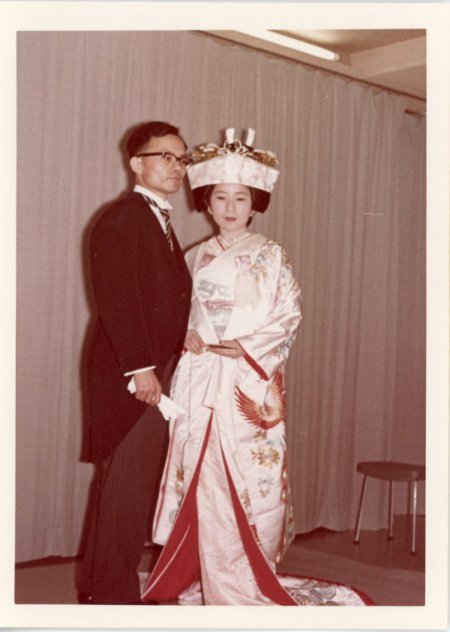
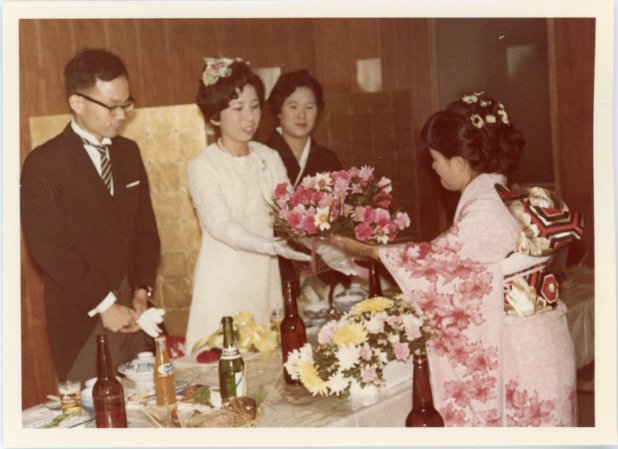
Hisao and Harue's wedding.
Hisao writes about his career:
1967-1974
After returning to Tokyo, I started my career as a structural engineer in the Steel Structure Division of IHI Co., Ltd. The economic prospects were improving, and the steel mill companies were in the process of expanding their steel mill facilities. My main assignment was the seismic analysis of the framework structure of the blast furnace. Major projects accomplished during the this period are as follows:
- Various technical experience in computer analysis and design of steel structures for industrial and marine uses, including experimental studies on hydraulic and hydrodynamic behavior of fixed and floating offshore structures (1967-72)
- Feasibility study and basic design of underwater crude oil tanks in deep seas, including hydrodynamic submergence test and field survey on an existing offshore tank off Louisiana, Gulf of Mexico (1973)
- Design and fabrication supervision of large-sized frameworks, including experimental studies on welded column connections to which the Japanese patents were granted (1973-74)
- Contract coordination for the licensing agreement for a semi-submersible drilling platform with Breit and Garcia, a US consultant (Louisiana, 1974)
Based on my experience in the field of steel structures, I applied and passed the examination for Professional Engineer (Construction Division) at the Ministry of Education, Science and Technology. After clearing the oral part, I received a Certificate of Registration on Aug. 6, 1969.
1975-1985
Marketing and project coordination for offshore projects:
Offshore Division was inaugurated:
- Marketing and project coordination for a jack-up platform with a 500-ton revolver crane for Aramco Overseas Company (1974-75) and the ongoing contract for the operator training on board the barge off the East Coast of the Arabian Gulf (1975-77).
The main contract included the shipment of the barge using a submergible carrier from the shipyard in Japan to Port of Dubai and ongoing mobilization to Saudi Arabia.
- Marketing and contract coordination for an offshore accommodation platform in Abu Dhabi (a full turn-key project) with Zakum Development Company-ZADCO, UAE (1977-78)
- Marketing coordination for ZADCO's platform construction in the Gulf of Abu Dhabi under Campagnie Francaise des Petroles (CFP/TOTAL), including subcontract administration for its marine civil (ETPM and GEM Hersent -France) and foundation design (ABC-France) (1979-80).
- Stayed in the UAE from March to December 1980 as an administration manager.
- Coordination of a technical assistance contract, including ZADCO’s operator training, for the platform operation in Abu Dhabi (1981-82).
- Contract and project coordination of joint design development for Aker Engineering A/S, Norway (1983-84)
Marketing platform structures for the North Sea and subcontract negotiations with prime contractors in Scotland and Norway (1984-85)
1986 --1997
In 1987, I was transferred to IHI's construction subsidiary Ishikawajima Plant Construction Co. (IPC) and was in charge of project control and procurement supervision for heavy machinery plants and bridge construction (1987-Aug. ‘97).
The safety management of construction projects, especially during the period (1993-95) was difficult but full of challenging experiences. I went around the sites frequently. Later, I applied for the examination of “Industrial Safety Consultant” by the Ministry of Health, Welfare and Labor. After clearing the oral part, I received a Certificate of Registration dated July 23, 1996. I subsequently joined the Japan Safety and Health Consulting Association (JASHCON) and was appointed to the member of its OH&S Management System Committee and taught the introductory courses for OH&S Management System to the construction site managers.
1997-2013
In August 1997, I left IHI after 36 years of employment and joined the Management System Assessment Center (MSA), which was a new center (body) established with the strong backup from the Ministry of Construction. At that time in MSA the conformity assessment framework as per ISO 17021 was being built for ISO 9001 (Quality) and ISO 14001 (Environment). In MSA, I was instrumental in building a similar assessment system which was proposed by RvA (Holland), using a quasi international assessment standard OHSAS 18001 issued from British Standard (BS). MSA was approved as the first center (body) certified in Japan. In parallel with the assessment and certification activities at MSA, I worked in the field of the management standards as a member of the OHSAS Standard Committee sponsored by Japan Standard Assoc. (JSA). I shared part of Article 4 “Interpretive Article” in OHSAS 18001 / 18002 –Translation & Interpretation.
For OHSAS 18001 I published “Application Guide Book of Occupational Health and Safety Management System” (Japan Standards Assoc. /2006) and co-authored four books for use by the personnel in the construction Industry. These were practical books which are based on my experiences as instructor or trainer in JASHCON. Later I presented a paper “Revised Risk Assessment Method for Use with OHSAS 18001:2007” in the Asian and Pacific Safety Symposium 2011.
ISO45001-International Standard - 2018
In accordance with the agreement between ILO and ISO, the development of the new international standard, Occupational Health and Safety Management System ISO 45001, was started by the new Committee, ISO/PC283, which was organized in the International Standards Organization headquartered in Switzerland. I participated in the standard committee as a liaison from the OHSAS Group based in British Standards Institution (UK), separately from the Japanese delegation team.
The committee meetings were held in Morocco (April 2014), the Caribbean Sea (Jan. 2015) and Canada (June 2016) with an additional group meeting in Dubai, UAE (June 2014). Additionally the revisit to Dubai, UAE recalled my memory of two offshore projects both in the Gulf, off Abu Dubai and Saudi Arabia in 1971 and 1977.
In case of the liaison member, all the travelling expenses were to be borne by myself, but the outcome of the above participation in these meetings was enormous for my consultant’s practices for OH&S management systems.
The standard itself, ISO 45001:2018 was finalized toward the end of 2017 and the Japanese version was published in October, 2018.
Combining my knowledge accumulated during the above standard development and consulting practices, I submitted a paper on the risk assessment method for ISO 45001 and accepted by National Institute of Safety and Health, Japan and published in the Journal of Occupational Safety and Health Vol. 12 No. 1, 2019.
Family:
Family: His wife, Harue, and their three sons.
He may be contracted c/o 24-12, 3-chrome, Kandaiji, Kanagawa-ku, Yokohama 221-0801, Japan.
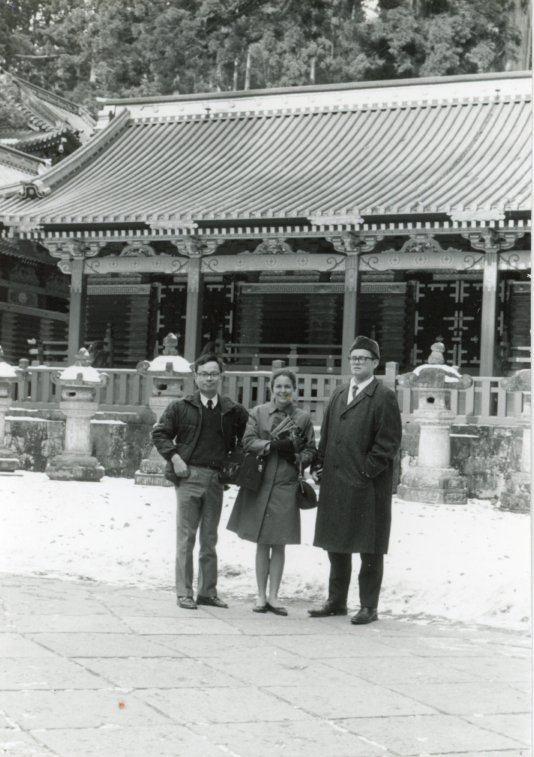
Hisao Toyoda, Nancy and Doug Hatch, February, 1969, at Nikko Toshogu Shrine. Nancy is sister of Pat Oakes.
The Expedition Story:
From "Sangaku", The Journal of The Japanese Alpine Cub, January 1962.
Chilean Central Andes, 1960,
by Hisao Toyoda
I would like to report the outline of the Chilean-Japanese joint Expedition to the Chilean Central Andes, 1960. Federaciøón de Andinismo y Excursionisimo de
Chile and the Alpine Club of Kobe University, Kobe, Japan organized a joint expedition party to the unknown zone of the Chilean Central Andes in order to promote not only mountaineering techniques but friendship between Chile and Japan.
During the expedition, we ate Chilean food and used equipments manufactured in Japan. Before the expedition our great concern was that of the problem of leadership and membership, because many failures of international expeditions had shown us this difficulty. In our case, however, we could completely overcome all kinds of misunderstandings which arose owing to the difference of languages, customs and way of living. We could complete the expedition successfully and not only learned the technique of mountaineering but also could establish goodwill between our countries.
The 1st Expedition : To the Yeso Valley (February 2—Feb. 22, 1960.)
Chilean Group : Kurt Claussen (Leader) and other four members.
Japanese Group : Naoyuki Ota (29 years old, Leader), Hiroshi Tanba (26 years old), Hisao Toyoda (22 years old)
As is well known, the climate in summer is quite mild and dry in this central part of the Chilean Andes. Therefore the glaciers are neither vast nor dangerous to pass through because of the dry climate. The two days caravan of 22 mules led by two muleteers started from Careda Lodara Mine for the Base Camp (3,600
m) at the end of the Glaciar Bello.
The dry climate enabled us to do without the tents and sleep in the open all through the night and we dreamed many beautiful dreams under the Southern
Cross. From Camp II on the Glaciar, we climbed the Cerro Kobe (5100 m, 1st Ascent), Cerro Belle (5200 m, 2nd Ascent) and Cerro Marmolejo (6100 m). Cerro Kobe is a beautiful mountain crowned with ice and snow. We named it in commemoration of Kobe University. Climbing was not so difficult but the route was quite dangerous because of its frail rocks.
We spent wonderful days wandering about virgin peaks day after day.
Our 2nd Expedition: To the Cipreses Valley (Feb. 27—March 14, 1960.) Five Chileans (Leader Alnardo Gonzalez) and three Japanese.
Ours was the second party that explored this zone. The map was not correct and even the muleteers did not know the topography of this part. It was a long
but wonderful caravan through woods of cypress.
In this region there are no high mountains above 5000 m, but the glacial topography was very characteristic of the Chilean-Central Andes. The Cipreses
Glaciar is vast and the mountains are small and their walls are sharp as the result of erosion by ice. Route-finding on the Glaciar was awfully diflicult and fatiguing because of “Nieve Penitente” (ice-needle, characteristic phenomenon of the glaciers in the Chilean Central Andes).
It was a wonderful climbing, basking in plentiful sunshine. We climbed these three virgin peaks:
Cerro Chile-Japón (4450 m)
Cerro Coton (4550 m)
Cerro Alto Coton Norte (4350 m)
Our 3rd Expedition : To the Colorado Valley (March 19—April 4, 1960)
Five Chileans (Leader : German Mills)
Two officers from the Mountain School of Chilean Army.
Three same Japanese
In this northern desert of Chile, the characteristics of the mountains are their frail rock and desolate scenery. The glaciers are rather small affected by the dry climate.
At the Rio Colorado Station of the Chile-Argentine International Railway we had to abandon the automobiles and ride on the back of mules for many days to
pass through dangerous cliffs. From the Base Camp on the Leiva Pass near Mt. Aconcagua, we made many ascents:
Cerro Expedición (1st Ascent, 5126 In)
Cerro Amarillo (1st Ascent, 5136 m)
Cerro Altar (1st Ascent, 4518 m)
Cerro de los Columpios (1st Ascent, 4200 m) /
Nevado Leiva (2nd Ascent, 4669 m)
From Alpine Journal, 1960-61
Chilean Notes
by Evelio Echevarria C.
EXPEDITIONS
ANDES. We have received further information about the joint Chilean—Japanese expedition to the Chilean Central Andes in the early part of last year.‘
Three weeks were spent in the Yeso valley (February 2–22), during which time the Cerro Kobe, 16,733 ft. (first ascent), Cerro Bello, 17,061 ft.
(second ascent), and Cerro Marmolejo, 20,013 ft., were climbed.
The expedition then moved to the Cipreses Valley: there are no peaks above 5,000 m. in this region. Route-finding on the vast Cipreses glacier was rendered dfficult and fatiguing by nieves penitentes. Three first ascents were made: Cerro Chile-Japón, 14,928 ft., Cerro Cotón, 14,272 ft., and Cerro Alto Cotón Norte, 13,944 ft.
Farther south of Santiago, three fifteen thousanders at the head of the Cipreses Valley, east of Rancagua town, were ascended for the first time by university students from Santiago, in February 1959. The same area was visited the following season, in February/March 1960, by a group of native and Japanese mountaineers, the latter from the Alpine Club of Kobe University. In the Cipreses Valley this strong group, ten climbers in all, ascended three fourteen-thousanders; later, in the valleys east of Santiago and Los Andes they climbed ten other peaks, most of them for the first time, thus greatly reducing the scope for pioneer mountaineering in Central Chile. It is believed that at present only four peaks over 17,000 ft. remain unclimbed, one of them being Chimbote, 17,815 ft. a rock peak that has repulsed every attempt 100 ft. below its last rock tower; the number of lesser unclimbed mountains may be much larger.
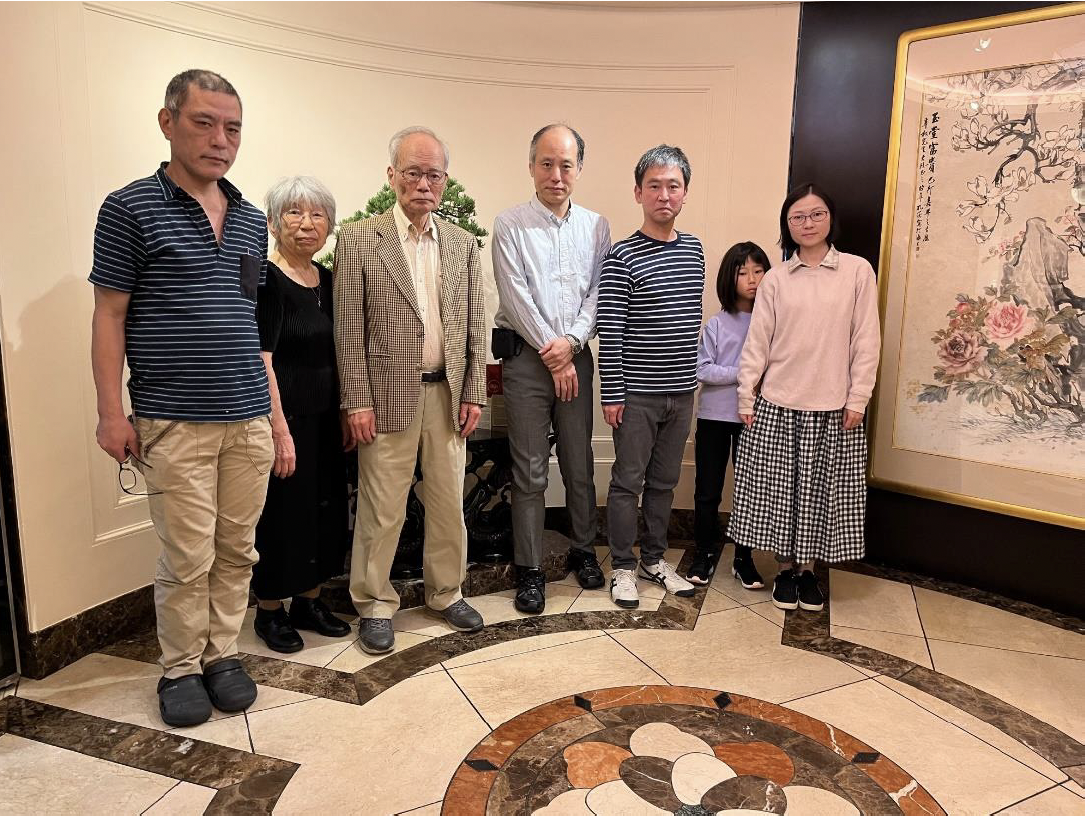
Takaaki, Harue, Hisao, Kenji & Shinichi’s Family , November 2, 2025 on the occasion of his 88th birthday (called Beijyu birthday).
On his 88th birthday, Hisao wrote a summary of the expedition which is included here:
[A] Expedition to the Andes of Chile in South America, 1960
The Alpine Club of Kobe University conducted a joint climbing expedition with Chile in southern Patagonia in 1958, successfully reaching the summit of Mount Arenales. To pass on the success of this experience to the younger generations of both countries, a joint expedition to the Central Andes of Chile was planned for 1960, involving younger members. I participated as a student member along with two alumni.
In Chile, three teams were formed mainly consisting of young members from the Mountaineering Federation. Each team collaborated with Japanese climbers to undertake joint climbs in the Yeso Valley, the Cipreses Glacial Area, and the Colorado River Basin (February 2 - March 29). In the mountains, local muleteers, knowledgeable about the geography of their respective areas, were hired to transport food and fuel prepared by the Chilean side, while the Japanese side provided the latest climbing equipment.
The joint climbs in the three mountain areas achieved the successful first ascents of eight peaks in the 4000-5000m range. Among these, an unnamed peak in the deepest part of the Yeso Valley (5067m) was successfully reached by a party consisting of two members from Japan and Chile on February 13, 1960, and was named Cerro Kobe (Kobe Peak). This peak is subsequently listed on maps published by the Chilean Army Geographical Institute (IGM) (Metropolitan area E-61/E-69).
At that time, Japan's foreign currency situation was strict, and the allocation of foreign currency quotas for the sports field, which did not directly contribute to industrial activities, was limited. The Ministry of Finance allowed only US$50 per person for overseas travel, which took about seven months. In response, the mountaineering club provided Japanese-made climbing gear to the Chilean side to cover food expenses during the climbing period.
The round trip to Chile for the expedition sought cooperation from a Japanese shipping company that operated regular routes along the west coast of South America, allowing us to embark on a cargo ship by paying food expenses (1,000 yen per person per day). We departed from Kobe Port on November 27, 1959, loaded cargo at four ports including Yokohama, and sailed from Muroran across the North Pacific to San Francisco. After stopping at 13 ports along the west coast of South America via Los Angeles, we arrived at Valparaíso, Chile, on June 30, 1960. We returned to Japan, leaving Chile on April 9, 1960, retracing the same route and arriving at Yokohama on June 30, where we disembarked.
Hisao also provided a short summary of his studies in US.
[B] Studying Abroad in U.S. Graduate School and Journey Back Home – 1965-67
- Application and Admission to U.S. Graduate School
About 3-4 years after starting my job, I felt a lack of fundamental knowledge as a structural design engineer and wanted to supplement it in graduate school. I narrowed my search to U.S. graduate programs that offered stipends, starting my investigation around January 1965. Fortunately, the Department of Civil Engineering at the University of Texas at Austin, which had a large-scale structural project, responded positively to my application.
I was accepted as a Research Assistant in the Steel Structures Laboratory and received preliminary approval for leave from my Japanese employer. By May, I was progressing with my admission application when I received a letter from the university’s International Office. The stipend of $200 per month from the university would be subject to federal income tax deductions of $30/month. Moreover, international students were required to pay a tuition fee of $200 per semester. I was informed that I was $450 short of the required amount of $2,500, which the International Office had established. Fortunately, my urgent application for an additional foreign currency quota of $450 was accepted by the Ministry of Finance.
I traveled by ship and bus. I paid the travel agency a total of $470 in Japanese yen for the ship fare of $370 and about $100 for the bus fare (which was half of the air fare at that time). On August 11, 1965, I set sail from Yokohama Port on a U.S. passenger ship via Hawaii, arriving in San Francisco on August 23. The next day, I began my journey across the continent by bus, switching buses in Denver and reaching Austin by August 28.
- Life in Graduate School – Lectures and Research
By mid-September, the fall semester of 1965 began, starting with my registration as a graduate student in the Department of Civil Engineering. From this semester, the Resident Rate was applied to my tuition as a funded student, allowing me to pay the same rate as local students. My tuition for the fall semester of 1965 was $39 (the total tuition I paid over my four semesters was $155).
Thus, the fall semester commenced, with morning lectures on campus and afternoon moving to the Balcones Research Center (now Pickle Campus) in the afternoons via shuttle bus to conduct experiments. In the evenings, after taking a shower in the dorm located on the outskirts of the campus, I often returned to the lab for meals at the student cafeteria and to prepare for the next day.
During the spring semester in February 1966, I took as many classes as possible and secured the necessary credits. Then, in June's summer semester, I focused on finalizing experiments and organizing results, completing preparations for my master's thesis. Based on this, I requested a six-month extension for my study period from my employer in Tokyo. During the fall semester starting in September 1966, I prioritized writing the thesis over attending classes and submitted my thesis draft for printing by mid-December.
Thanks to the kindness of the Oakes professor and his family, I was invited to their home in Vicksburg, Mississippi, for Christmas, where I spent a delightful holiday. The drive along the interstate was also a joyful memory.
- Returning Home - From the U.S. to Japan via Europe and the Soviet Union
- Application for transit from Europe through the Soviet Union During that period, a new route was established to return to Japan from Europe. I first submitted a request to change the transit countries in my passport to the Japanese consulate in Houston. Initially, the answer was 'No,' but after explaining the situation, they reconsidered and finally gave me the green light. Next, I determined the transit route and itinerary from Austin to Japan as follows: Austin-Washington D.C.-New York-London-Paris-Brussels-Düsseldorf-Frankfurt-Zurich-Rome-Vienna-Moscow-Irkutsk-Khabarovsk-train:Nakhodka-ship:Yokohama.
For this itinerary, I paid the local travel agency: $848.93 for airfare, hotel fees for six nights in the Soviet Union, and $335.3 for first-class ship fare to Yokohama, totaling $1184.23. Converted at the rate of 360 yen/$ at that time, it amounted to over 400,000 yen, but considering that my tuition was charged at the in-state student rate and I would receive a tax refund of $371.7 on the stipend from the university, it was manageable.
- From the U.S. to Europe
After waiting for the end of the autumn semester, I left Austin on January 27, 1967, visited Washington and New York, and flew to Europe on the 30th. In London, I met Professor Chapman at Imperial College, handed over my letter of introduction from my advisor, and had a discussion with him. After that, I flew from Paris to Brussels and by train to the city of Liège, where I visited a local university where an acquaintance of my advisor taught.
I then crossed the border by land from Germany, moving from Cologne to Düsseldorf and Frankfurt, and finally entered Switzerland, heading to Zurich. There, an acquaintance (consultant) of my advisor had arranged a hotel for me. He was interested in the experiments I conducted at the U.S. graduate school, and we had a meaningful discussion about the characteristics of the target steel structures. With that, my assignments from my advisor were completed, and after visiting Rome and Vienna, I flew to Moscow via Warsaw in Poland on February 13, 1967.
―Journey from the Soviet Union to the Sea of Japan
At that time, the Soviet Union was completely hidden behind a curtain of its society and language; it was a completely different world. I didn't know anyone personally who had experience entering the country at that time. I stayed in a neat hotel lining Red Square, toured the city of Moscow, and walked through the interior walls of the Kremlin; at every turn, there were staff from state-run travel agencies who spoke English, providing assistance efficiently, so I didn't feel any inconvenience. For example, when I requested tickets for "Swan Lake," they found them for me for 3.5 rubles (about 1400 yen at the time), and I was able to watch the performance from seats close to the stage at the Bolshoi Theatre. After wandering around the city for a while, I realized that I was traveling with the most valuable foreign currency (dollars/yens) in the Soviet Union at that time.After staying in Moscow for four days, I took a night flight on February 16 to eastern Siberia. I arrived at Irkutsk Airport the next morning at 8:30, toured the frozen Lake Baikal with a guide from the state-run travel agency, and in the afternoon, I flew to Khabarovsk, which was the endpoint of my long air journey from the U.S. The next day, I spent the whole day exploring the city and took a night train south along Sino–Soviet border and boarded the Baikal which was waiting at Nakhodka harbor (February 19, 12:00).
As a first-class passenger, I continued my comfortable journey through the Tsugaru Strait for two nights and three days, landing at Yokohama on February 21, 1967, at 16:00. I had set sail from the same port to the east (Hawaii) on August 11, 1965, traveled around the globe, and returned from the west after 20 months.
Chilean-Japanese Expedition GalleryAcknowledgment: "Pictures posted from the expedition appeared in home page of |
|
|---|---|
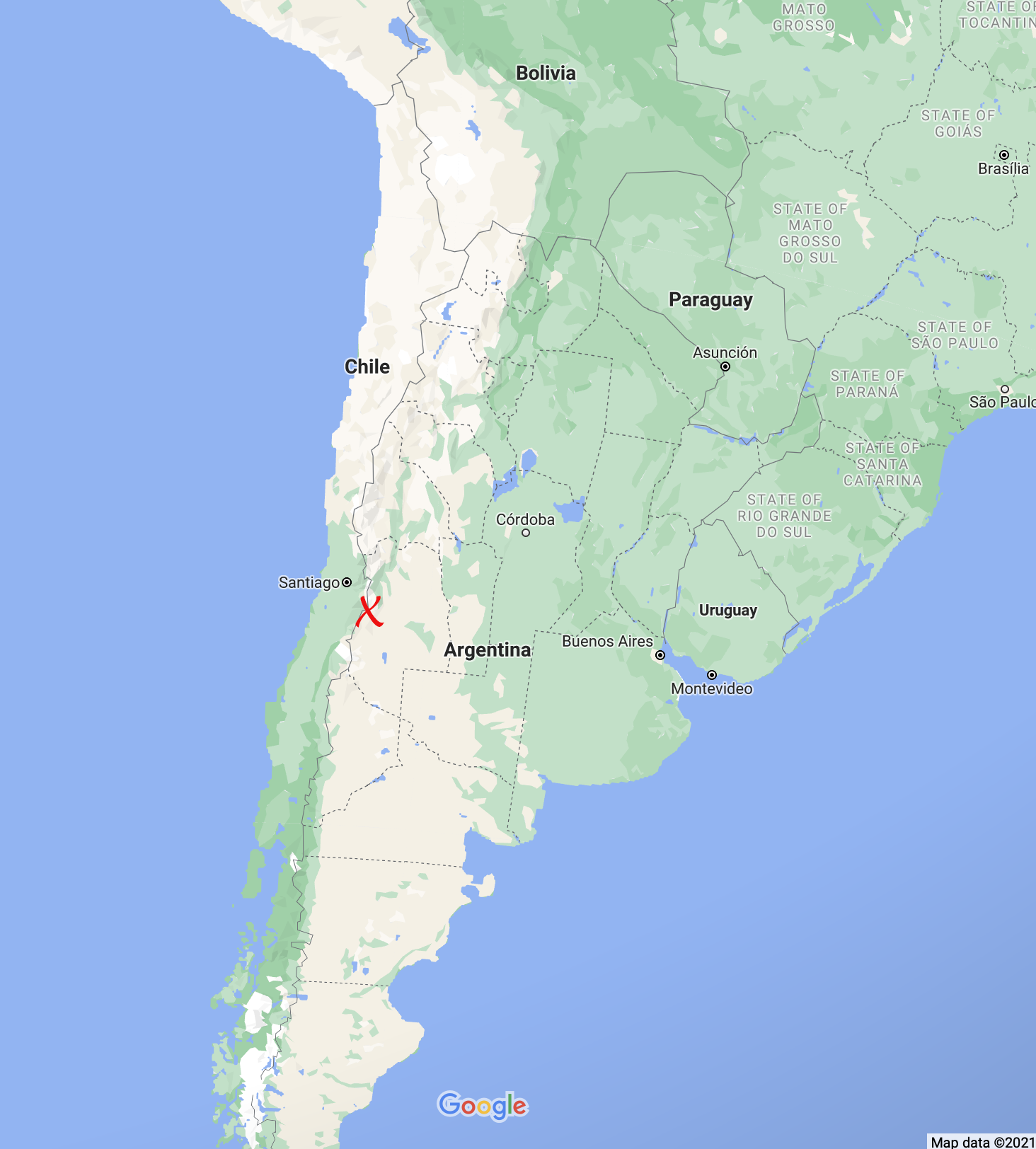
Red X marks approximate location of expedition. |
|
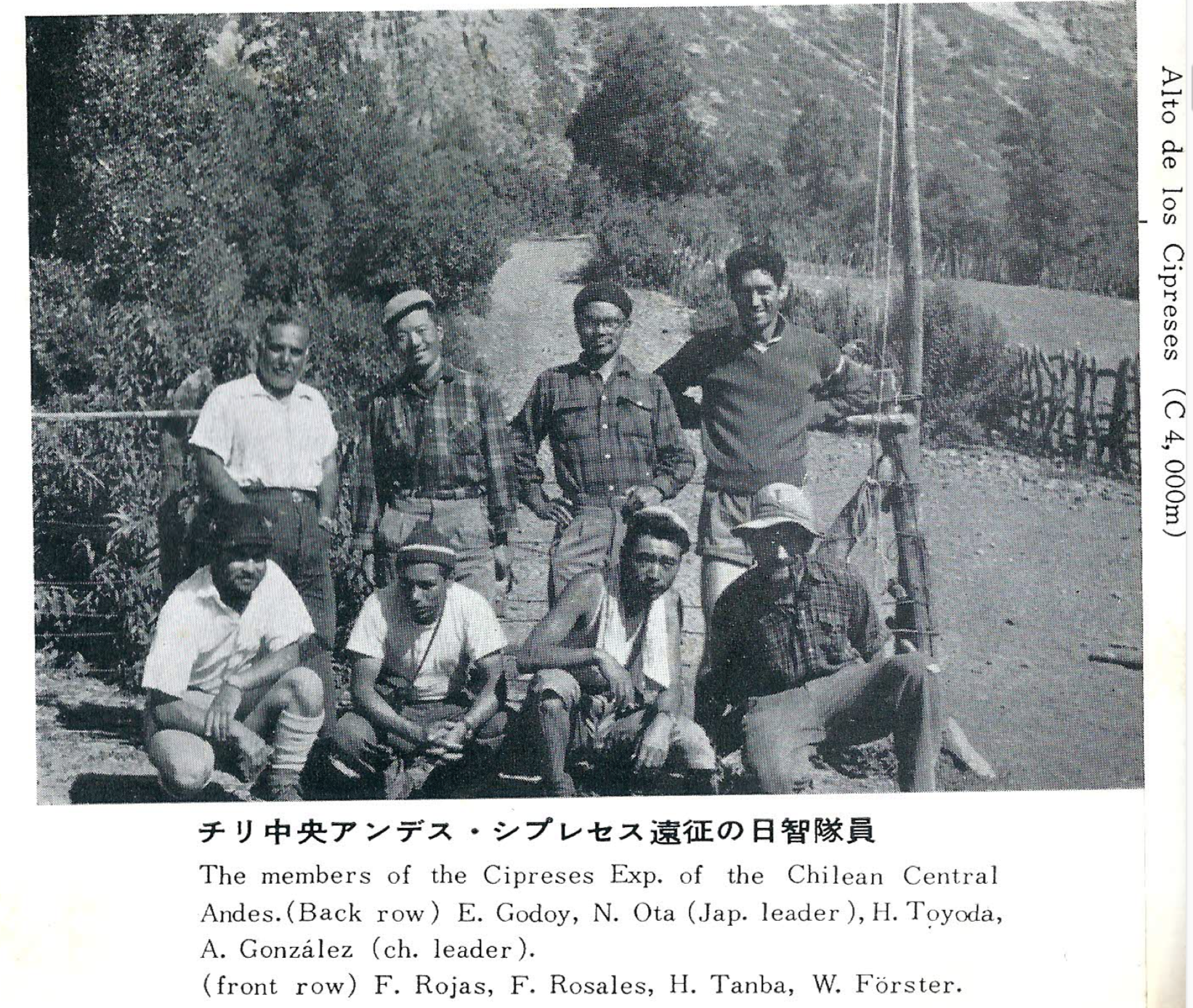
Expedition Members |
|
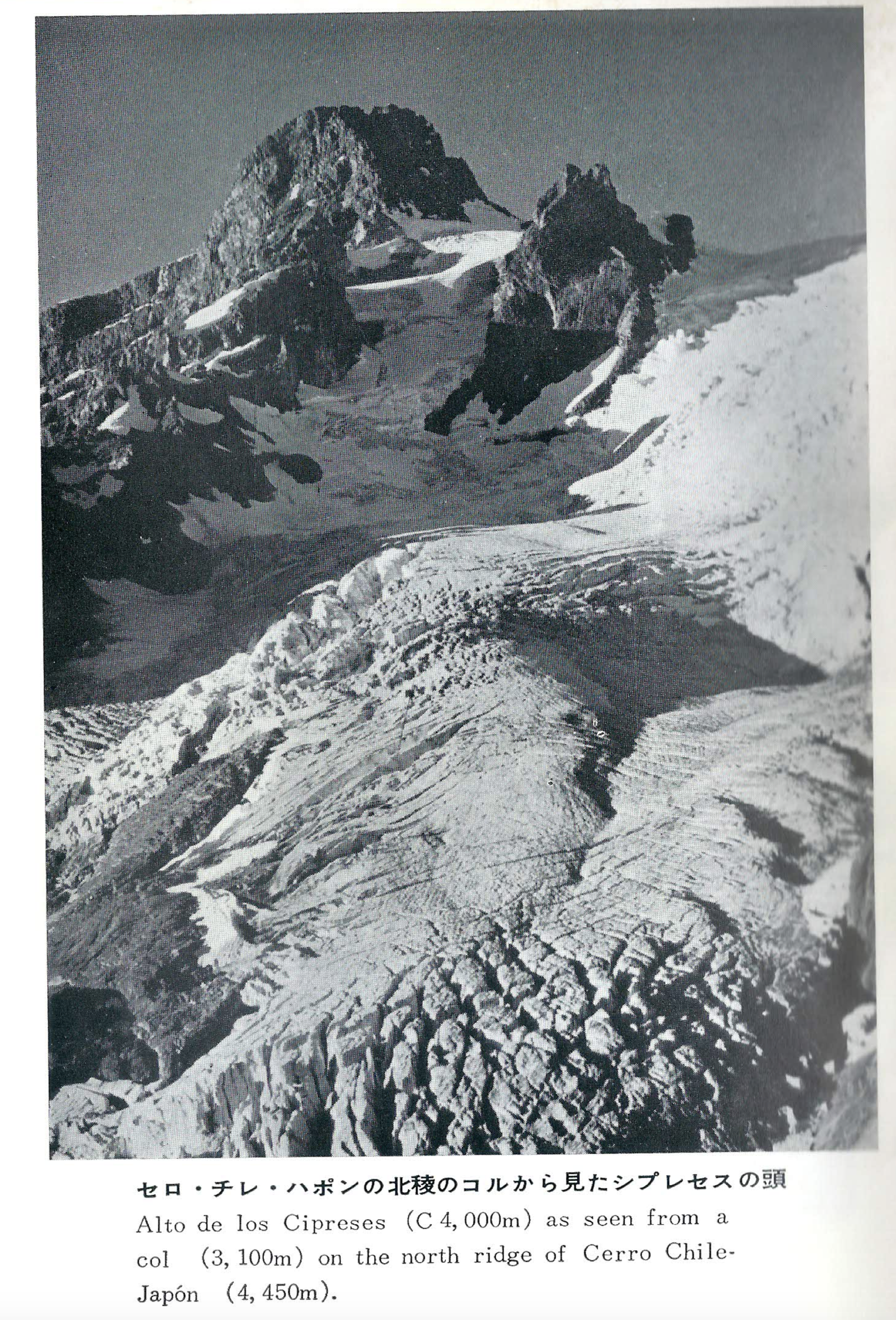
Alto de los Cipreses |
|
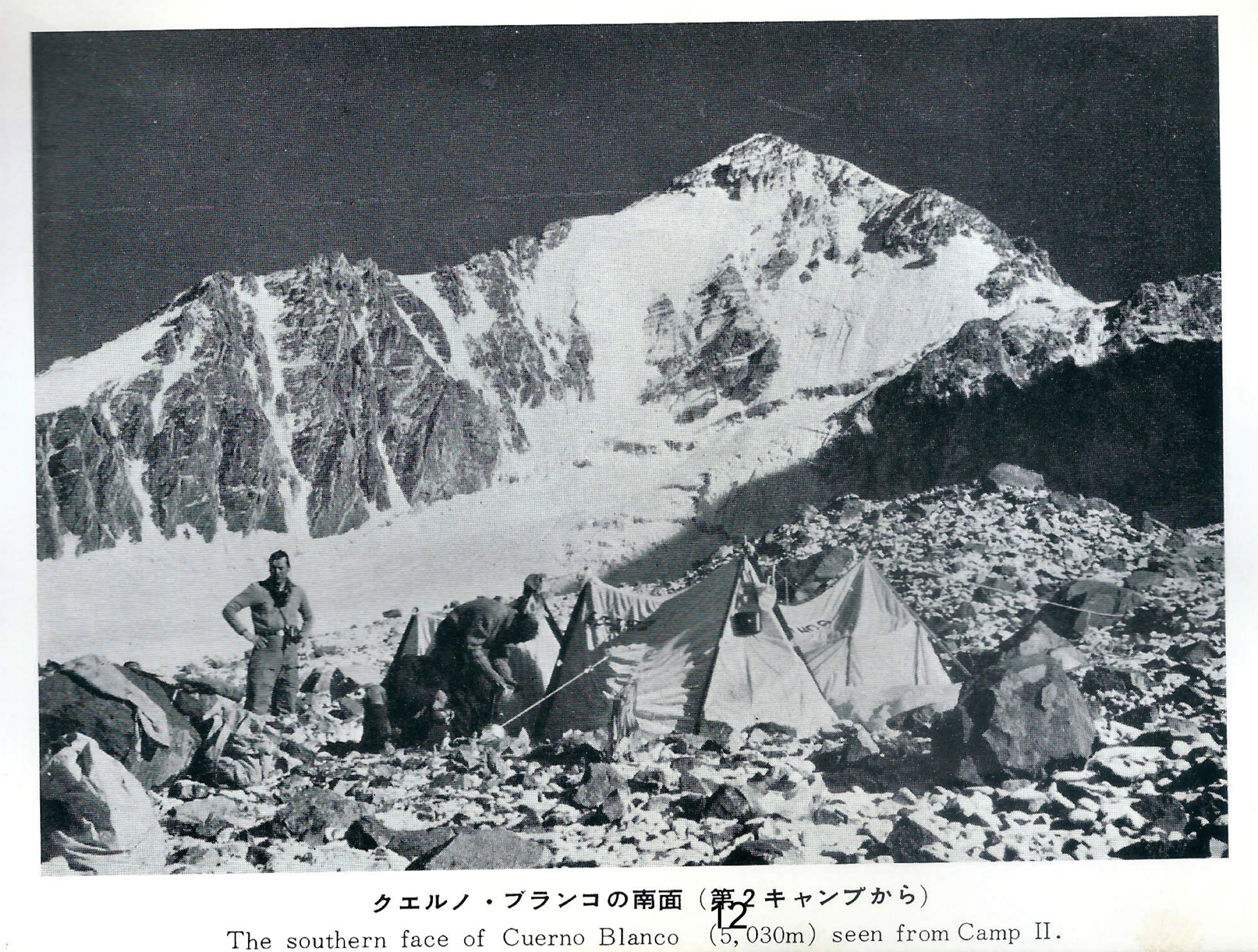
Southern Face of Cuerno Blanco |
|
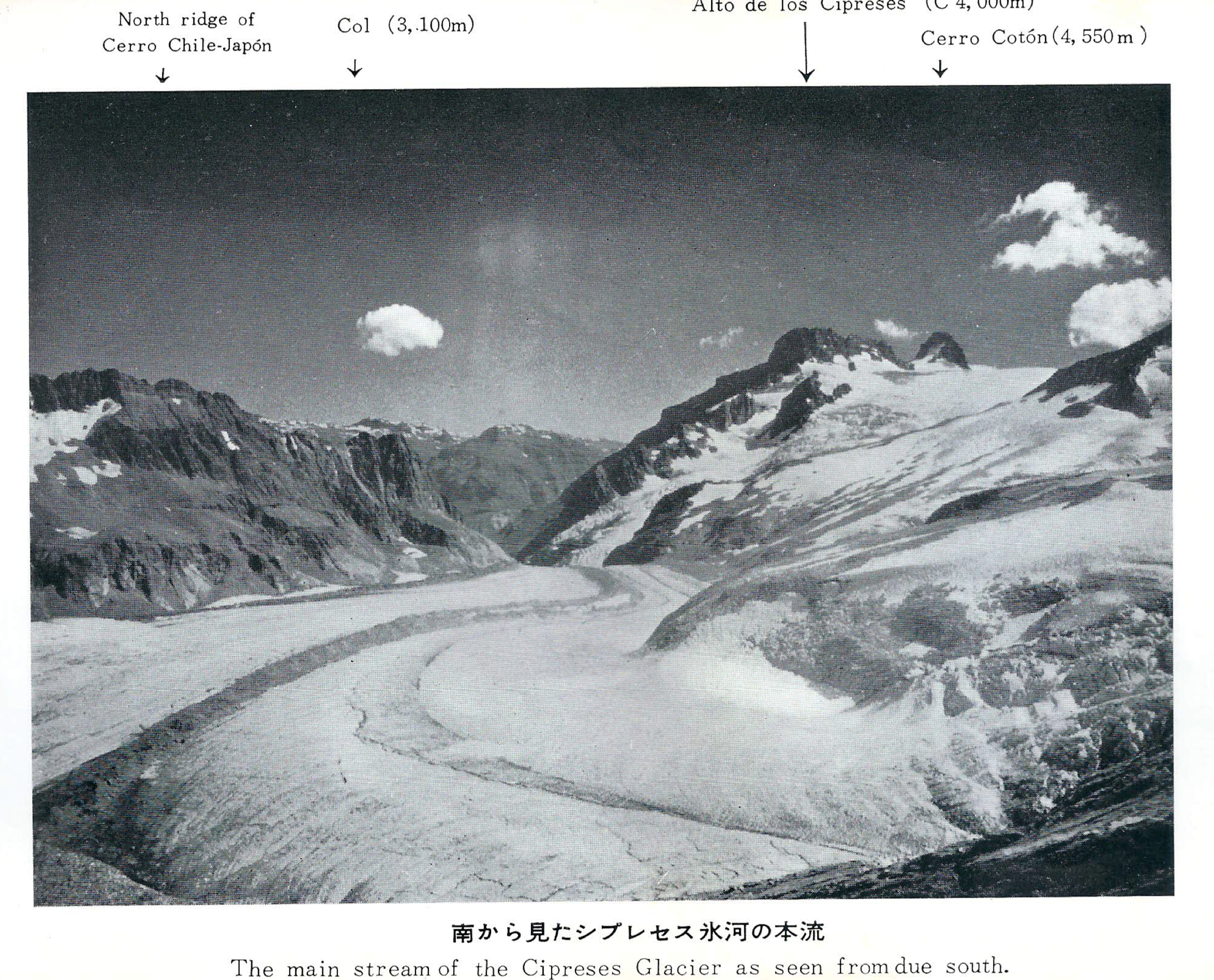
Main Stream of the Cipreses Glacier |
|
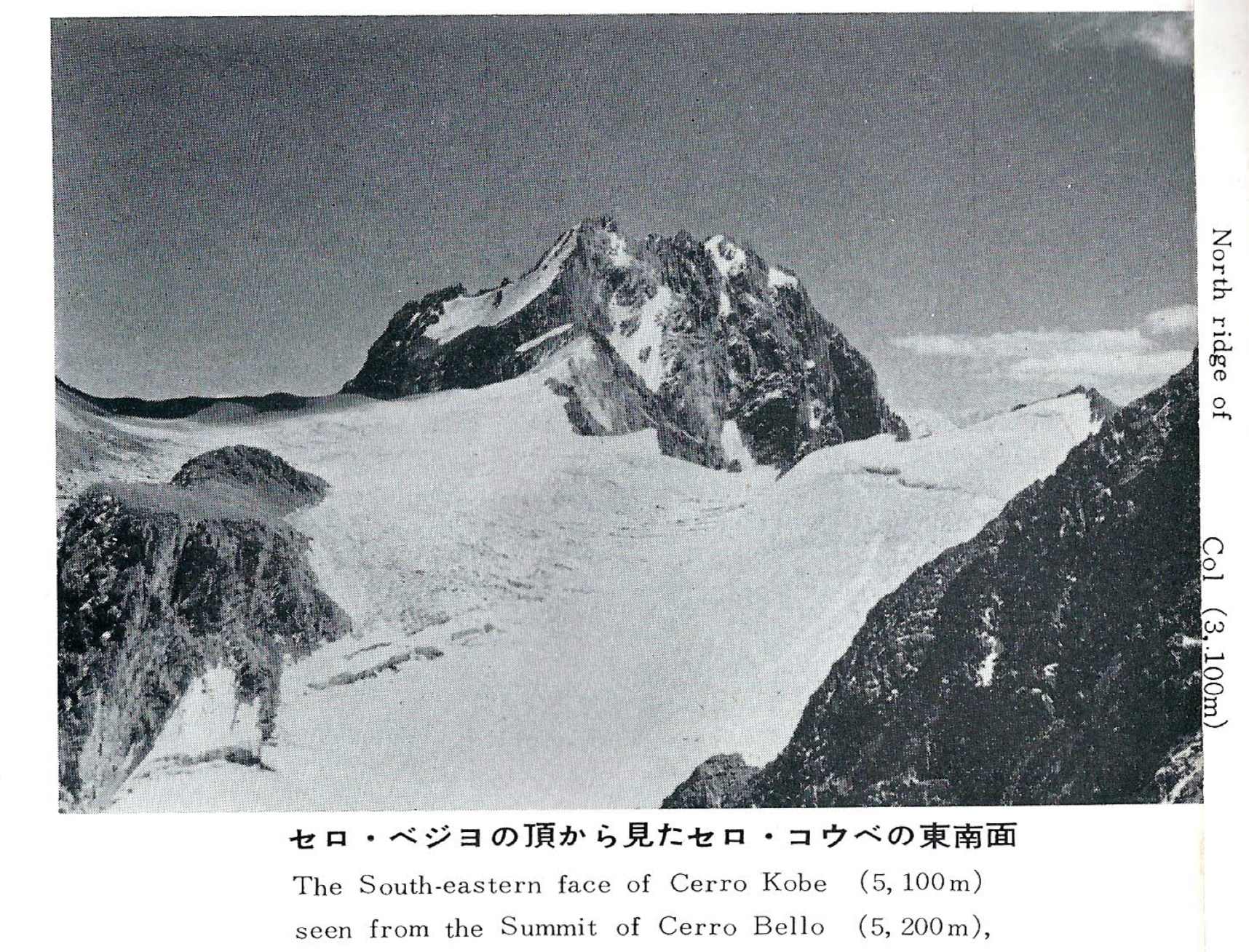
Southeastern Face of Cerro Kobe
|
|
Yeso Feb 2-20, 1960. Chilean-Japanese Expedition Gallery |
|
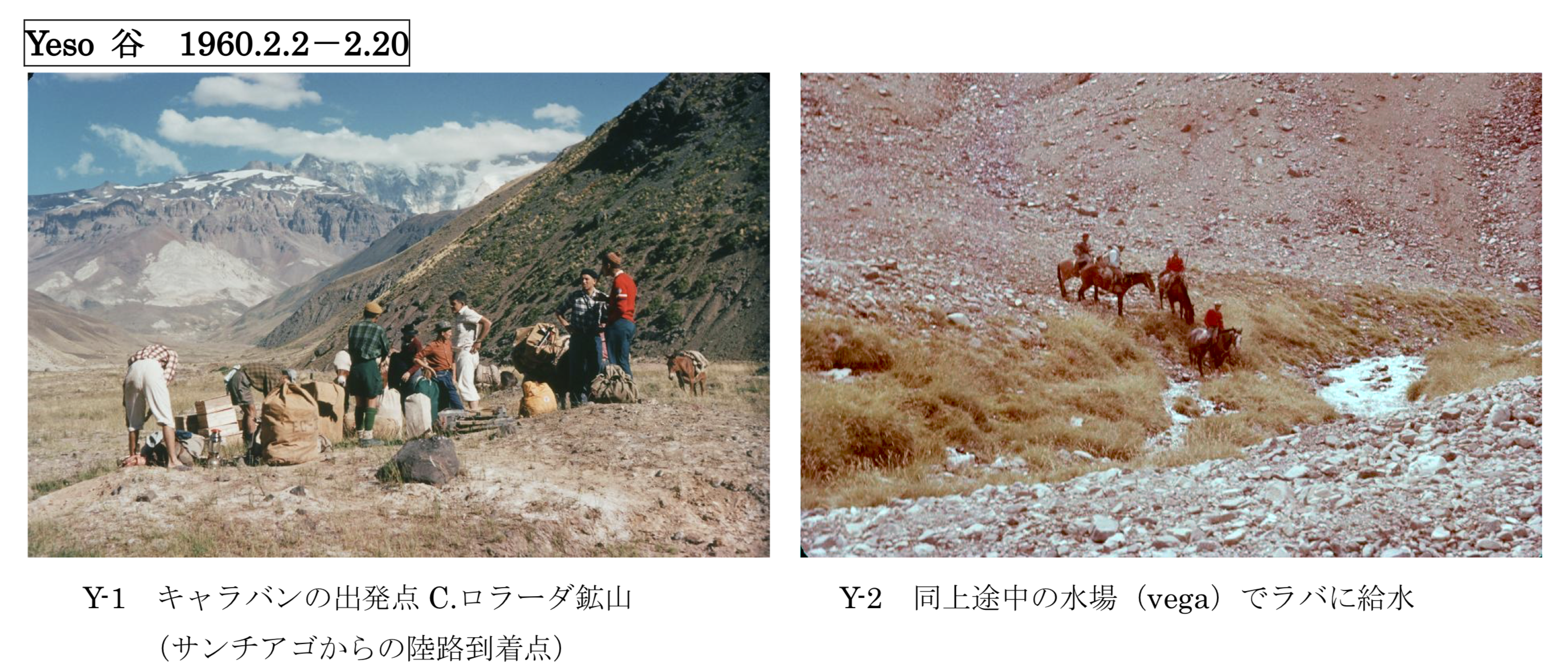
Y-1 Start of Caravan at Rodada Mine (Terminal Depo of the overland access from Santiago) |
|
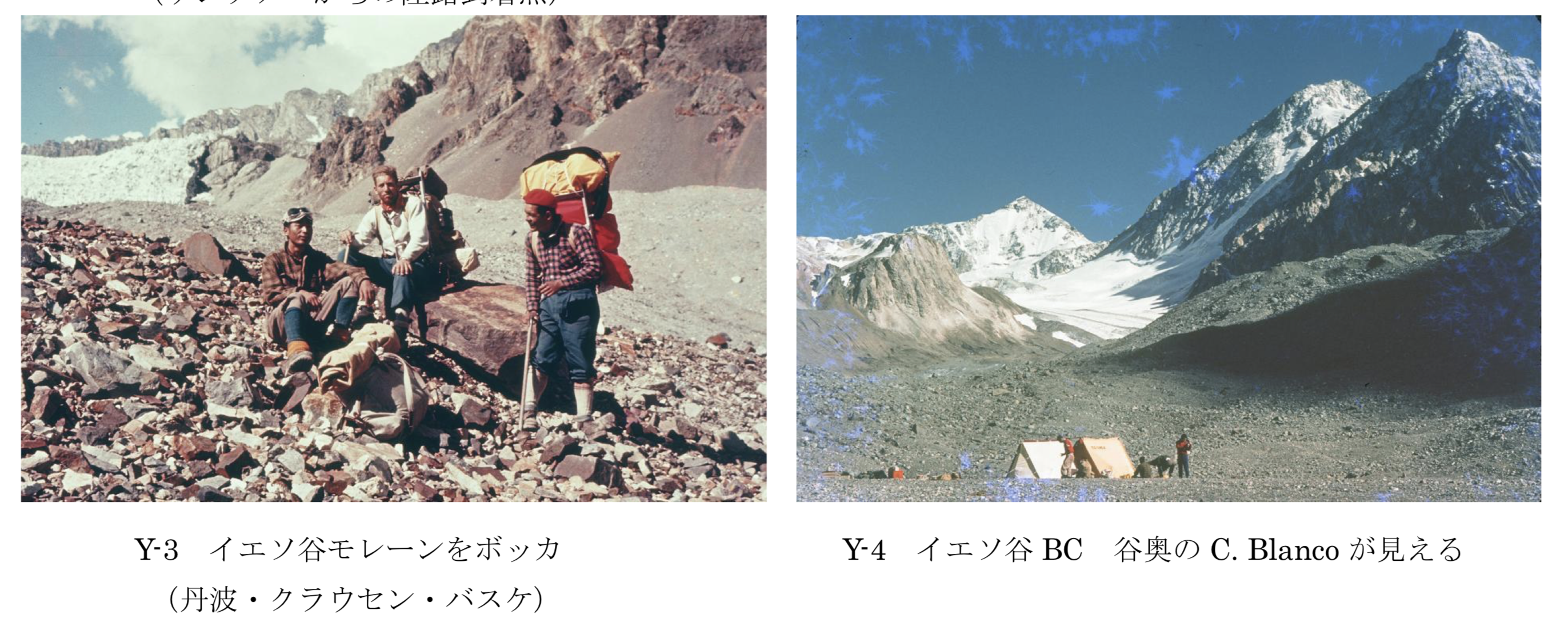
Y-3 Portage along the moraine of Glacier Bello in Yeso Valley |
|
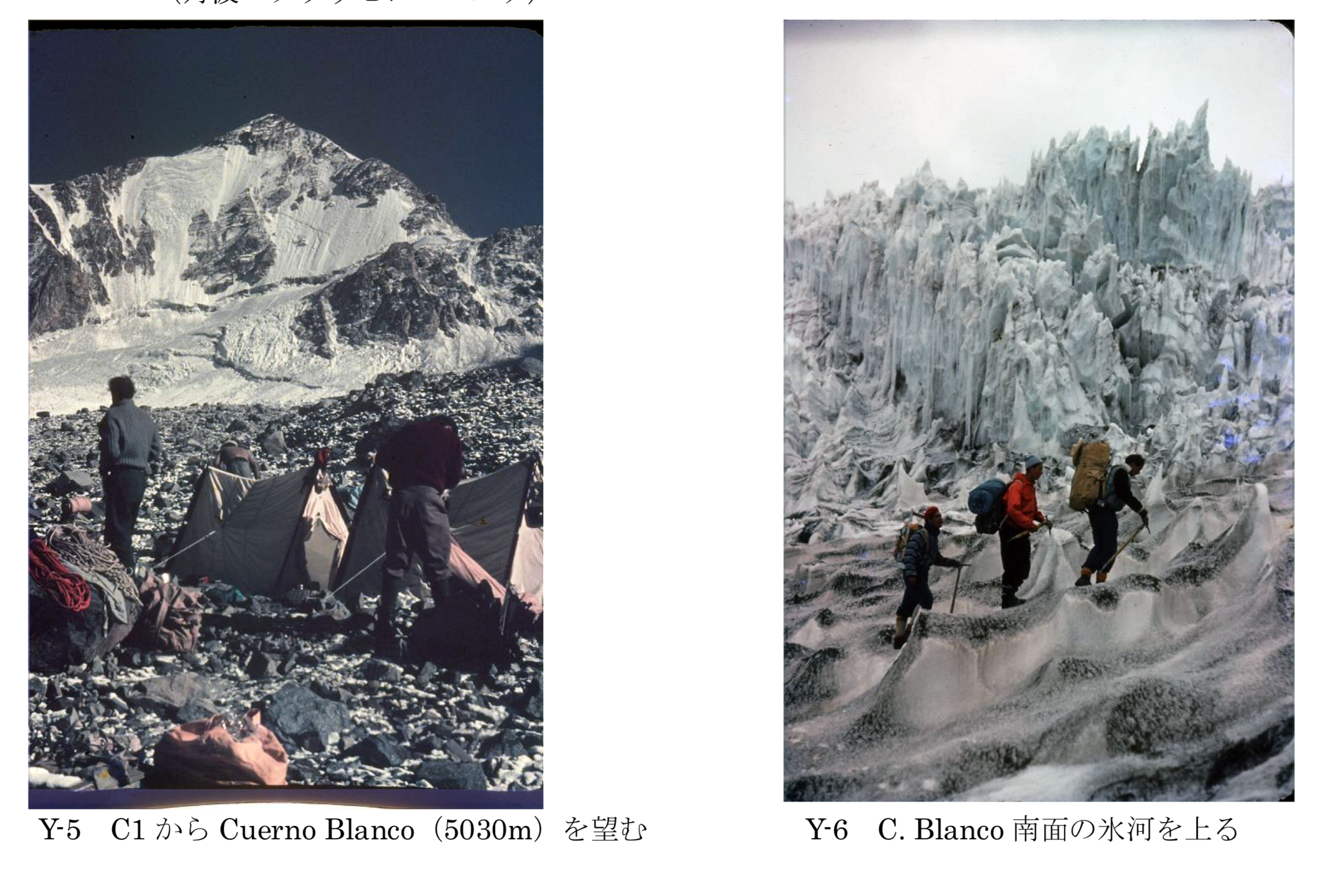
Y-5 View of C. Blanco (5030m) from Camp I |
|
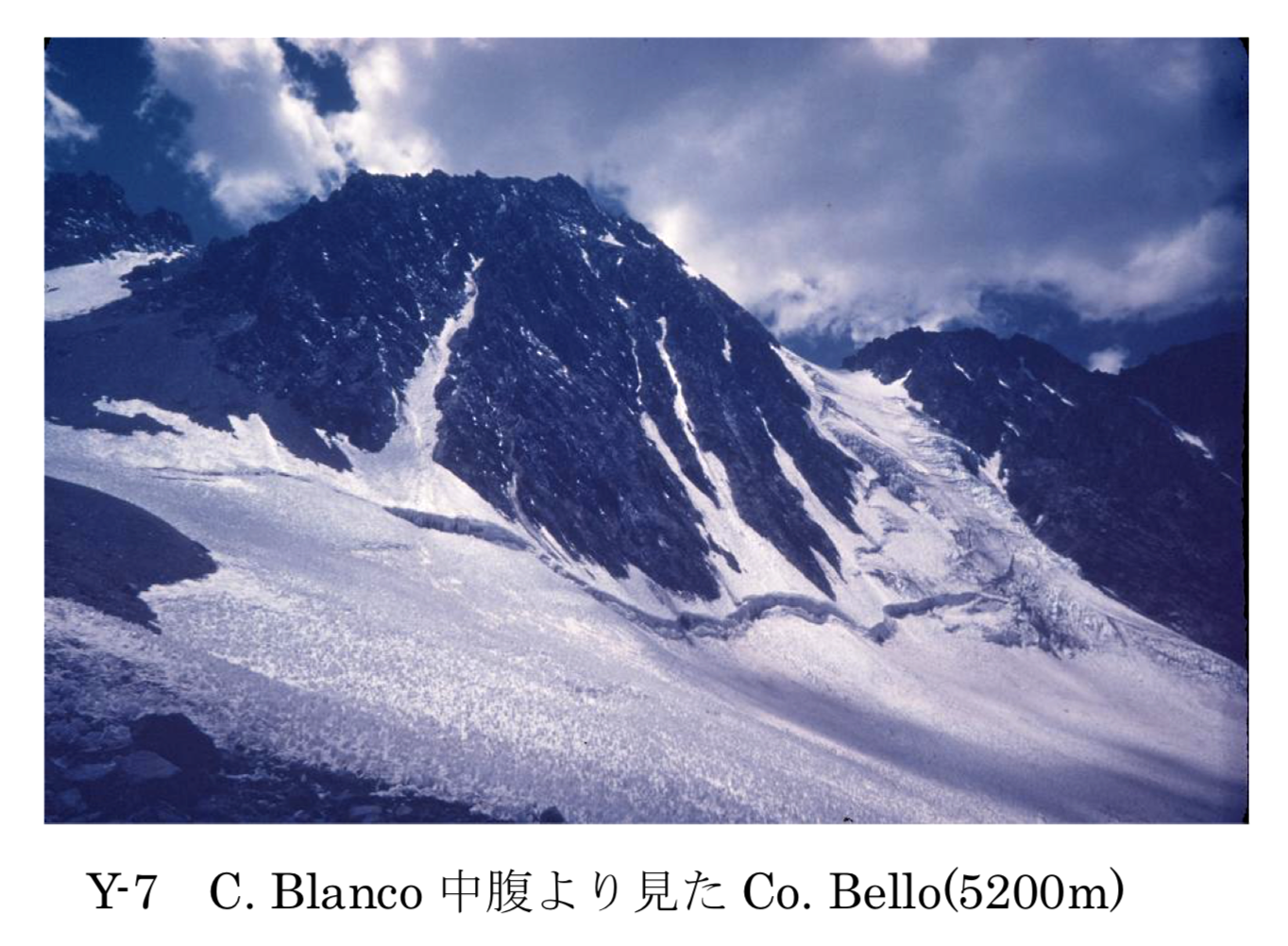
Y-7 View of Co. Bello (5200m) |
|
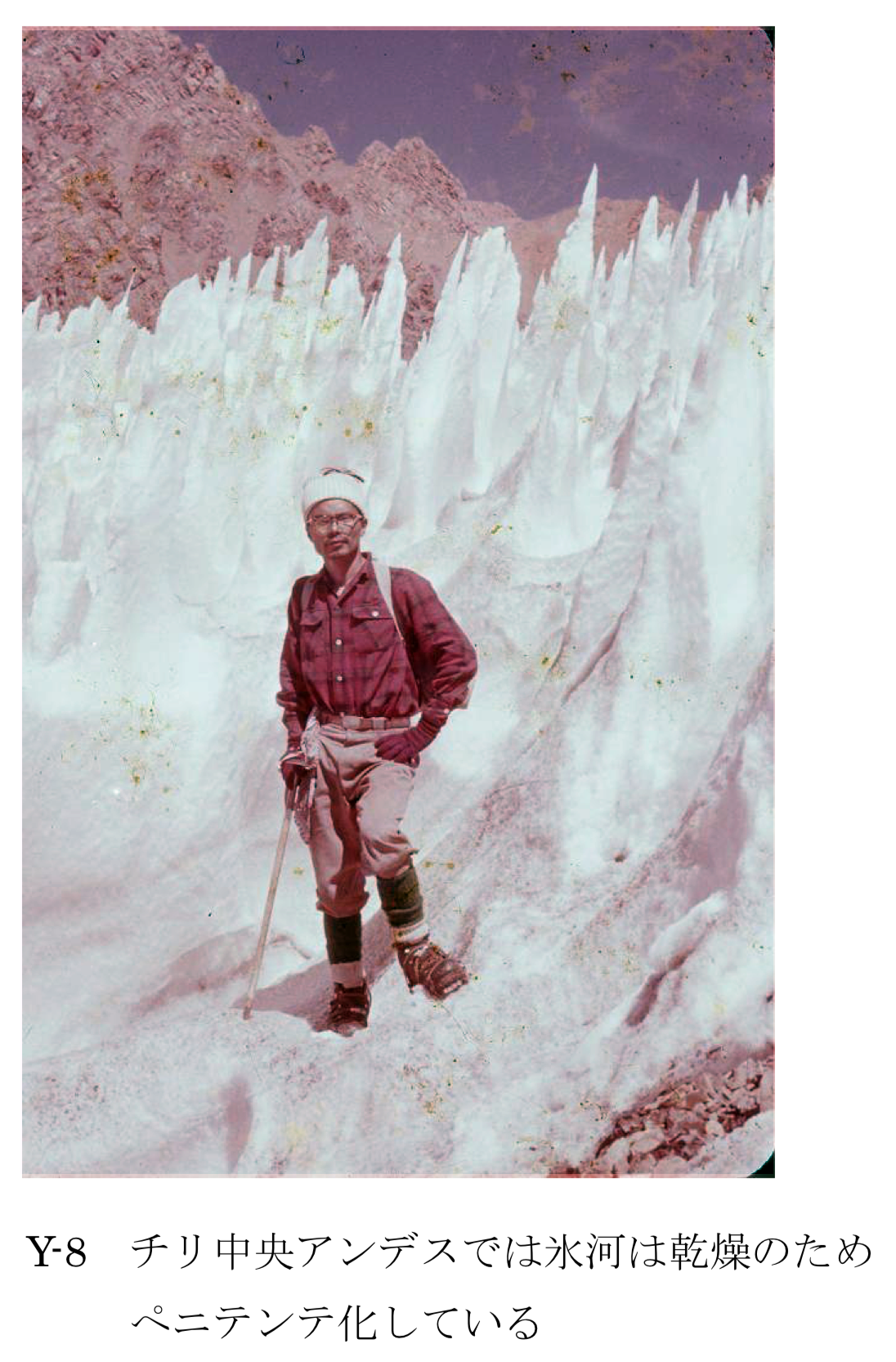
Y-8 Toyoda with Nieve Penitente (ice needle) |
|
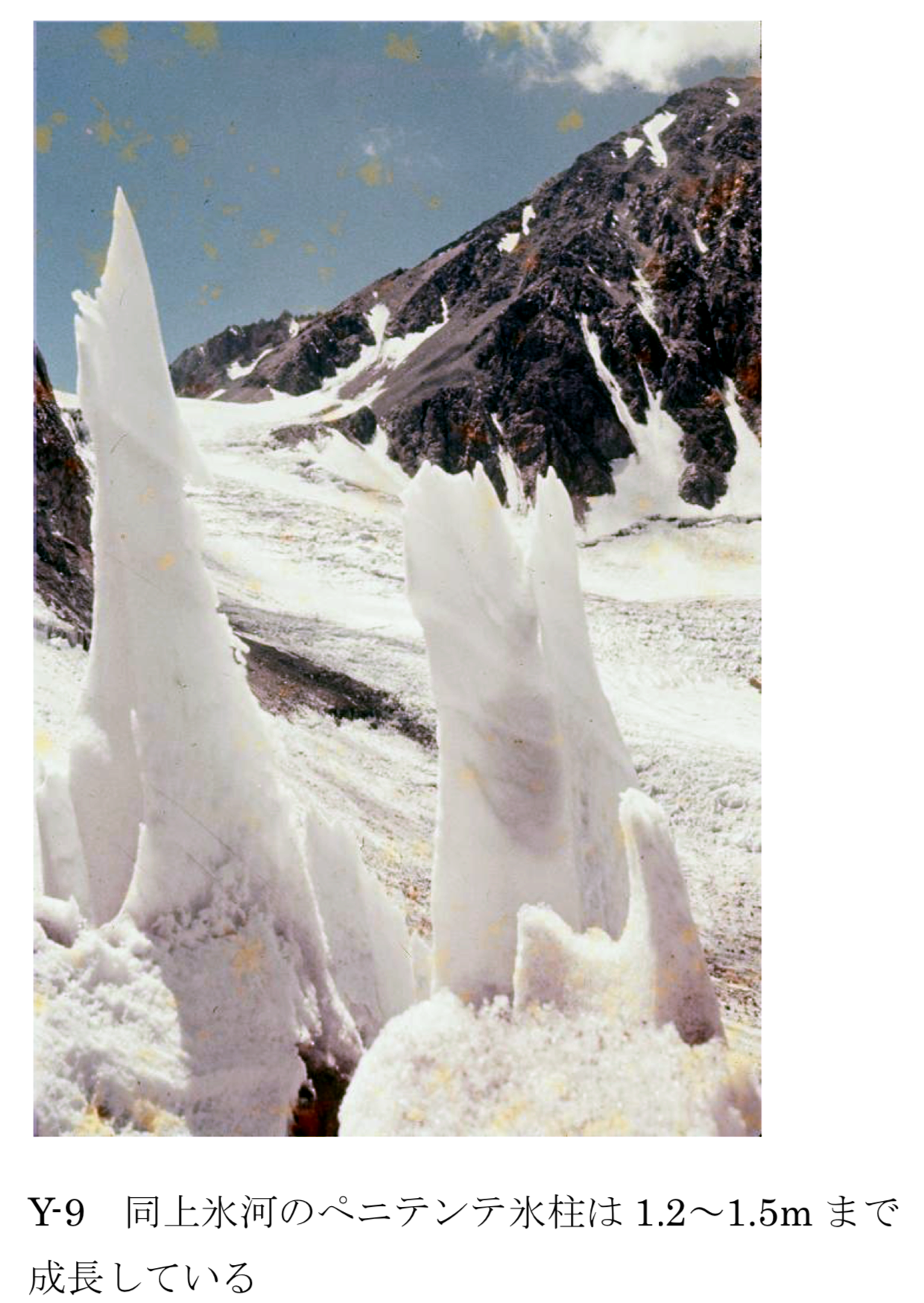
Y-9 Same as Y-8 (ice needles grew as long as 1.2 - 1.5m in Chilean Central Andes) |
|
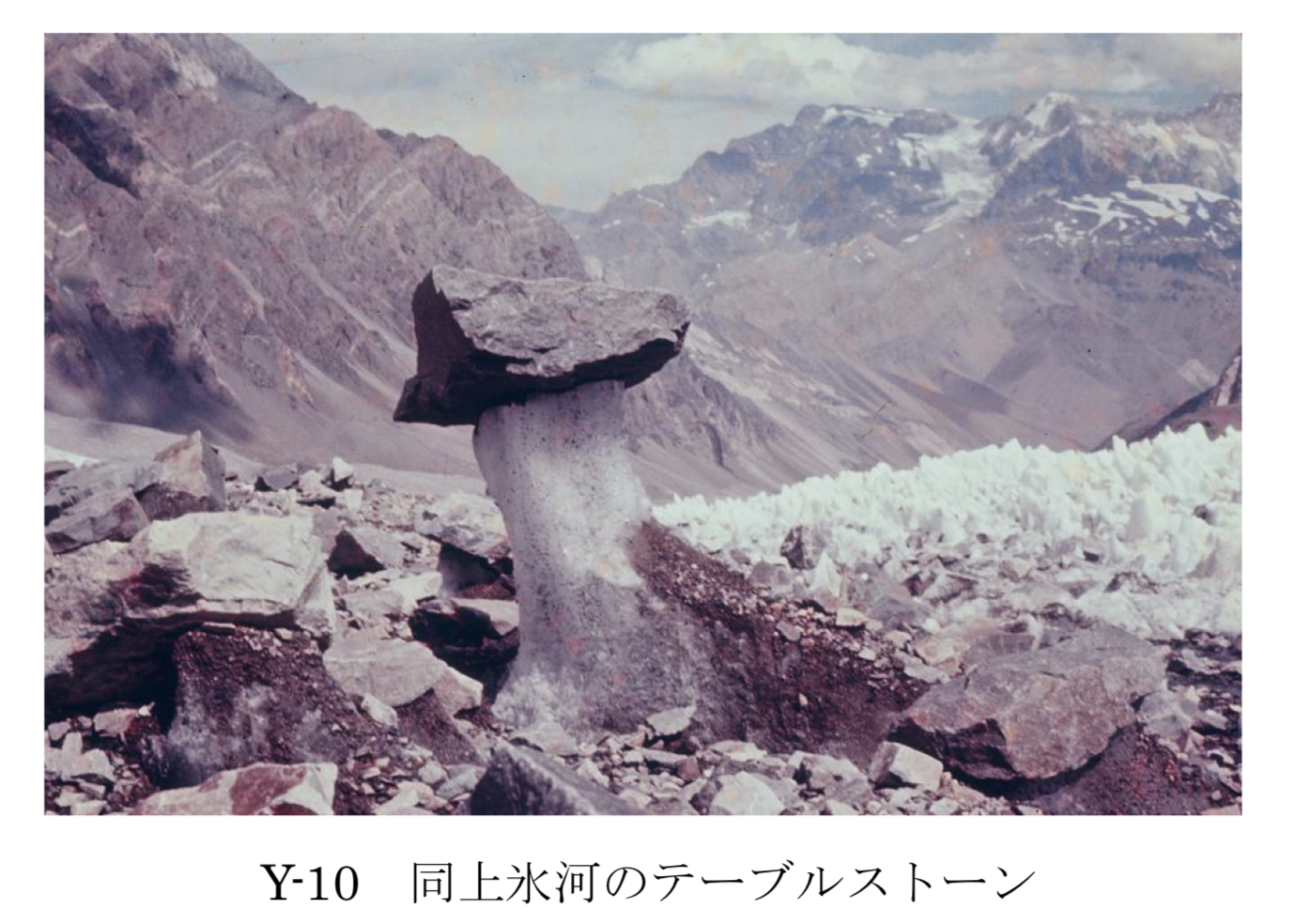
Y-10 Table stone on Gl. Gello |
|
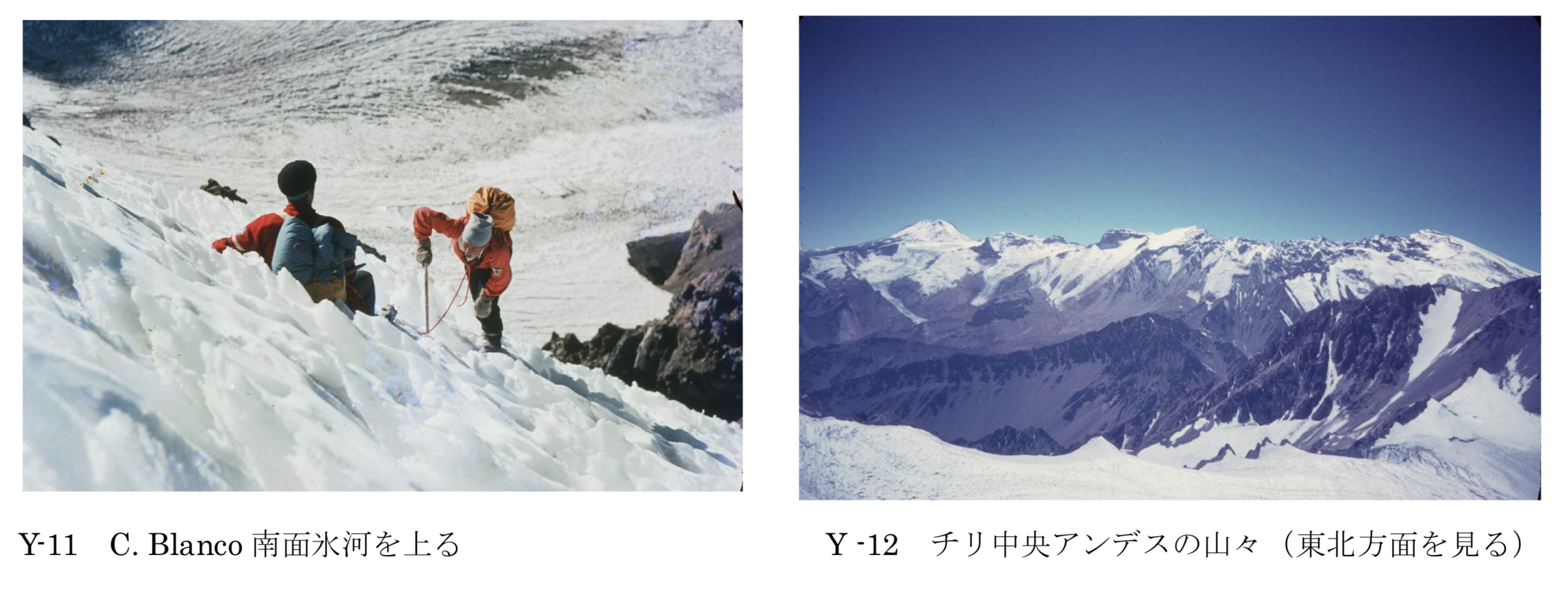
Y-11 Ascending Gl. Bello on South Wall of C. Blanco |
|
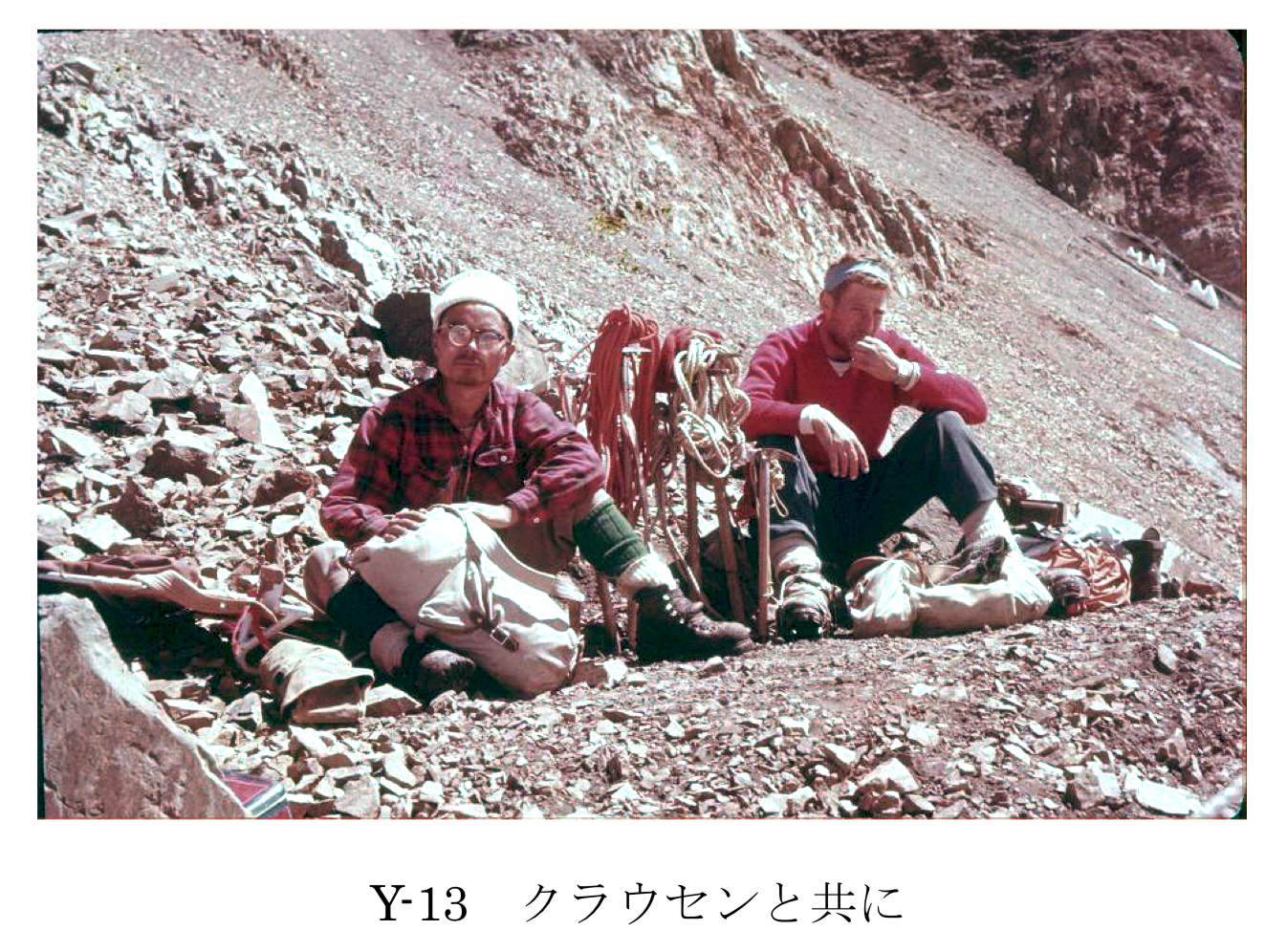
Y-13 Toyoda with K. Claussen, Chilean Leader |
|
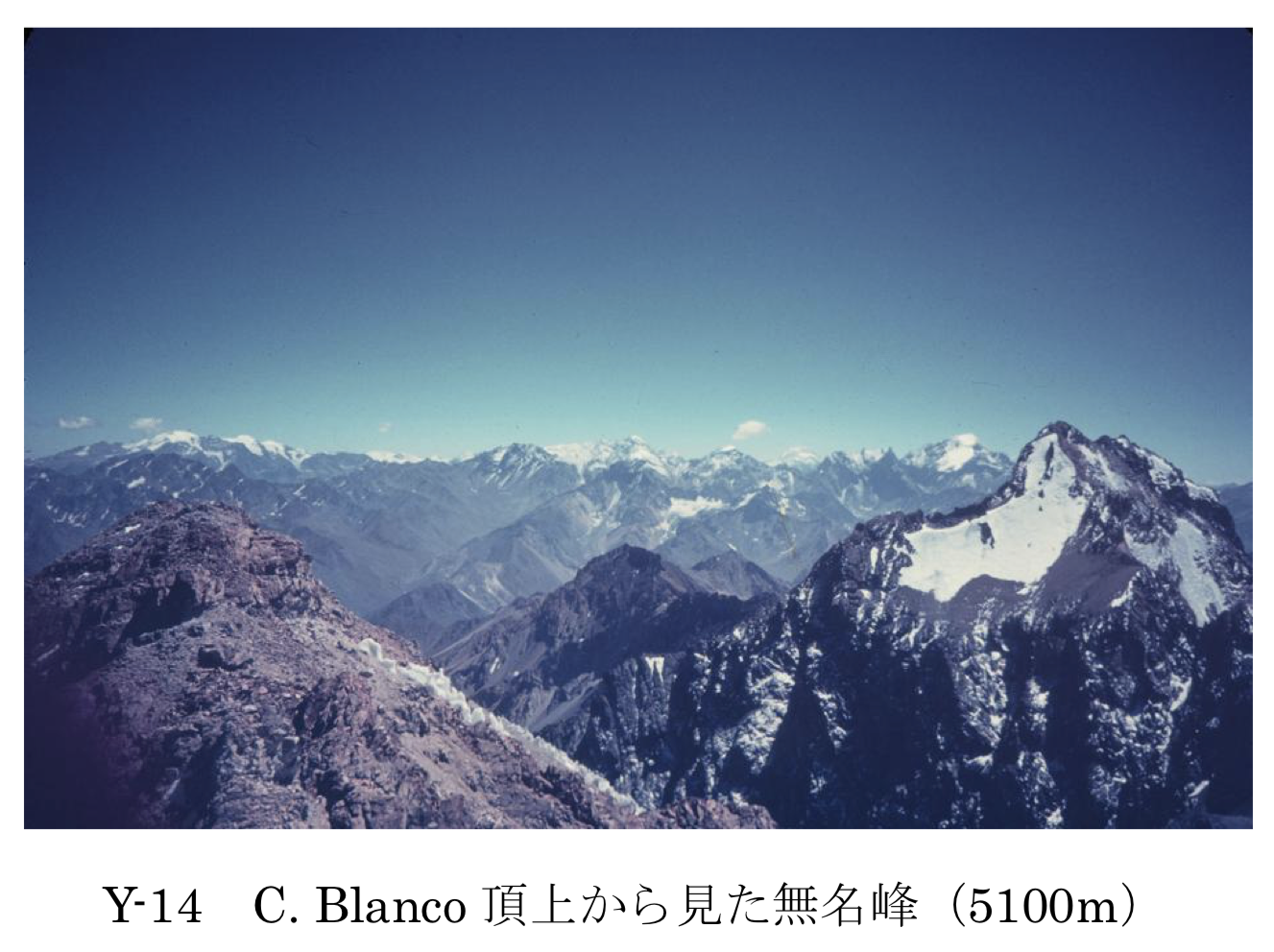
Y-14 Unnamed Peak (5100m) from the summit of C. Blanco |
|
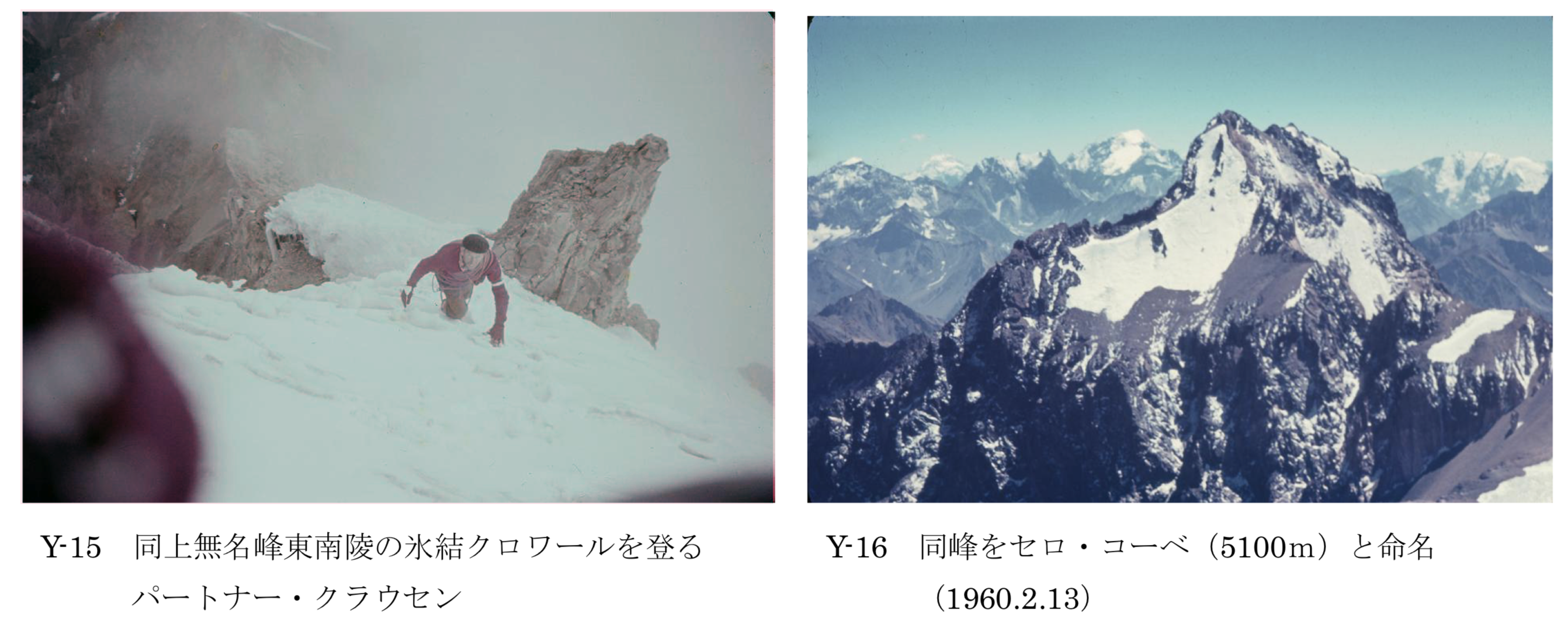
Y-15 Parter Claussen climbing ice covered couloir along the S-East ridge |
|
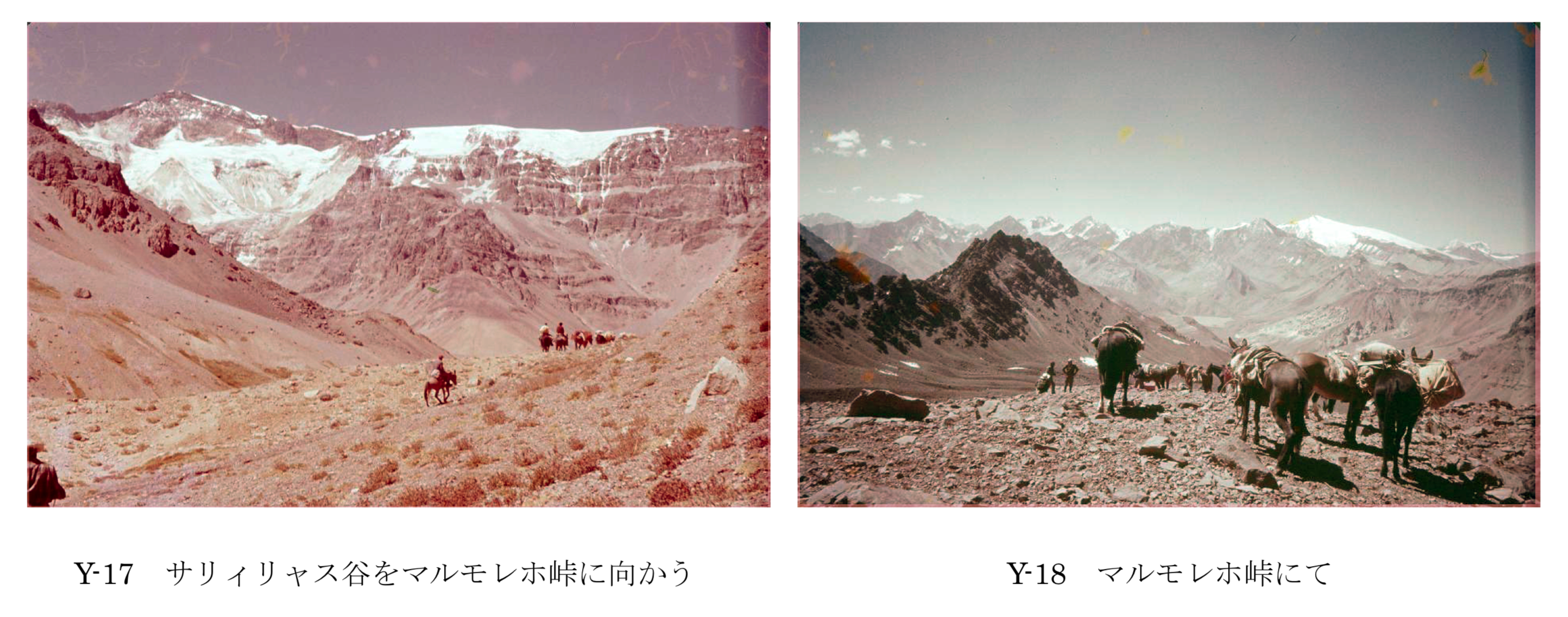
Y-17 Transfer caravan through Salillas Valley to Marmolejo Pass |
|
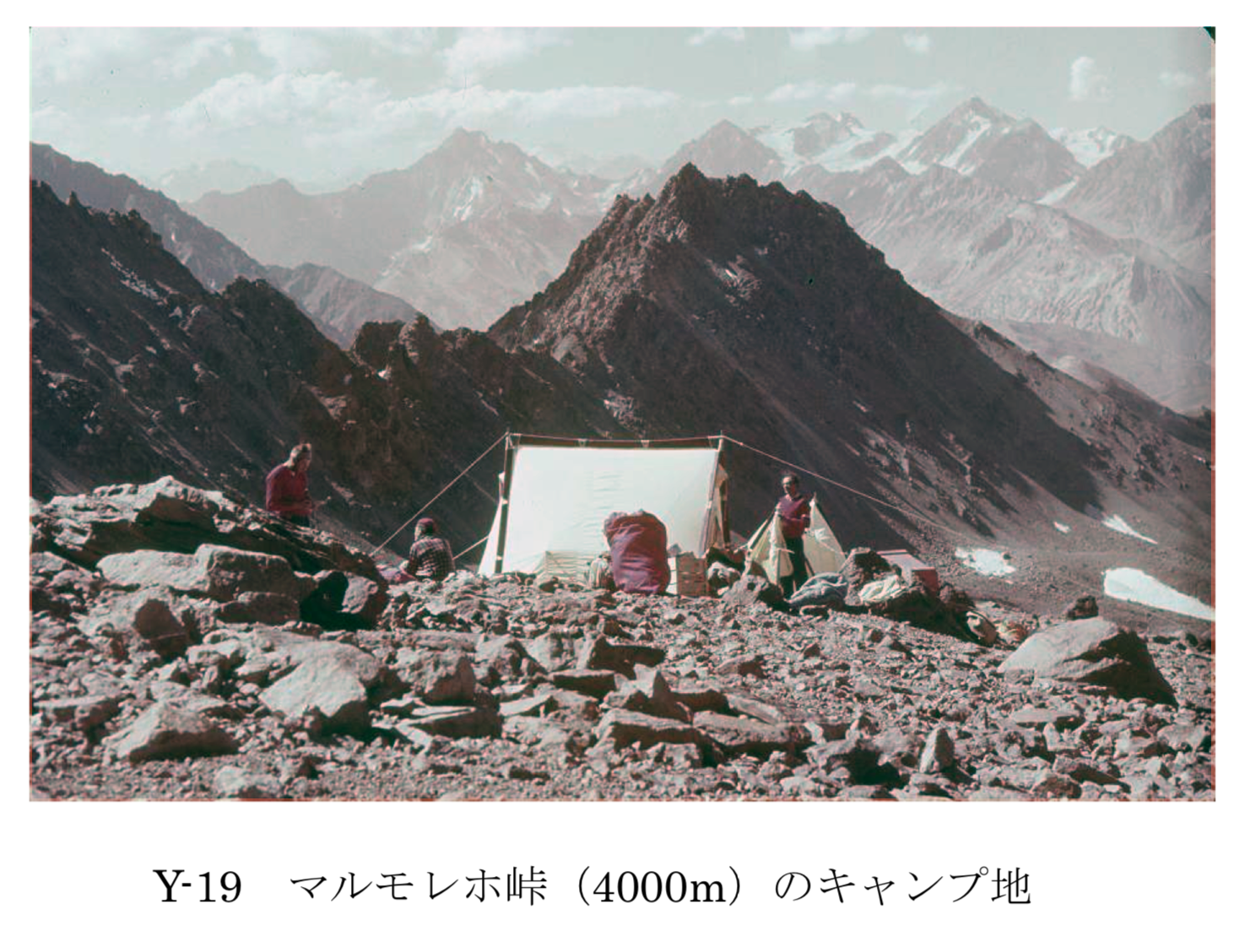
19 Camp site on the mid-slope of Co. Marmolejo |
|
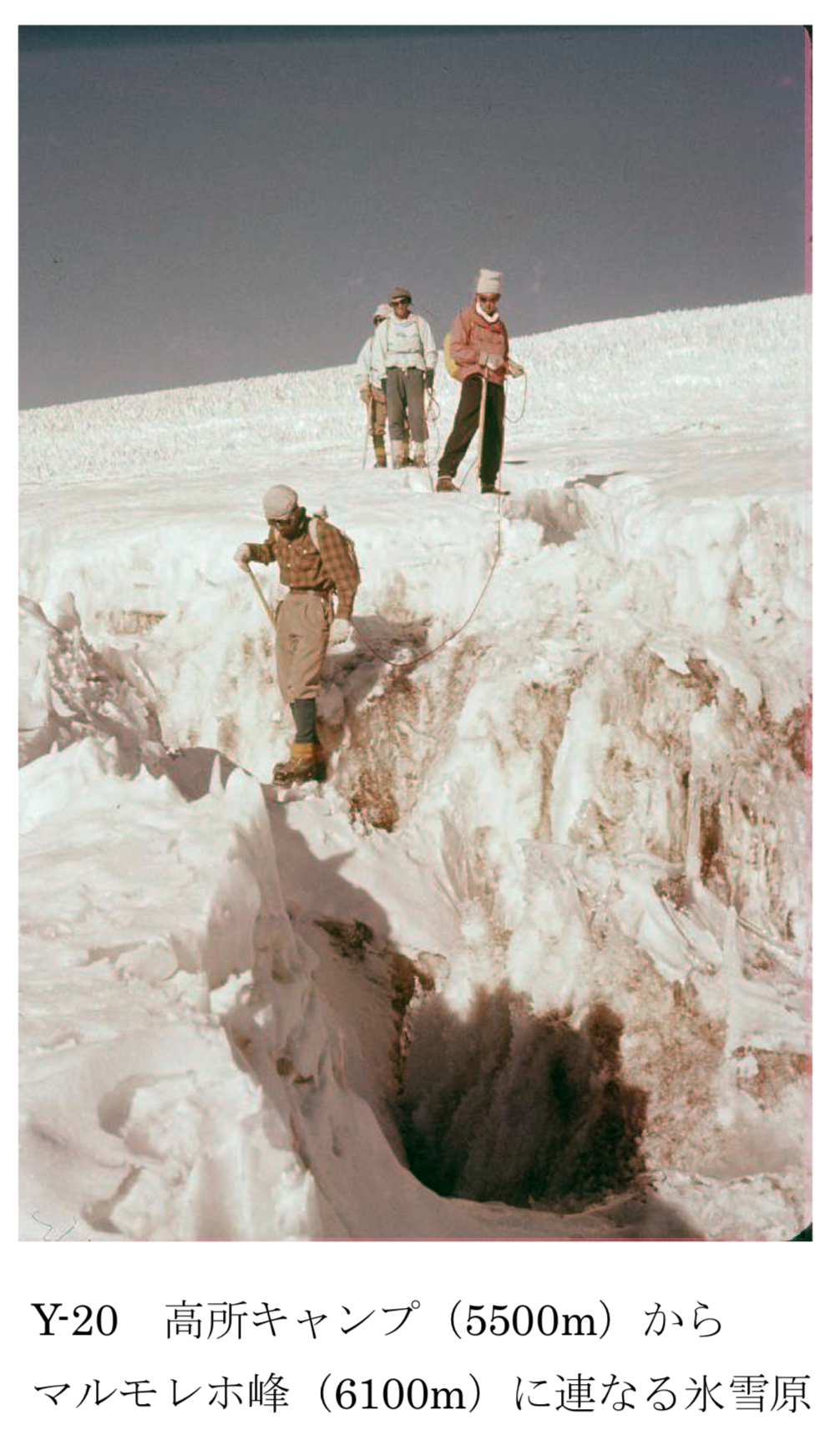
Y-20 Crossing a crevasse on the ice plateau between High Camp (5500m) and Co. Marmolejo (6100m) |
|
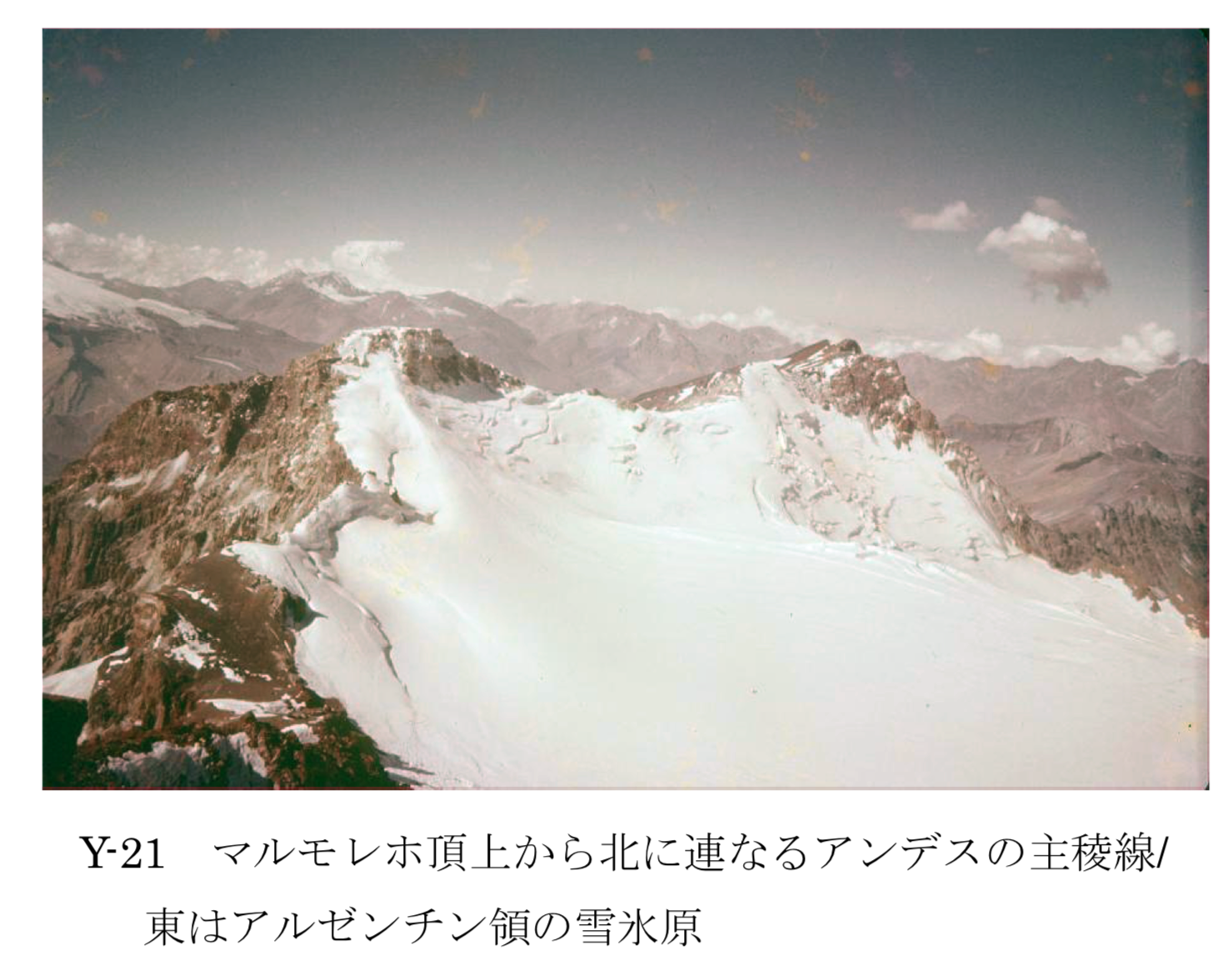
Y-21 Chile - Argentine Border with ice and snow covering the slope of Argentine side |
|
Rio de los Cipreses Feb 27-Mar 13, 1960. |
|
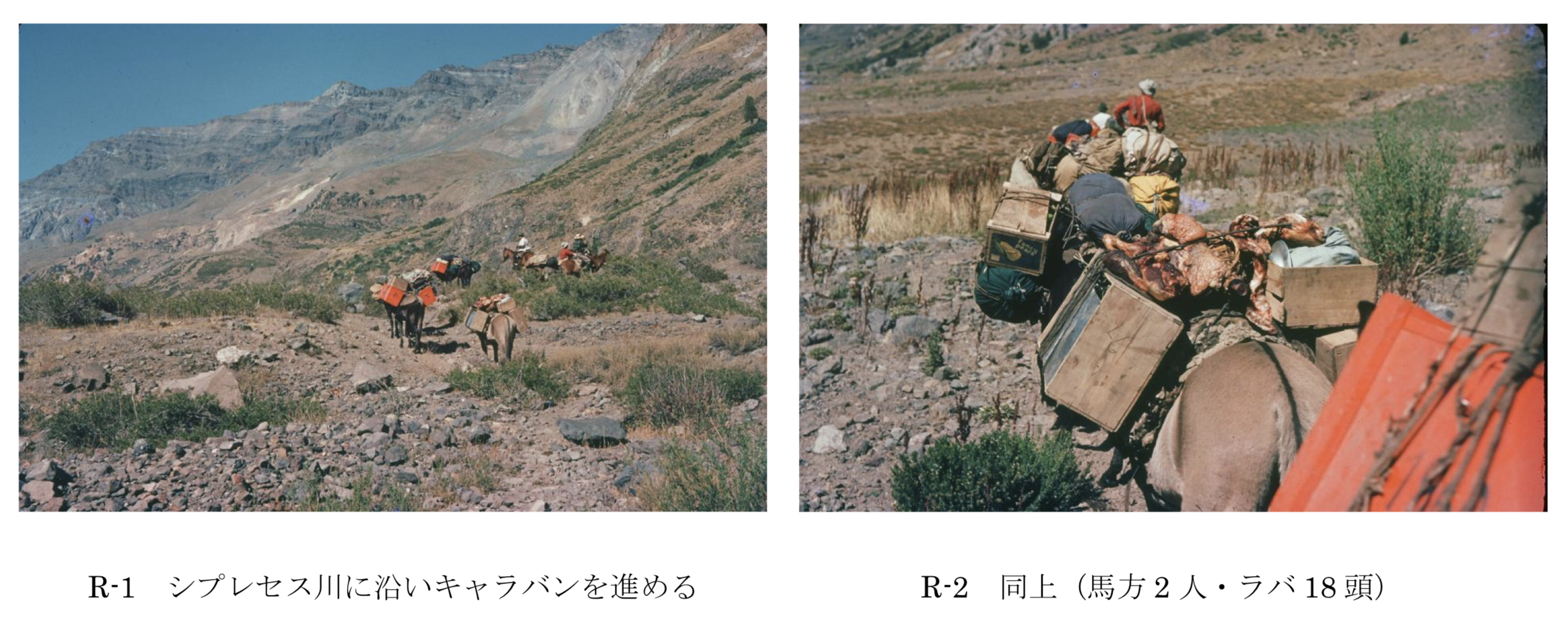
R-1 Caravan through the trail along Rio de los Cipreses |
|
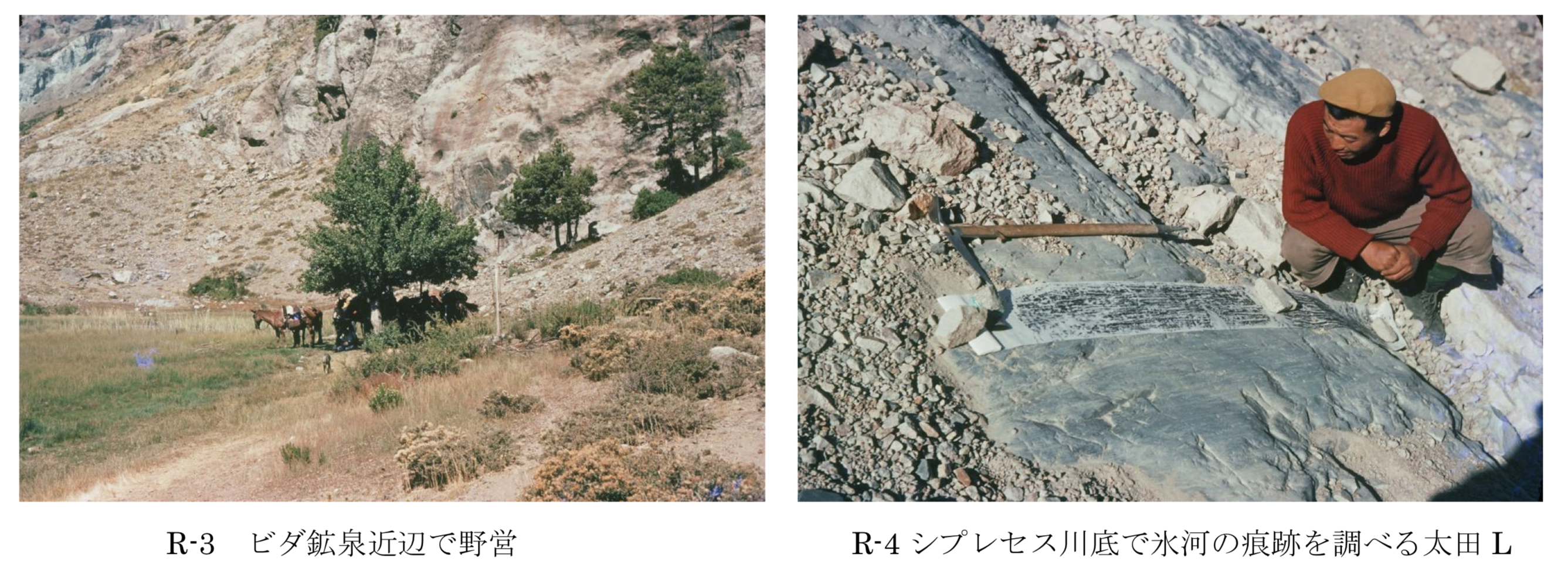
R-3 Camping at Agua de Vida Mine R-4 Surveying the glacier vestiges along Rio Cipreses Valley |
|
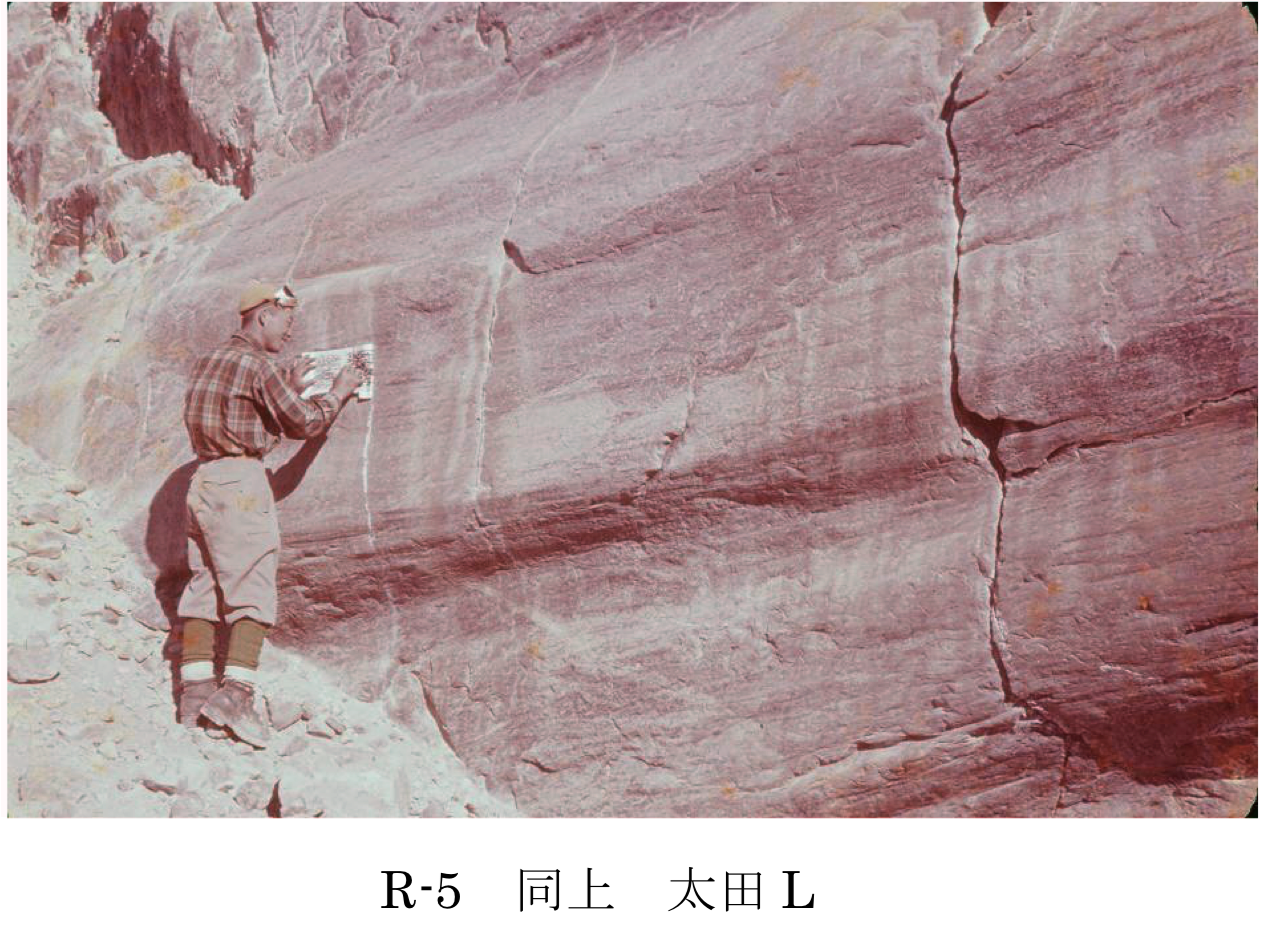
R-5 N. Ota made a rubbing of the ancient glacier |
|
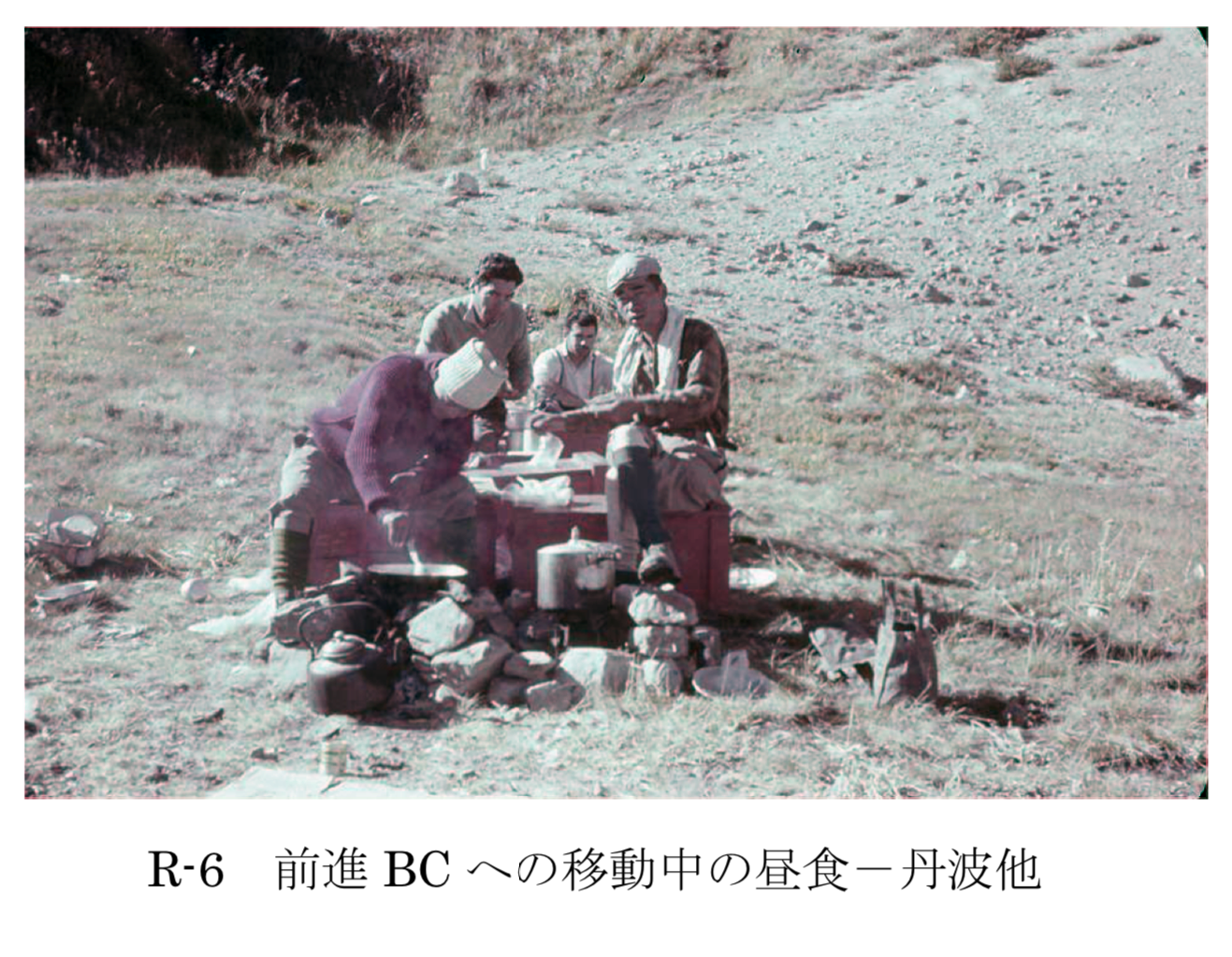
R-6 L to R: Hisao Toyoda, P. Claussen?, ?, H. Tanba |
|
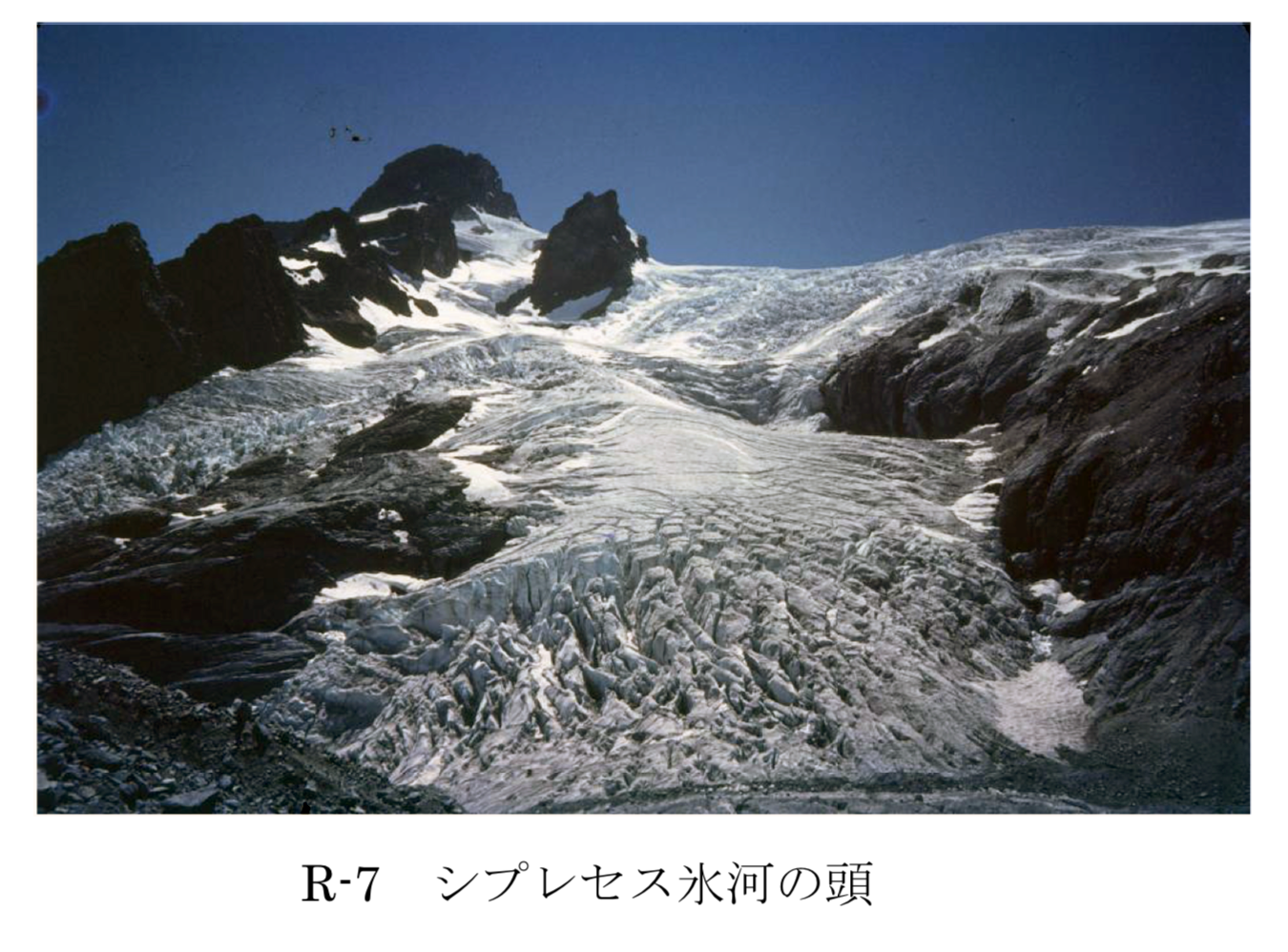
R-7 Co. Alto de los Cipreses with the overhang glacier |
|
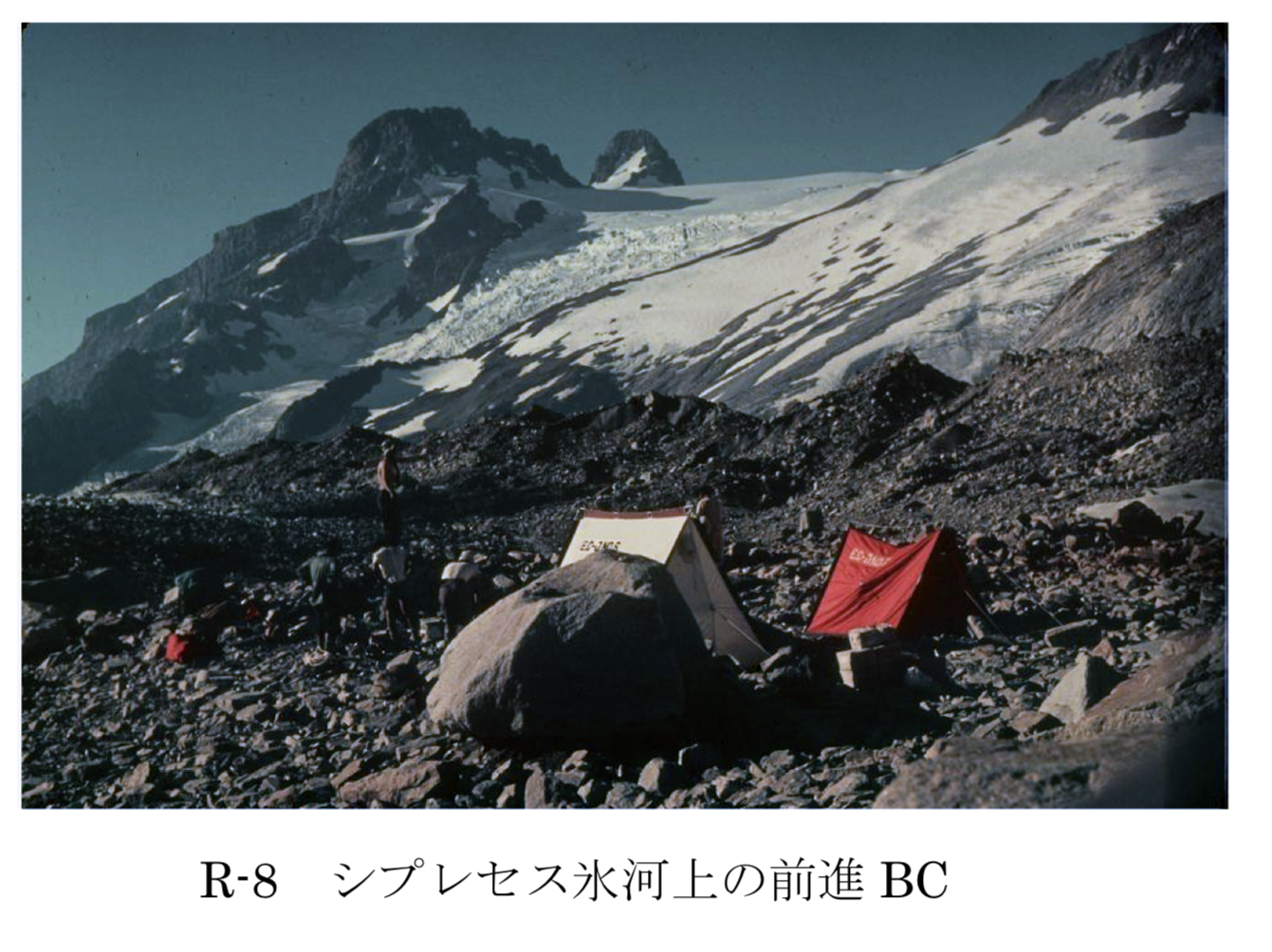
R-8 Advance Base Camp on Gl. Cipreses |
|
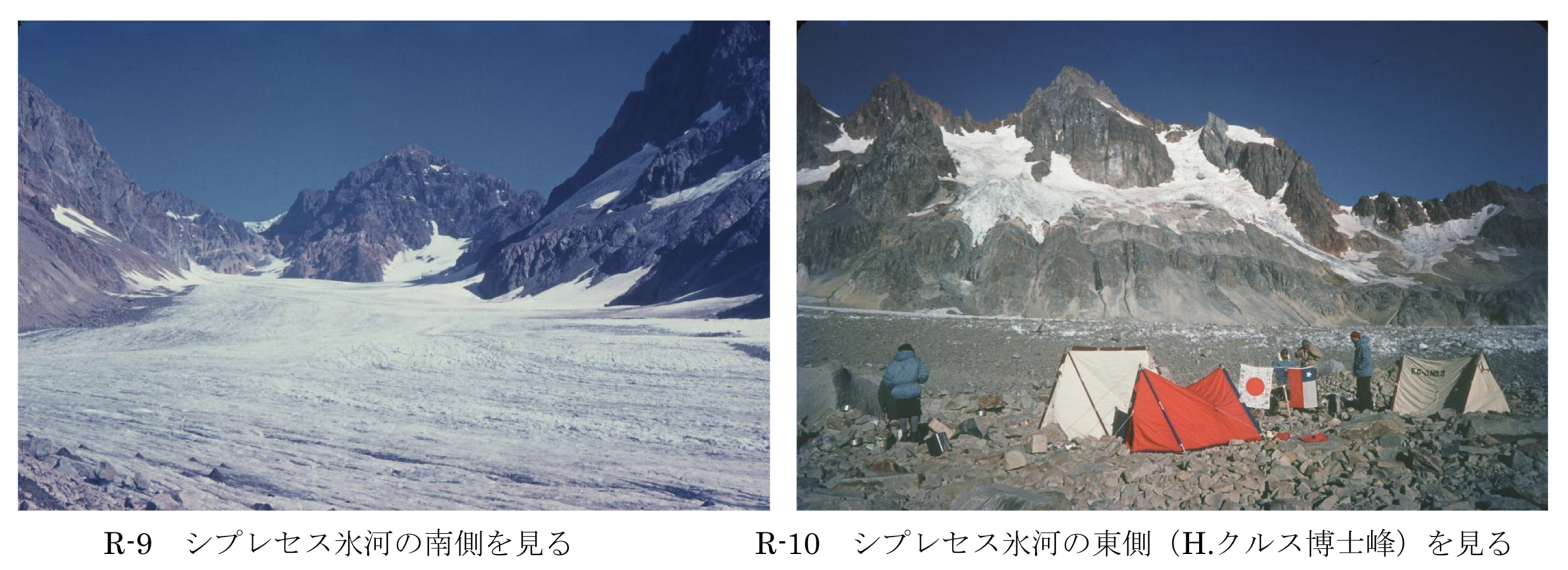
R-9 Upstream (South) view of Gl. Cipreses |
|
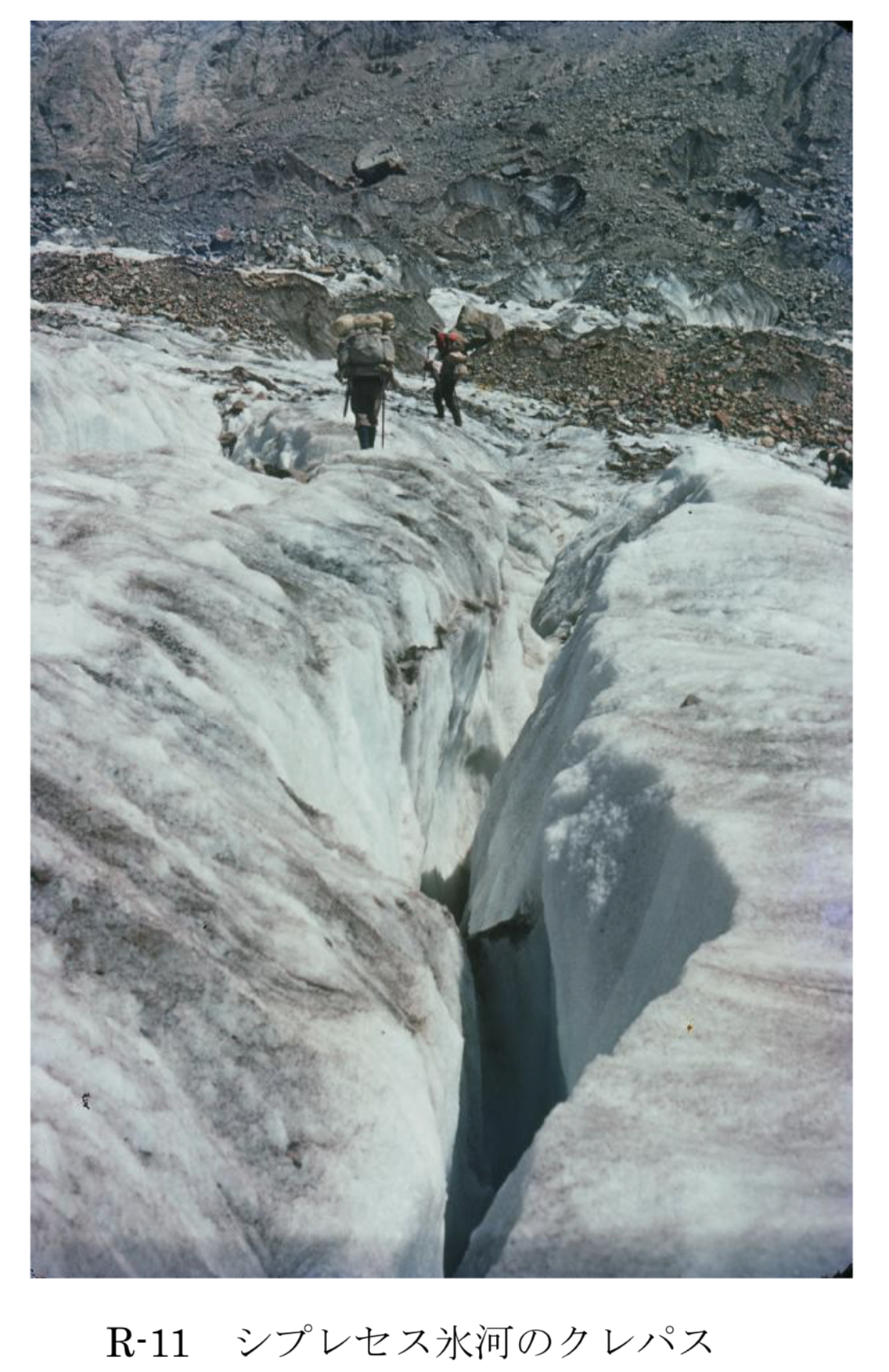
R-11 Crevasse of Glacier Cipreses |
|
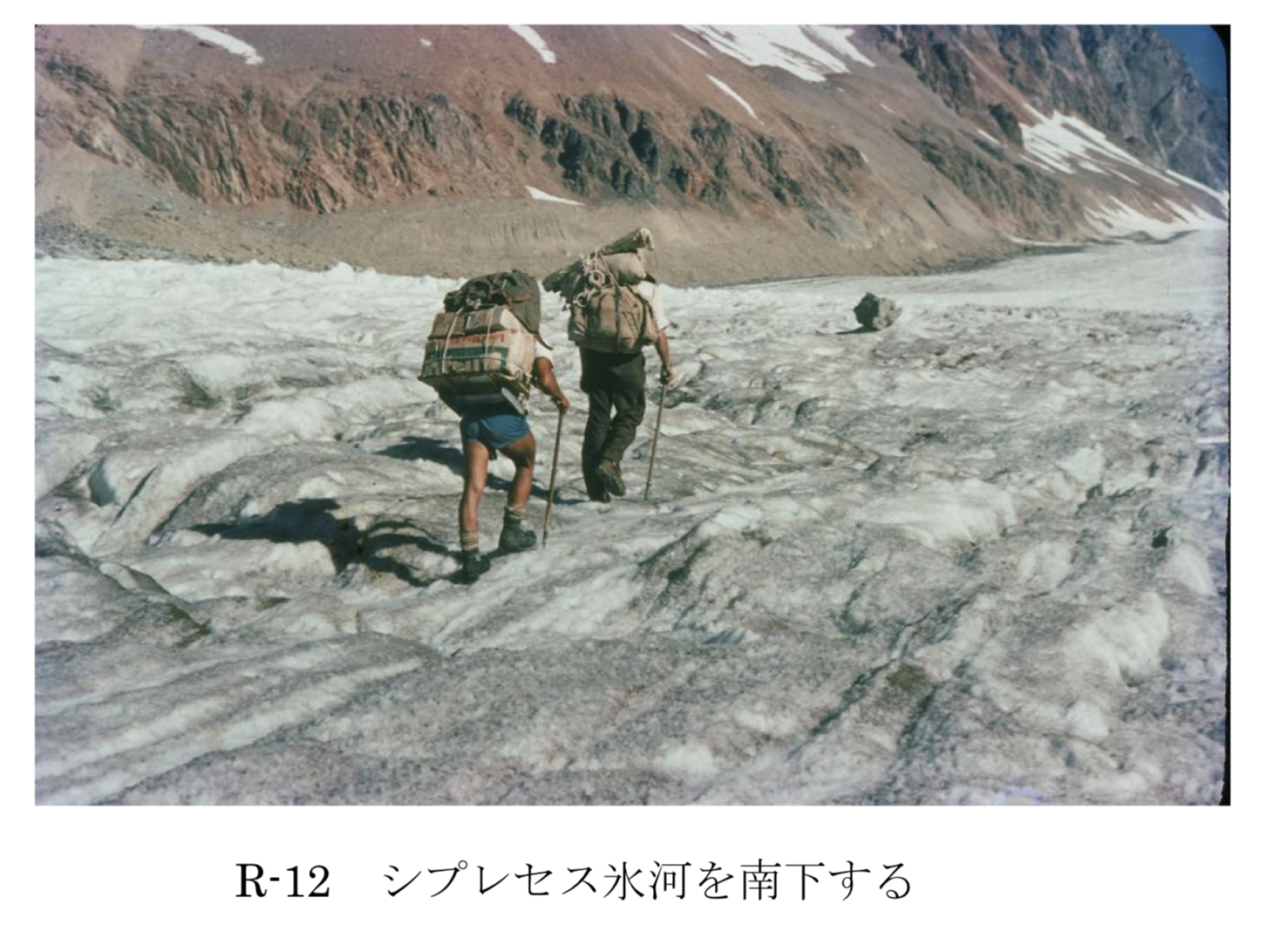
R-12 Going South along Glacier Cipreses |
|
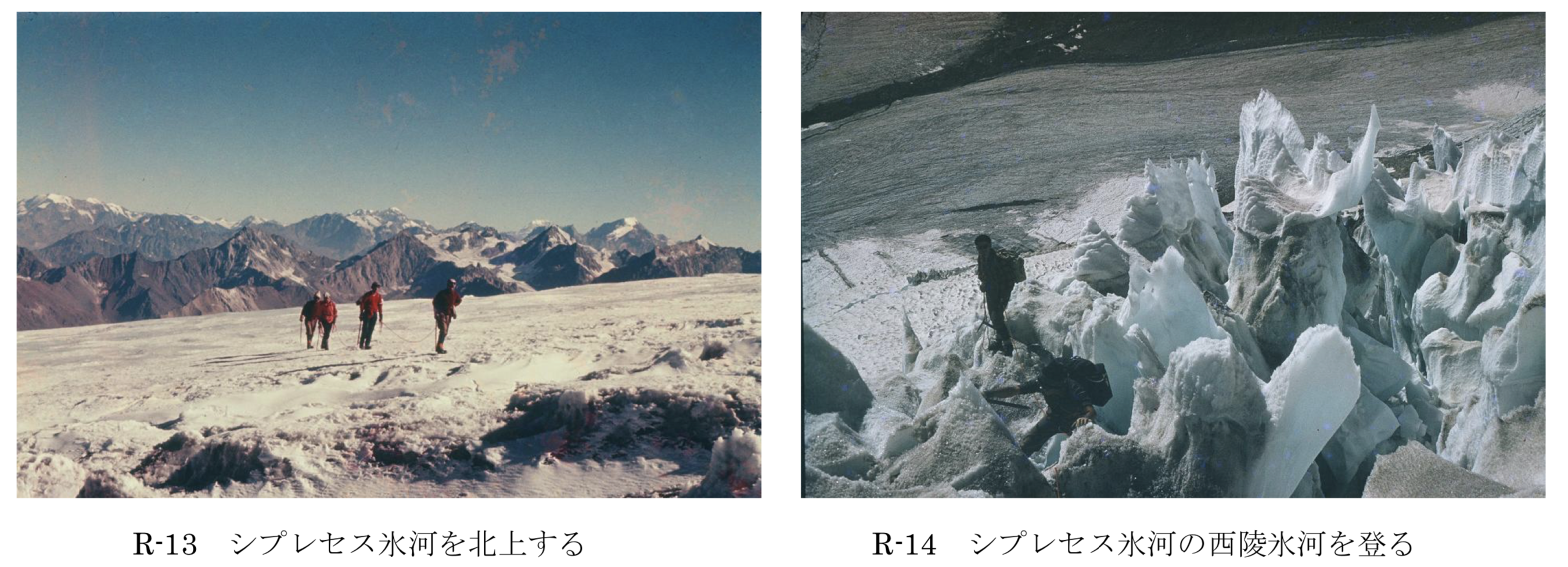
R-13 Going up to North on Glacier Cipreses R-14 Passing through the ice fall covering West ridge slope |
|
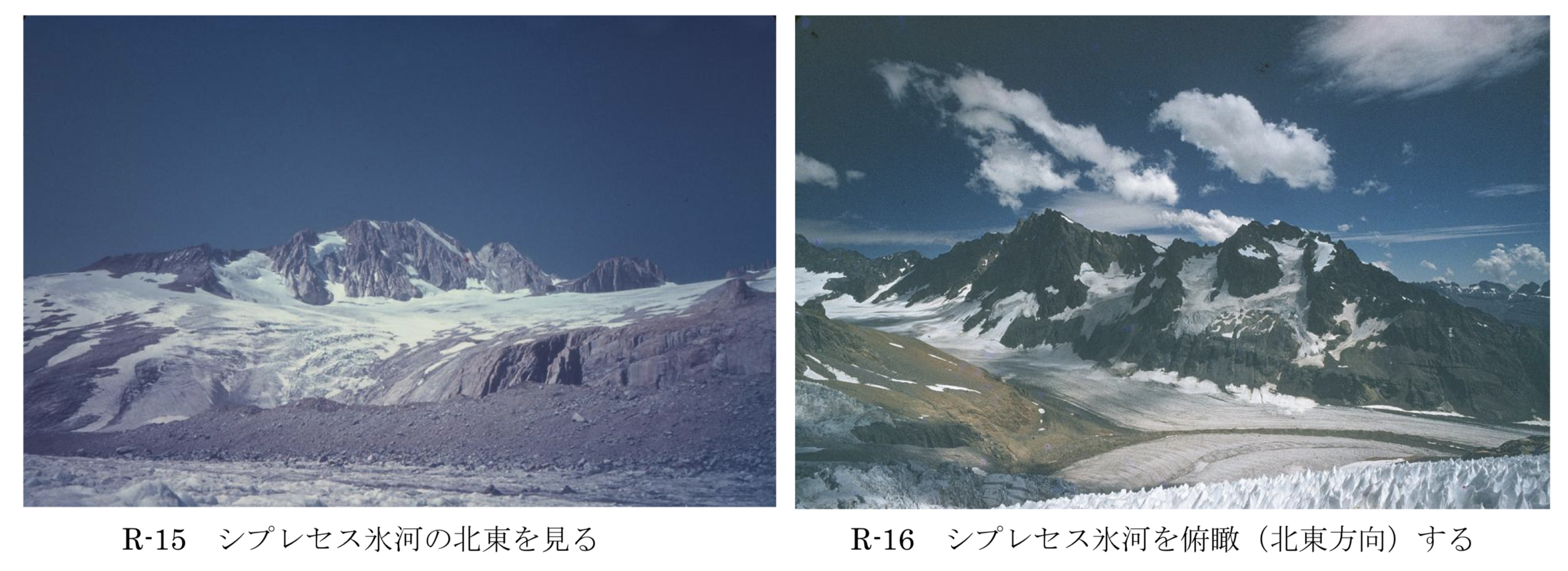
R-15 N-East ridges of Gl. Cipreses Valley |
|
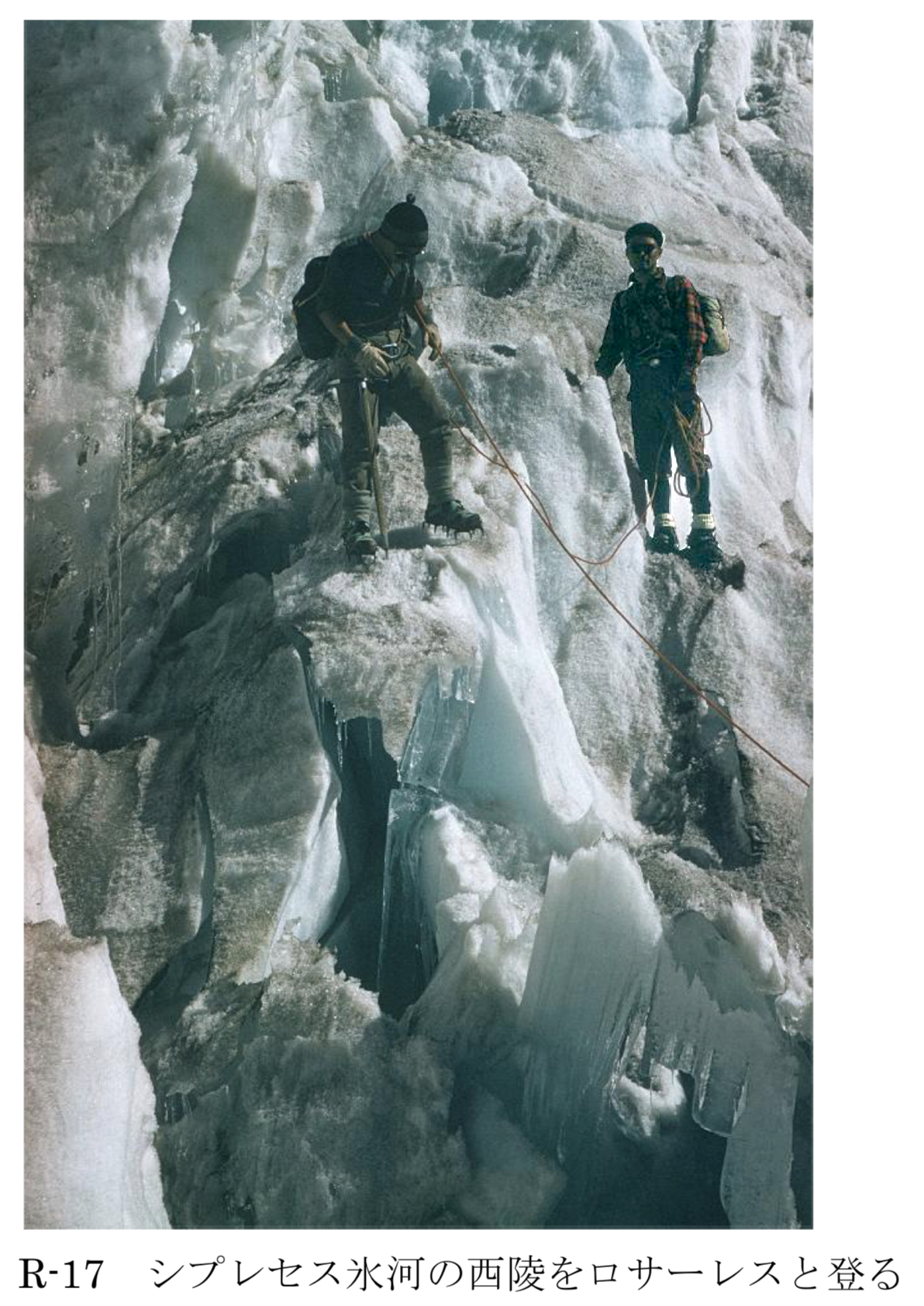
R-17 Climbing through the ice fall of West ridges (Toyoda at right)
|
|
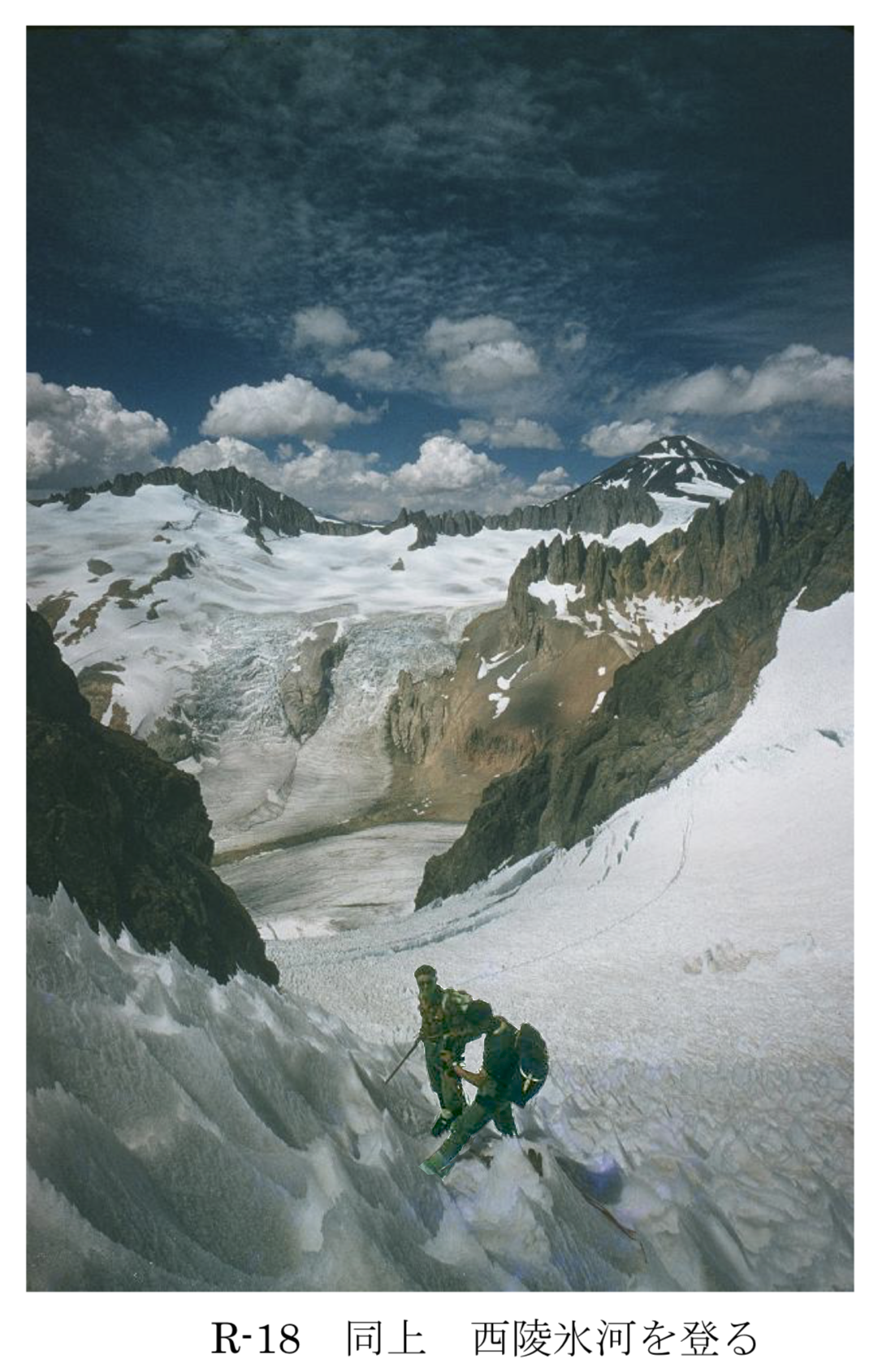
R-18 Passing through Nieve Penitente slope (Toyoda at left) |
|
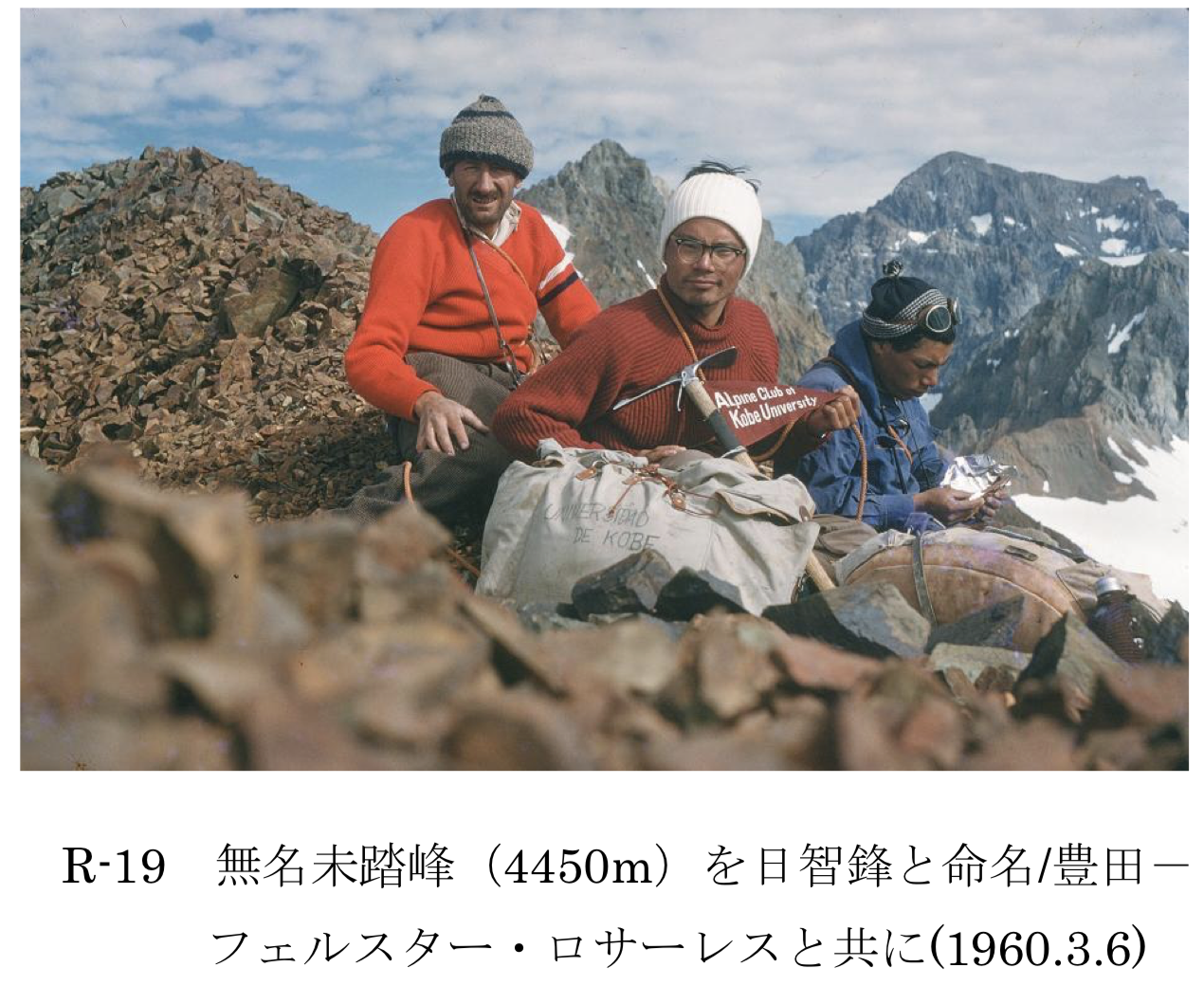
R-19 Toyoda (middle) with Forster & Rosales at the summit of an unnamed peak (christened "Chile-Japon" 4450m/1960.3.6) |
|
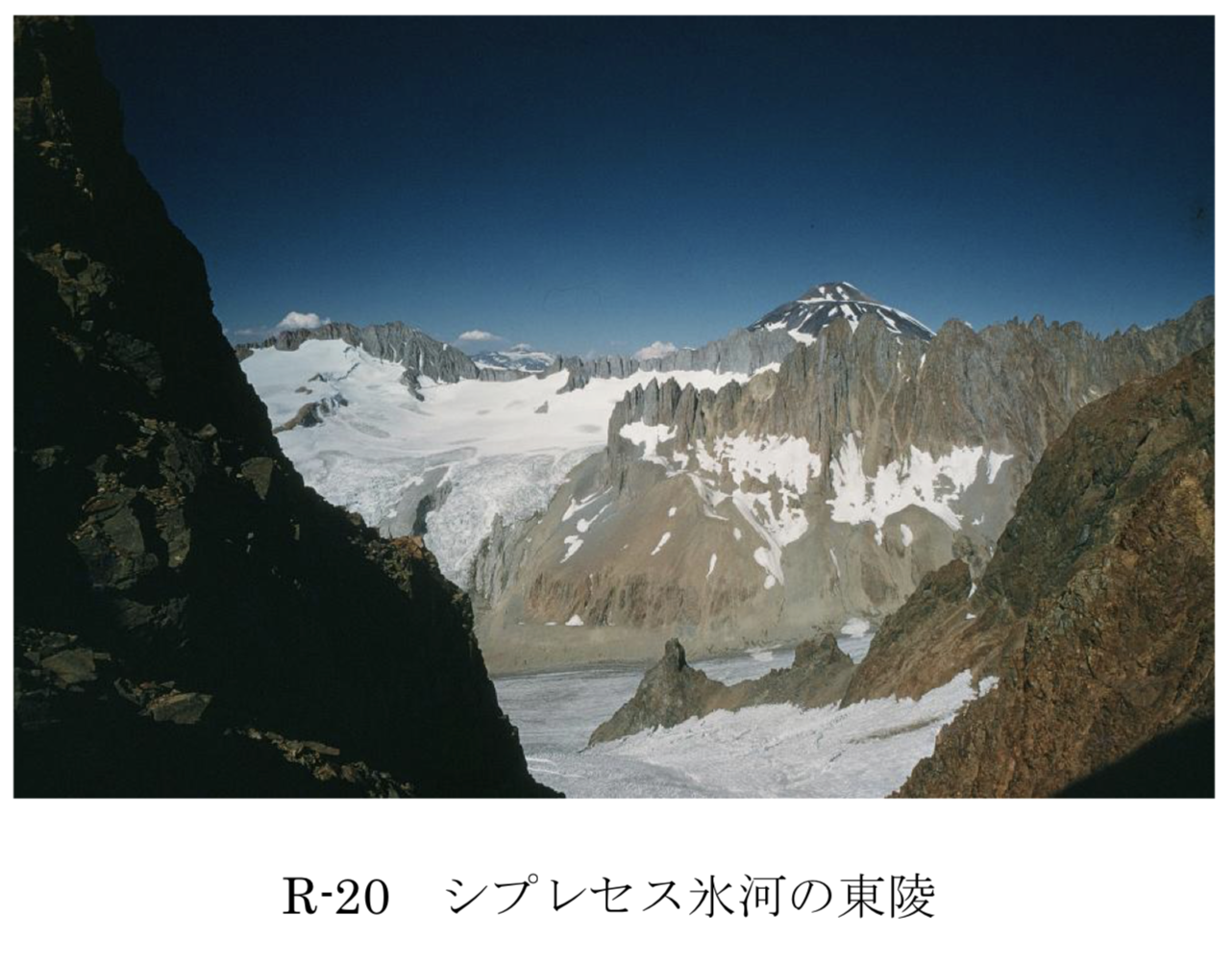
R-20 East ridges seen from the opposite side which formed the branch peaks to Border mountains |
|
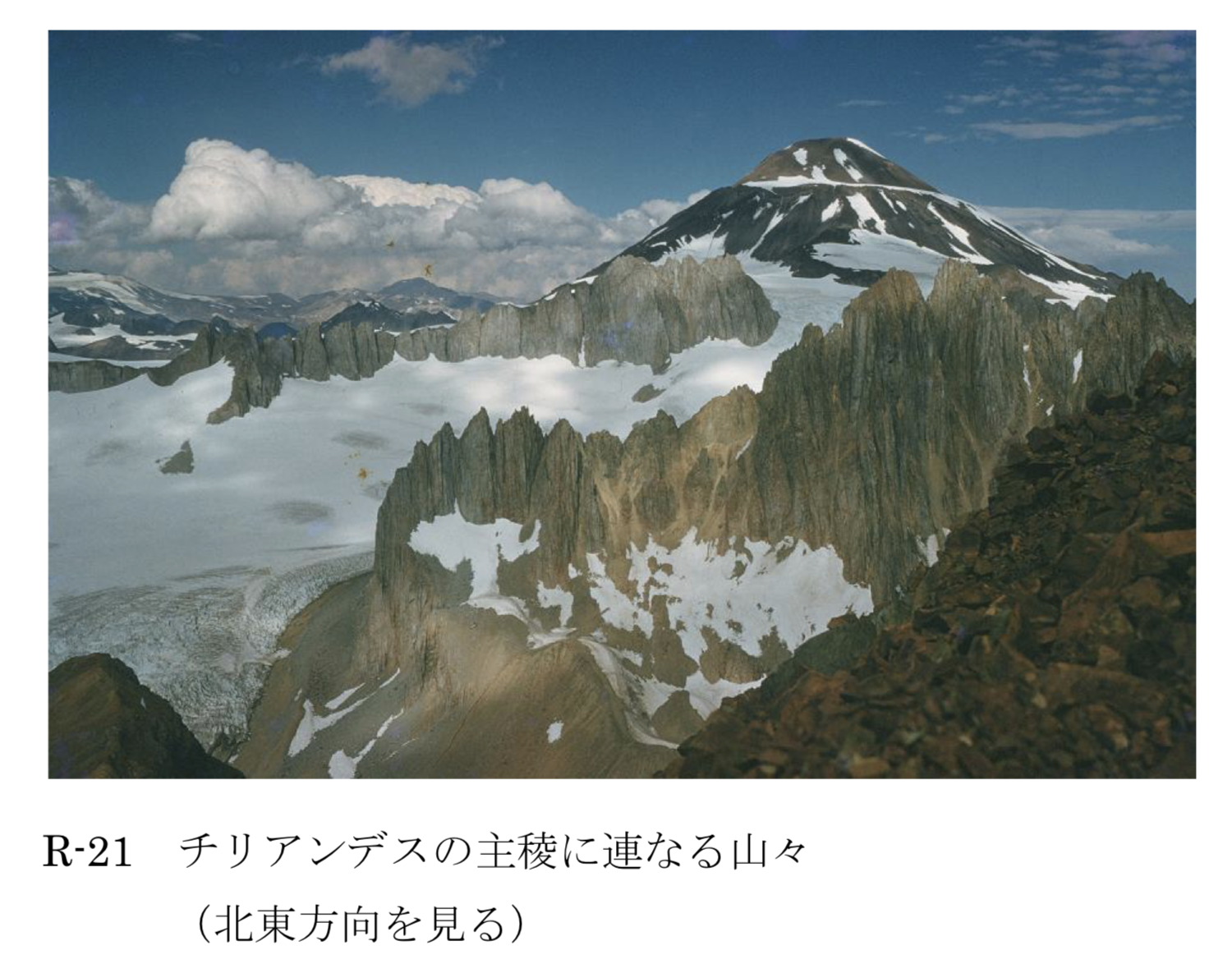
R-21 View of East ridges with Volcano Paloma in their back |
|
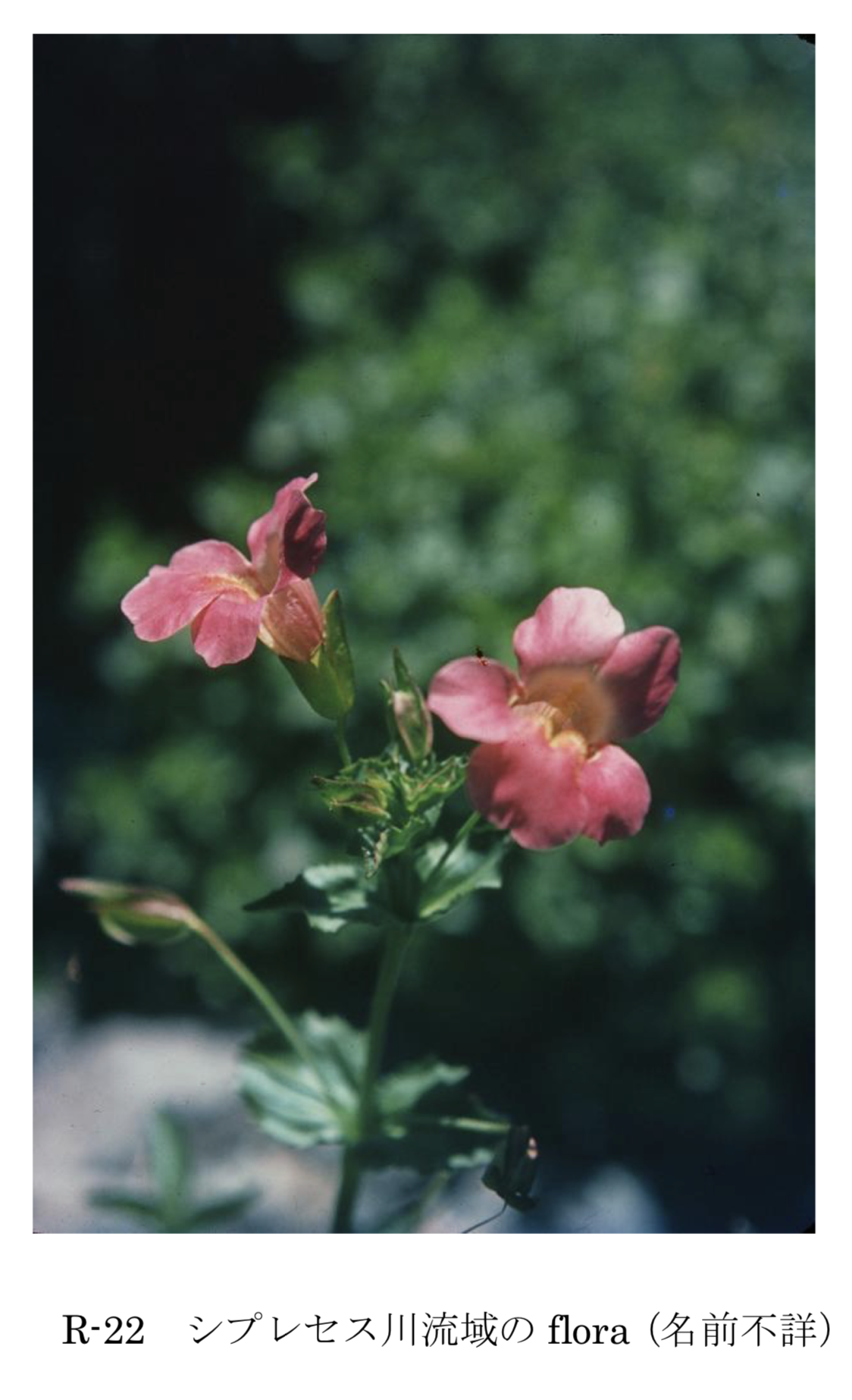
R-22 Flora in Central C. Andes (name unknown) |
|
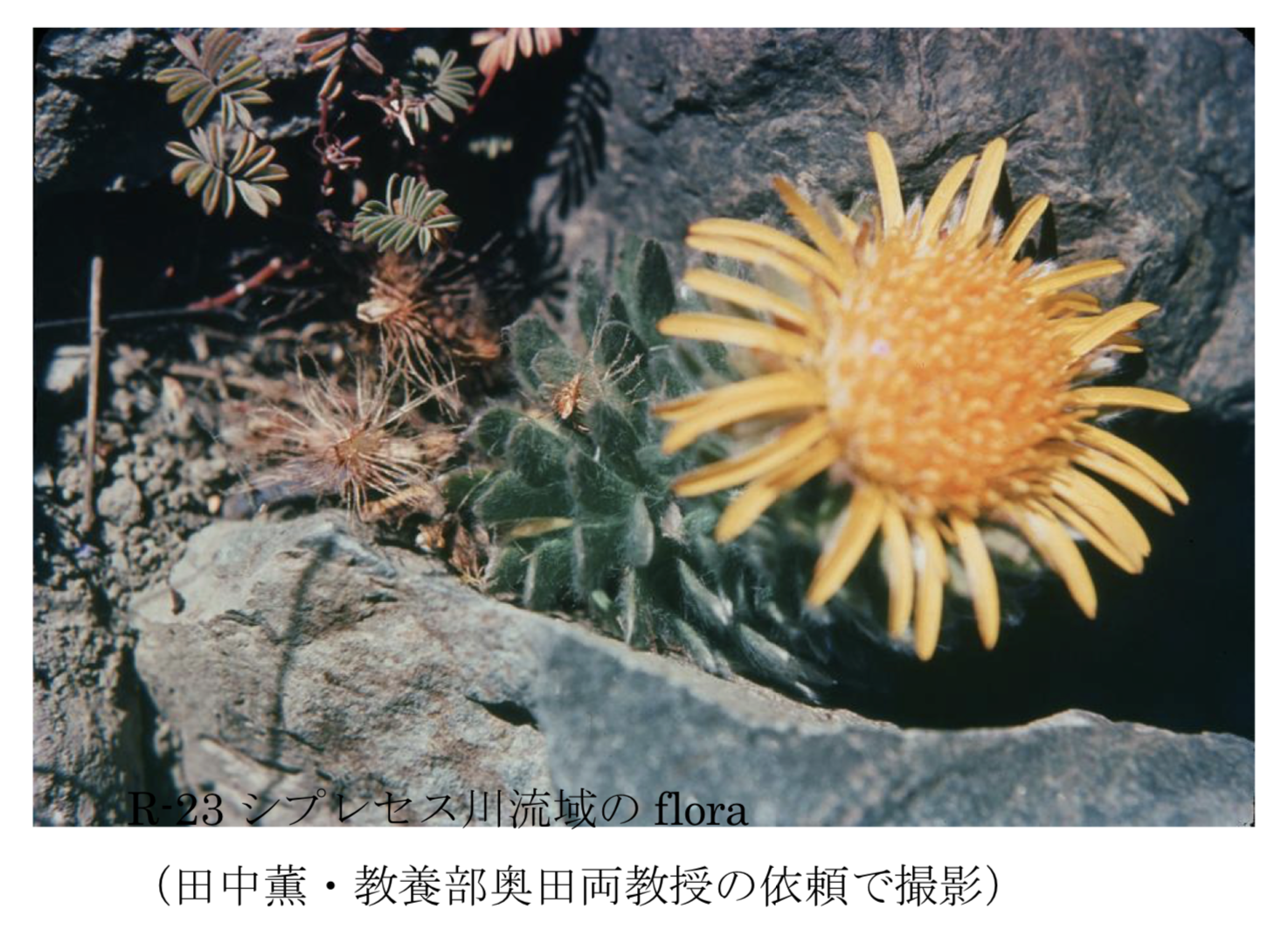
R-23 Flora in Central C. Andes (name unknown, these pictures were taken as per request of Kobe University researchers)
|
|
Colorado March 19- April 4, 1960. |
|
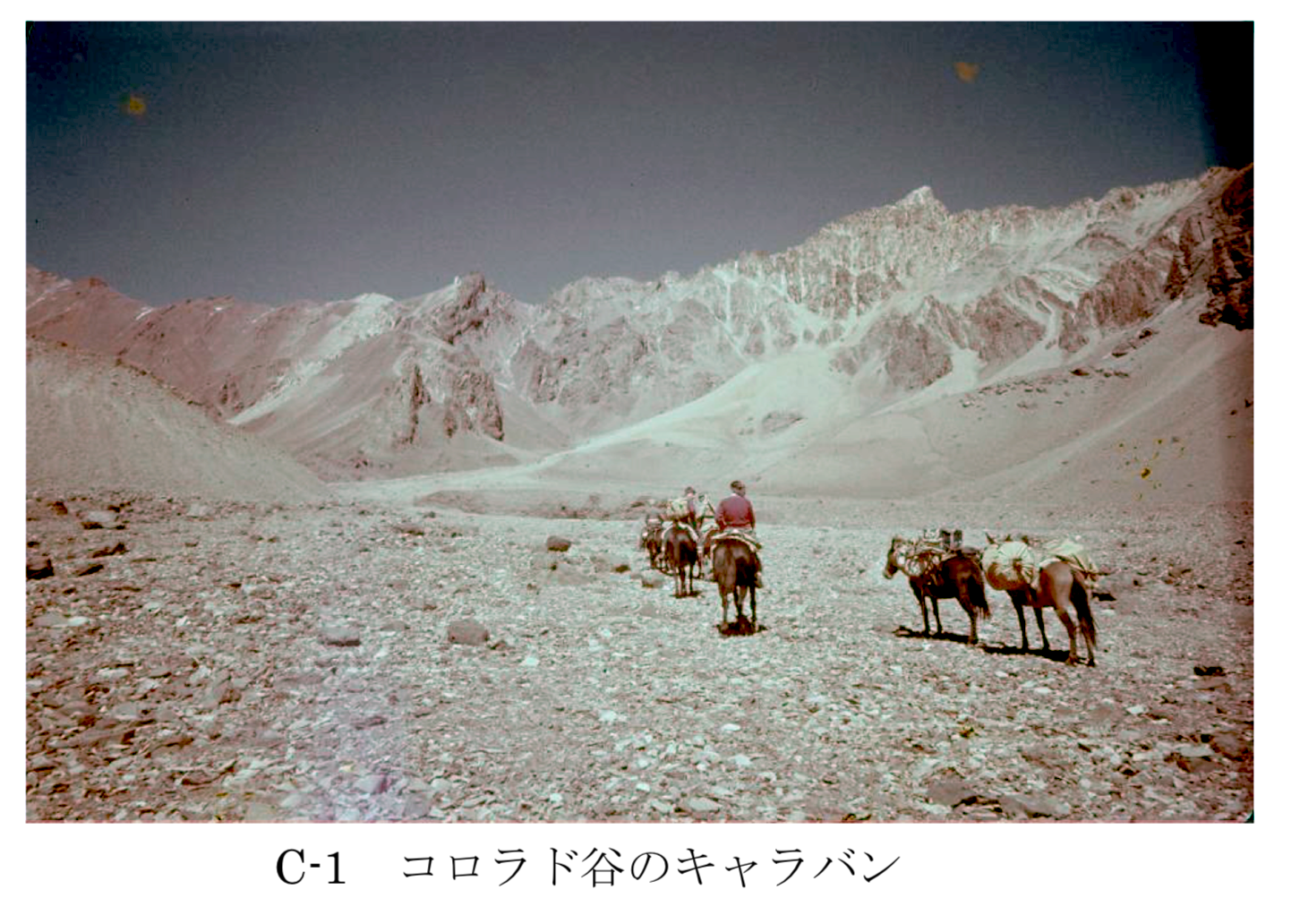
C-1 Caravan through the highland up in the tributary of Rio Colorado |
|
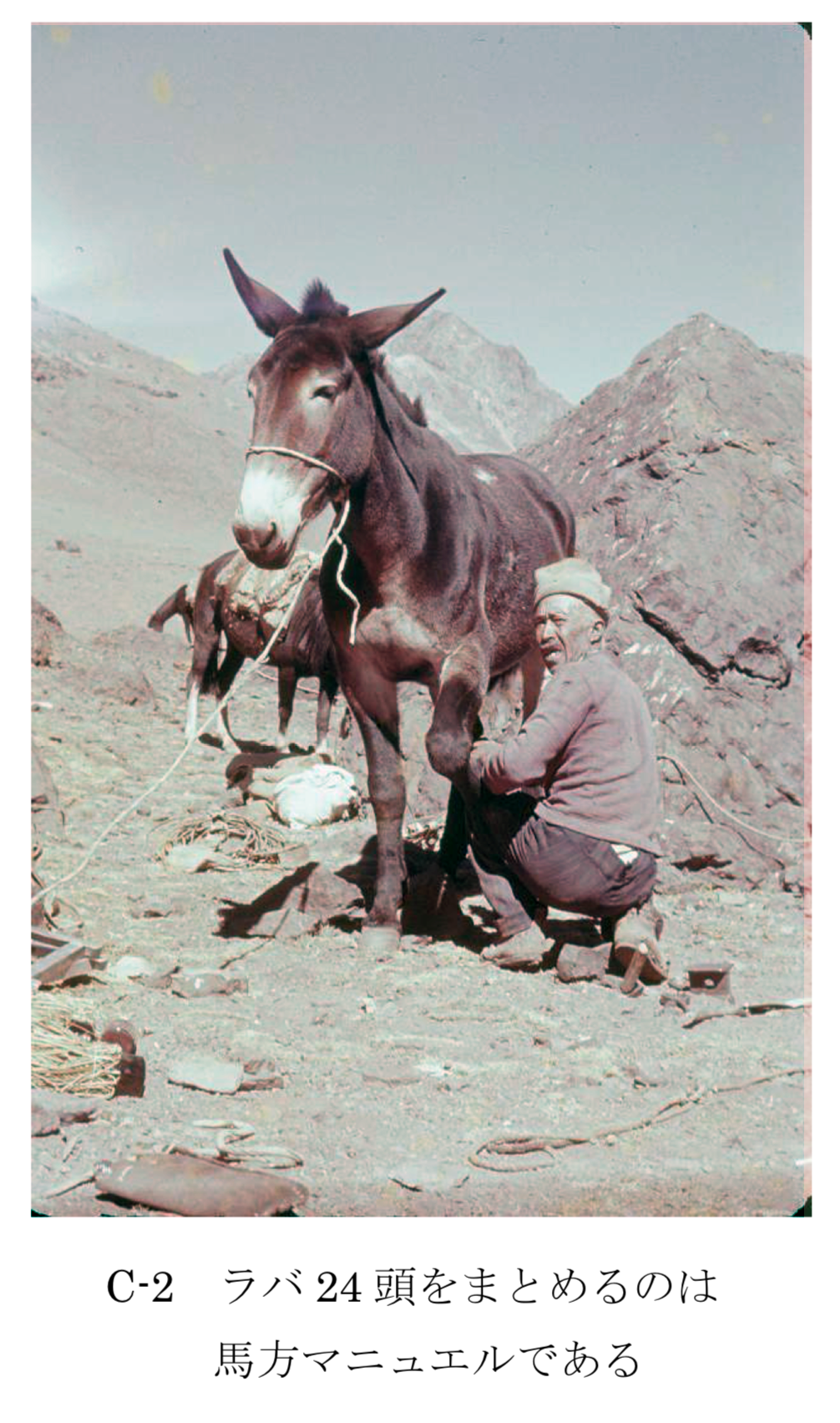
C-2 Arriero Manuel who managed 24 mules with his assistant |
|
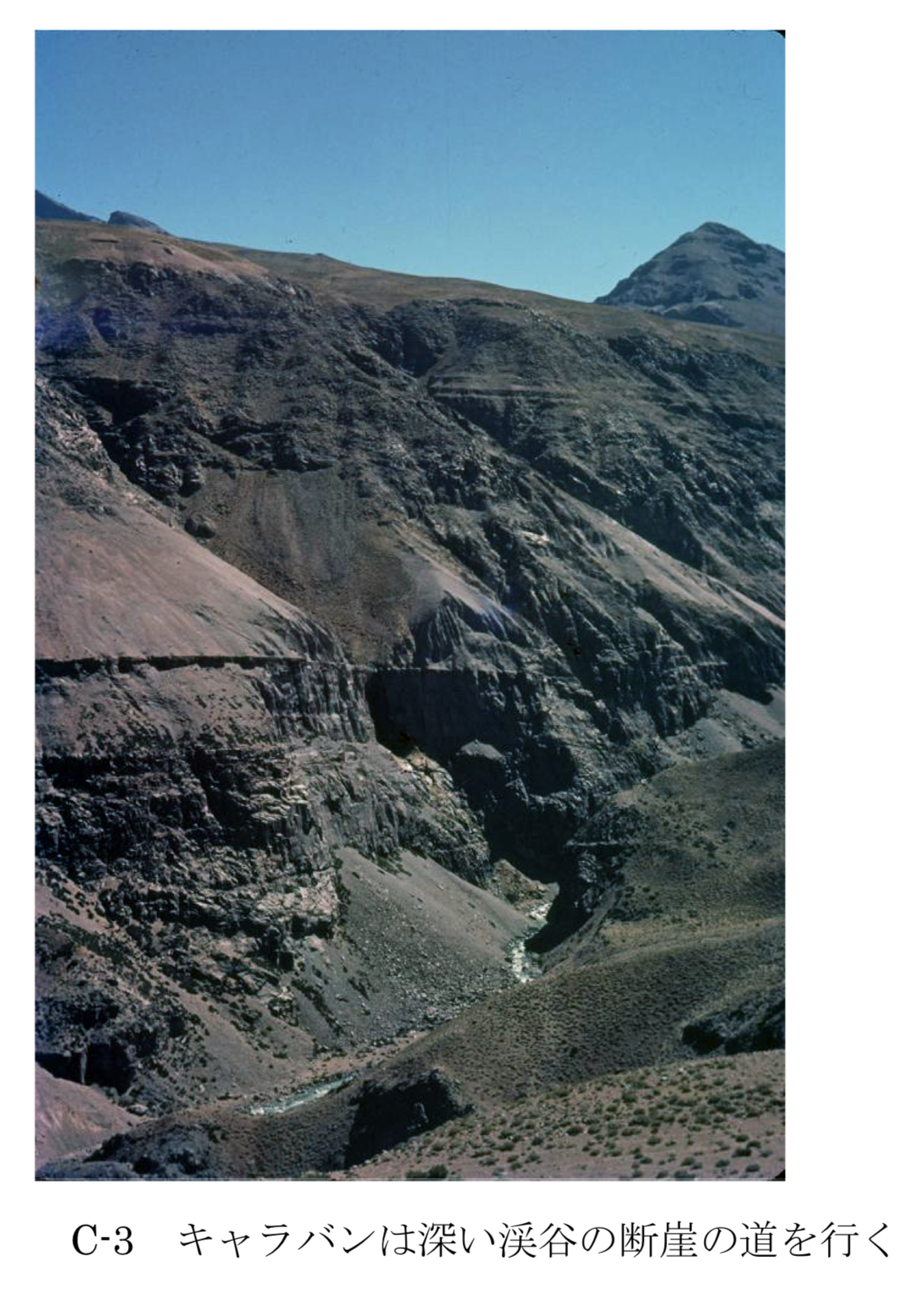
C-3 Caravan went through the trail high up of Rio Colorado Canyon |
|
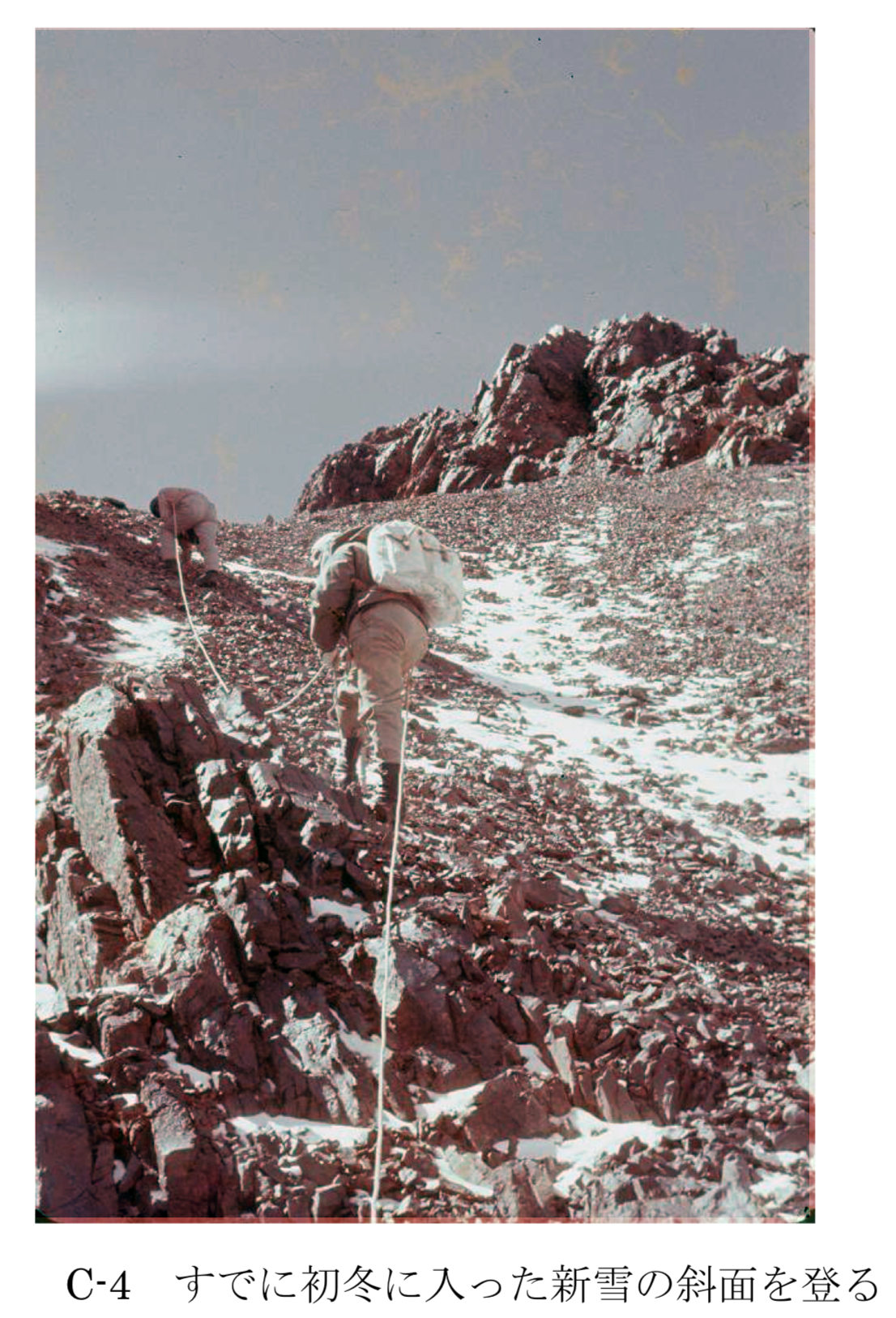
C-4 Climbing the ridge through the slope covered with fresh snow |
|
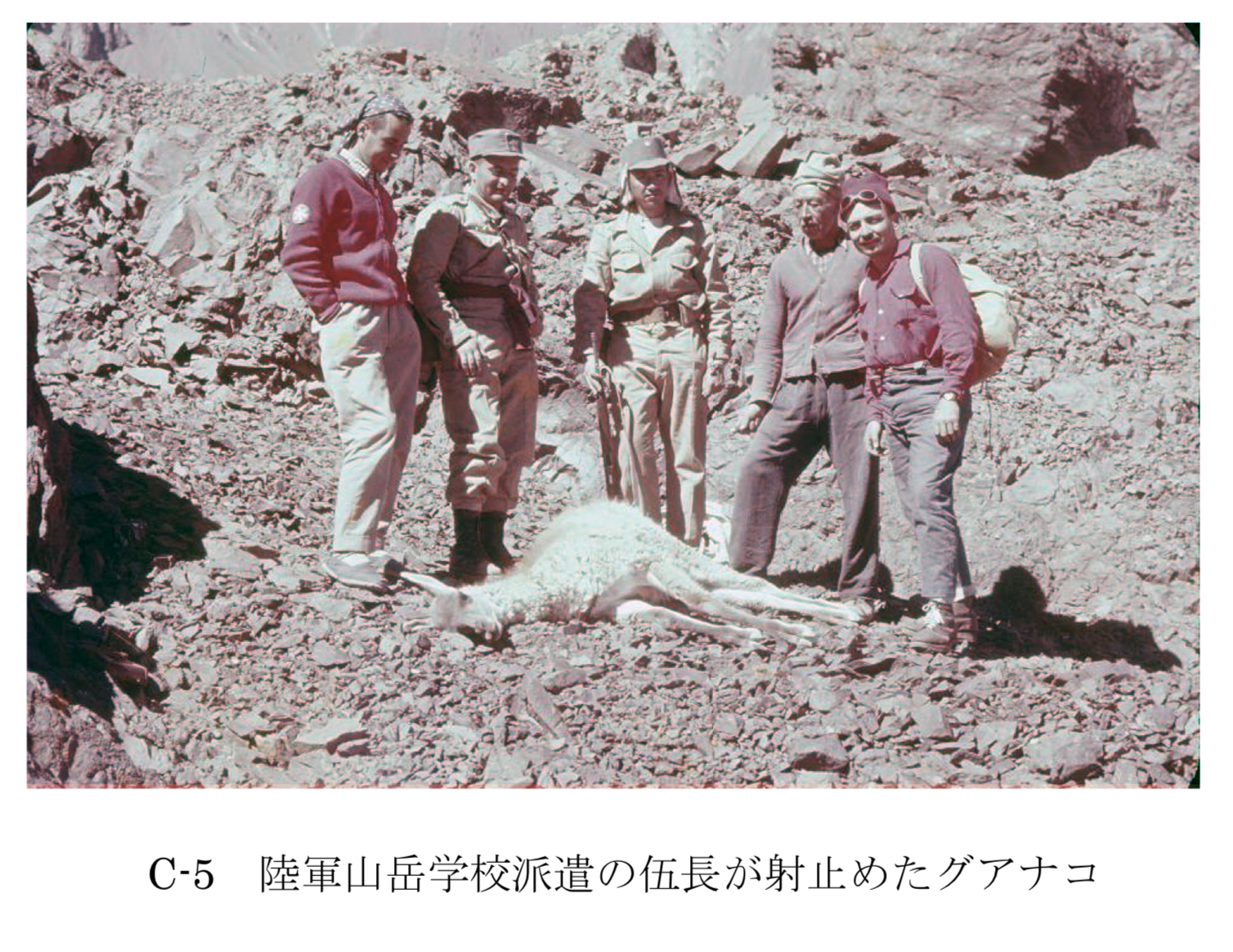
C-5 Guanaco shot by the border guard with us. The guanaco (Lama guanicoe) is a camelid native to South America, closely related to the llama. Its name comes from the Quechua word huanaco (modern spelling wanaku). Young guanacos are called chulengos. Guanacos are one of two wild South American camelids, the other being the Vicuña, which lives at higher elevations. L to R: ?, Teniente Bocaz, ?, Arriero Manuel, ? |
|
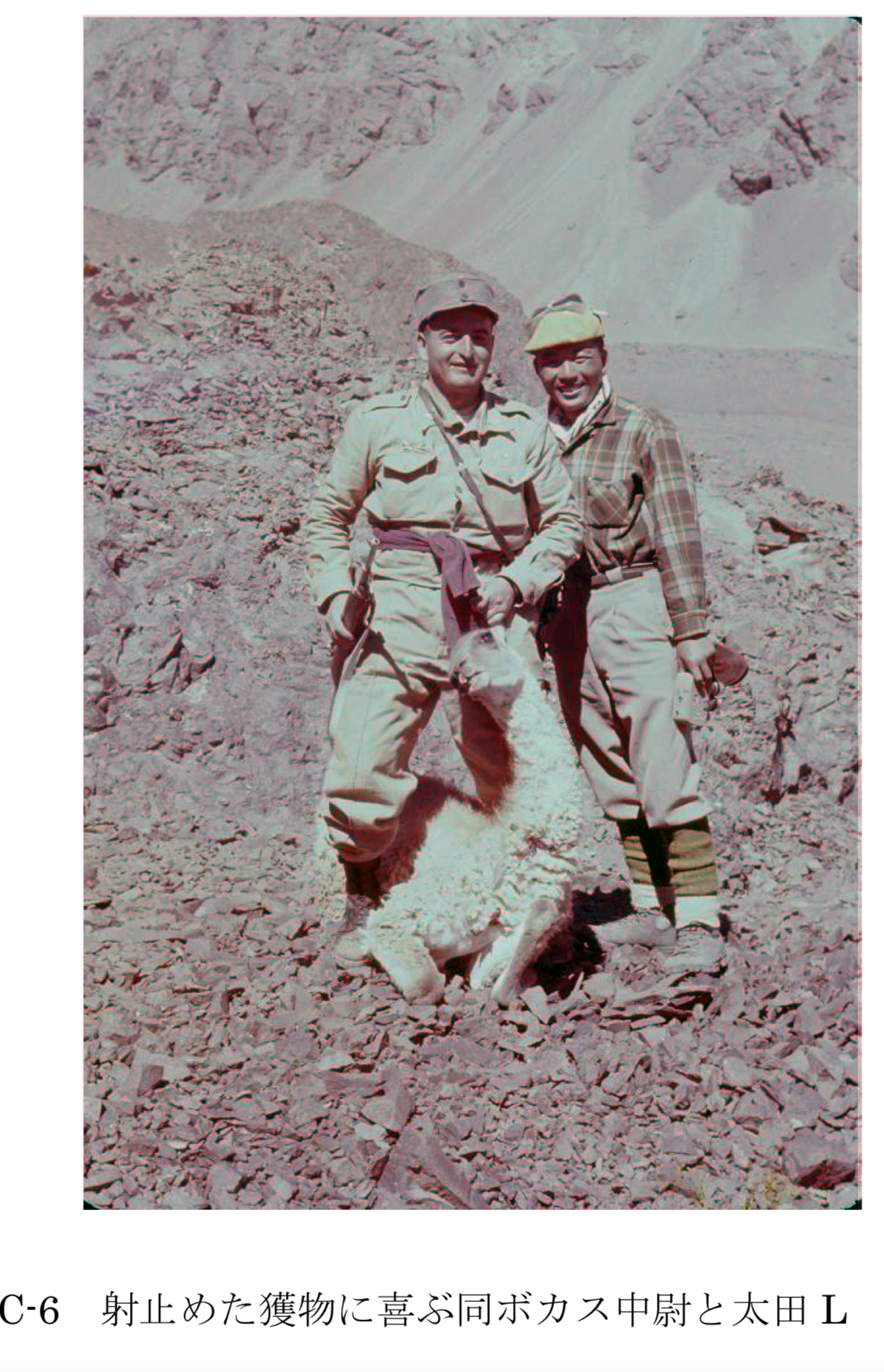 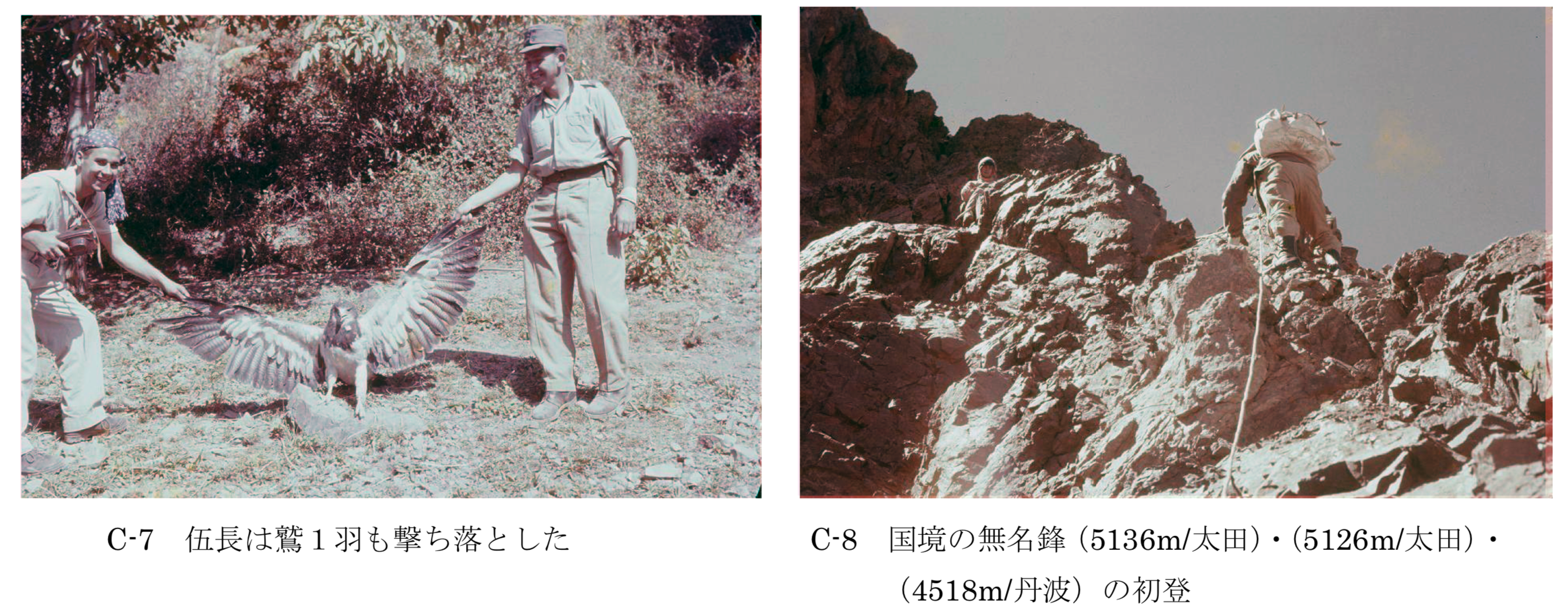
C-6 Teniente Bocaz & Ota were excited by a big game |
|
C-7 Border guard shot a condor too |
|
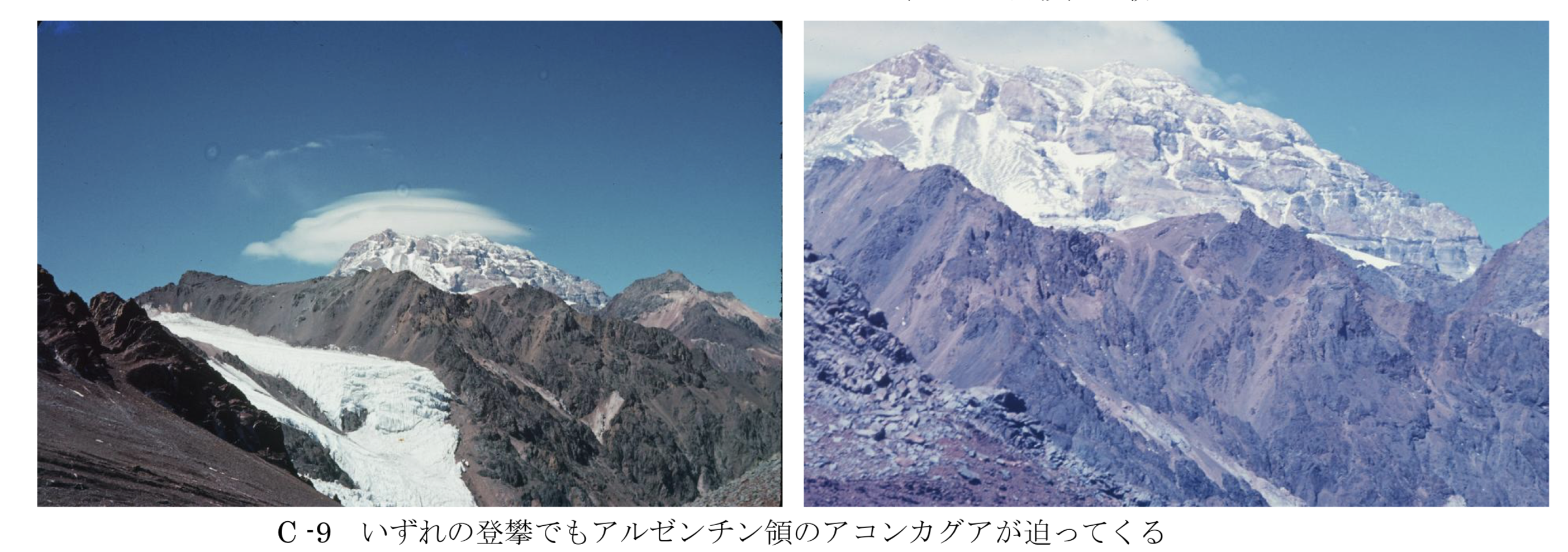
C-9 During each climb we were overwhelmed by Mt. Aconcagua (6960m) of Argentina |
|
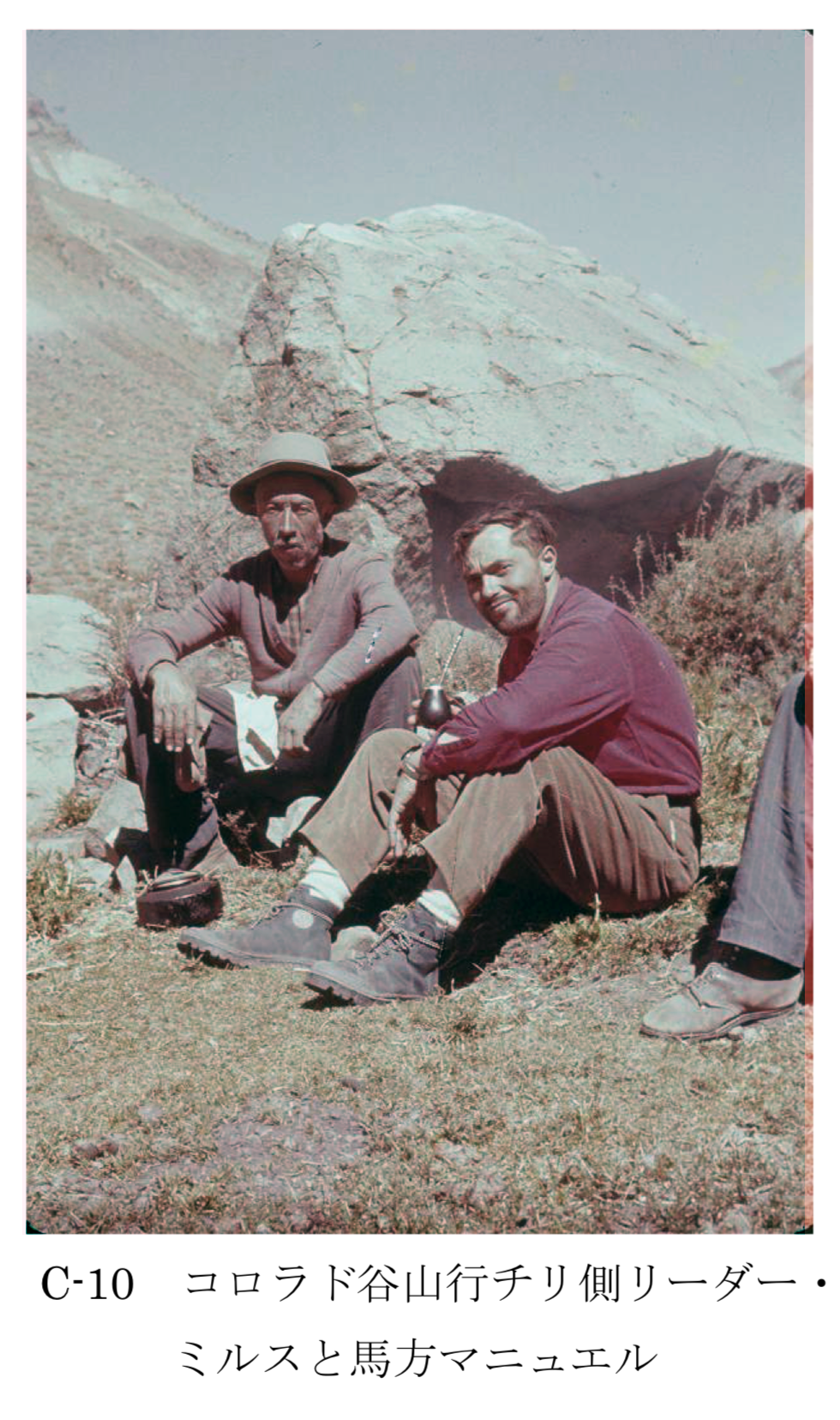
C-10 Chilean Leader, G. Mills, with Arriero Manuel |
|
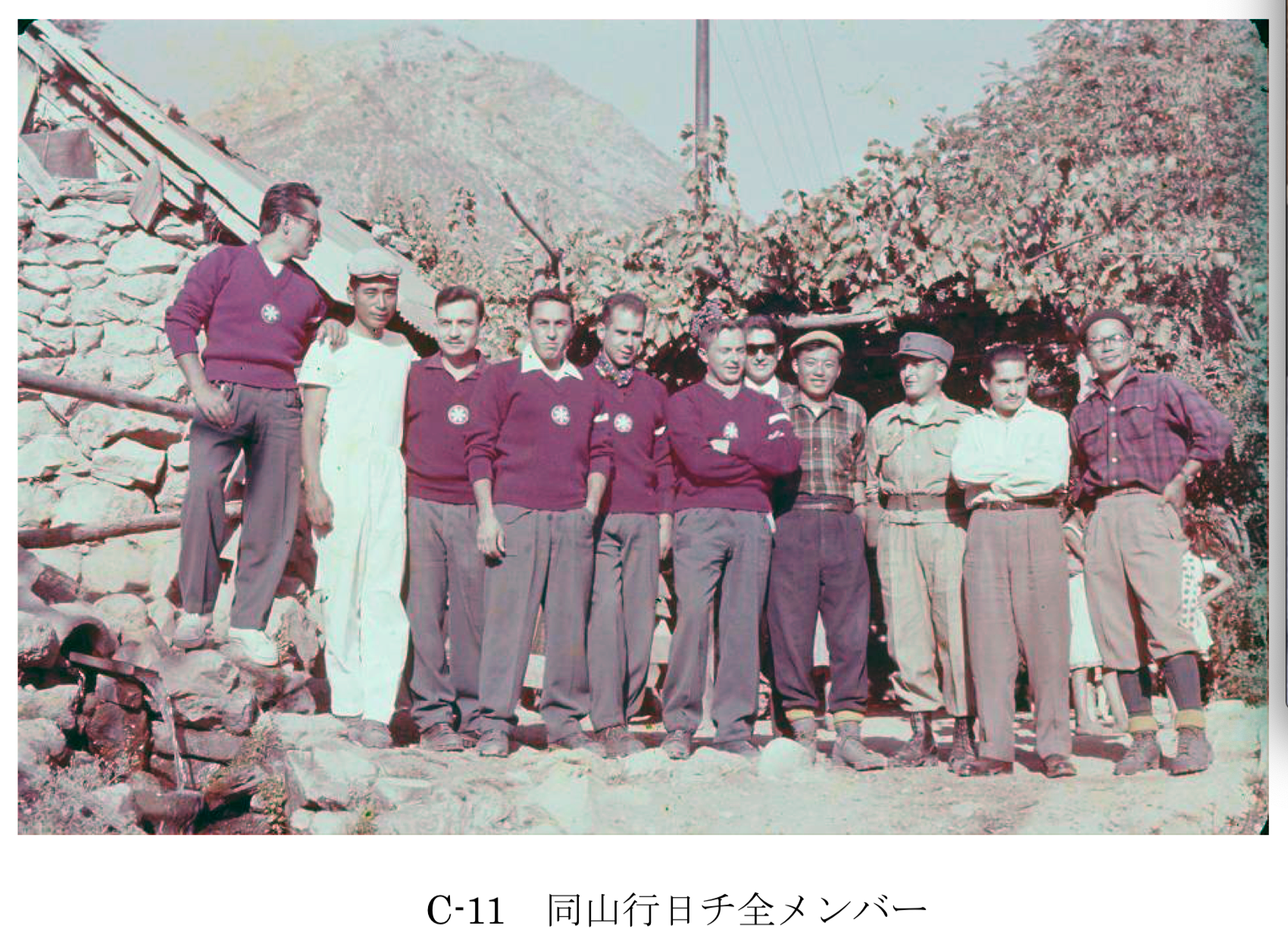
C-11 Members of Chile-Japan Expedition to Rio Colorado Valley. L to R: ?, H. Tanba, ?, F. Rojas?, ?, ?, ?, ?, N. Ota, Teniente Bocaz, ?, Hisao Toyoda
|
|
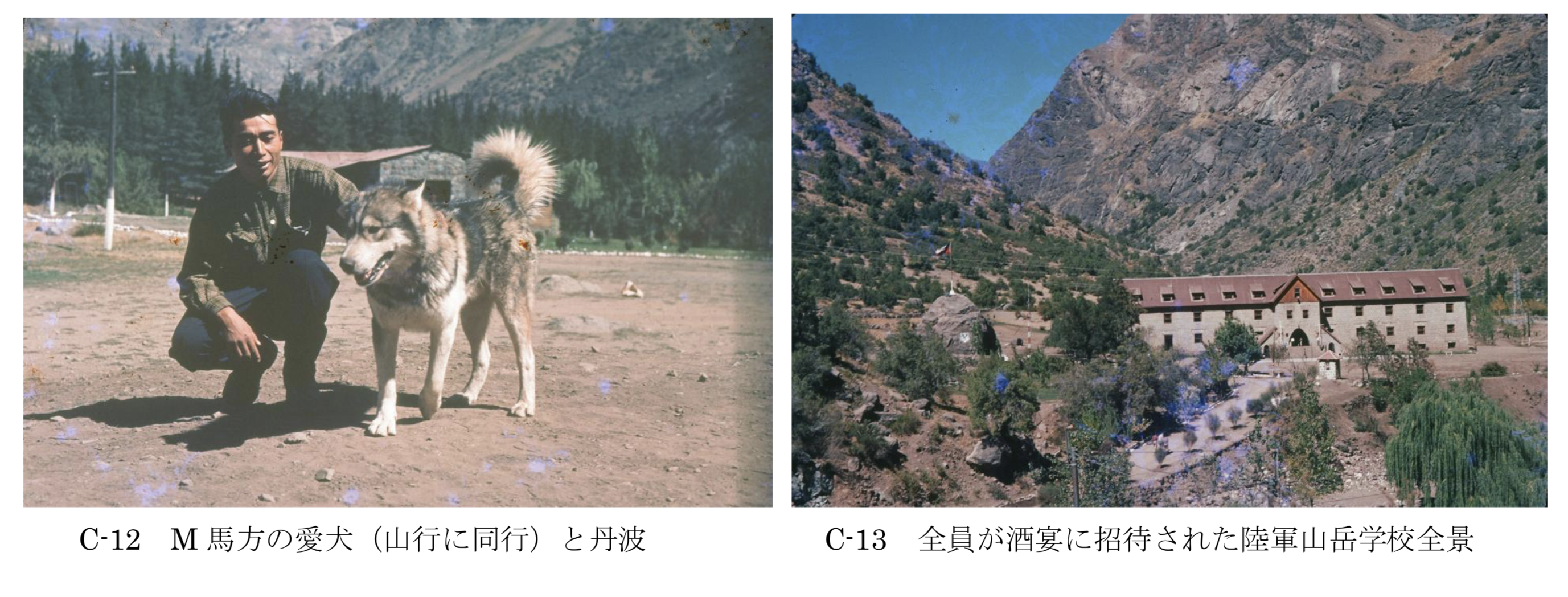
C-12 H. Tanba with Manuel’s dog |
|
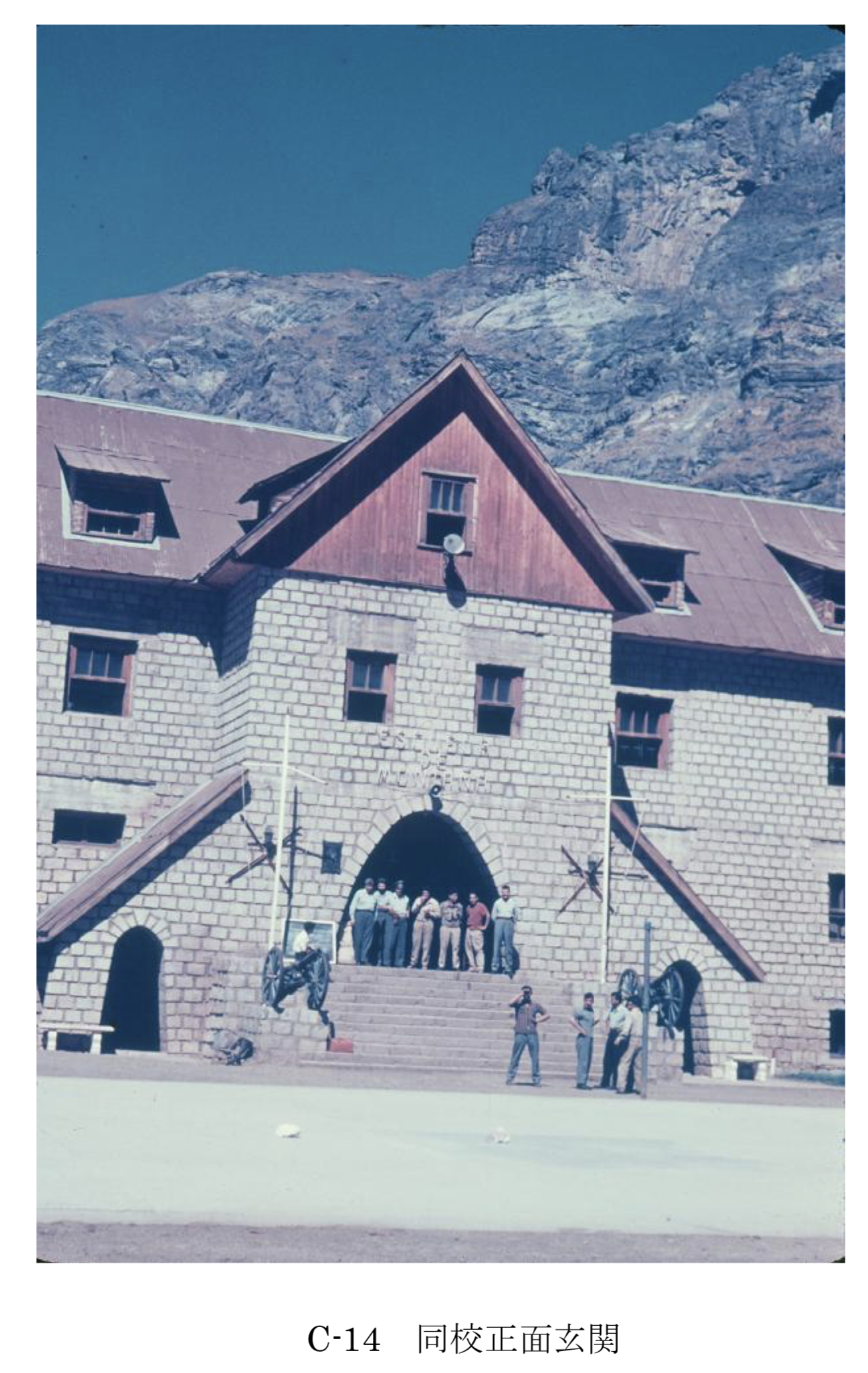
C-14 Entrance to Mountain School of Chilean Army |
|
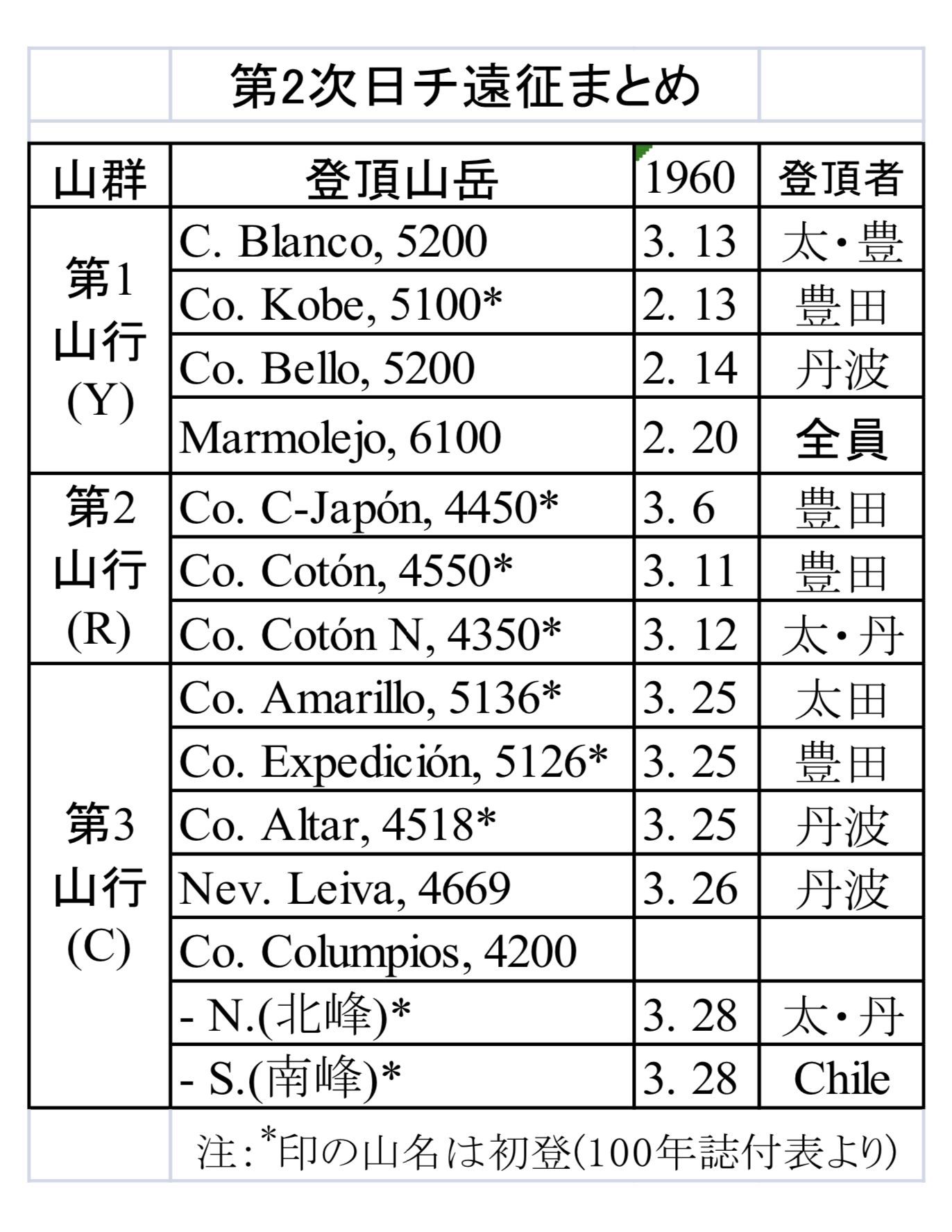
Table of Peaks
|