“A History of the Congregational Church of Austin”
by Pat and Mel Oakes
2014
Sources include: Histories by Hildegard Kuehne Everett, Ralph Bickler, Annie Doom Pickrell, Additions by Matt Wilding, Mathis Blackstock and Brenda Tingle
T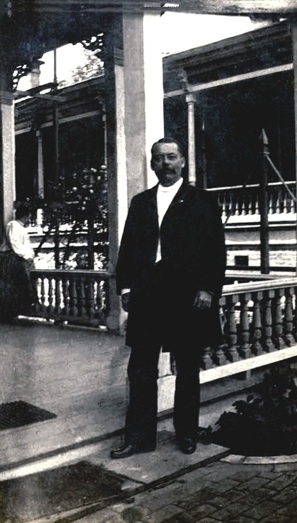 he history of the Congregational Church of Austin, Texas, begins in the early part of the 20th century. The minister,Rev. Ritchie J. Briggs (at right), of Tenth St. Methodist Church (located at what is currently Brazos and Mulberry (Tenth) Streets), ceased believing in a literal hell and had other problems with the Methodist hierarchy. Twelve followers signed Articles of Incorporation on March 21, 1901, and filed them with the State of Texas on April 2, 1901, to become an independent church named The Methodist Church of Austin. The twelve were Major William Martin "Buck"Walton (1832-1915 attorney, Attorney General of Texas 1966, D. W. Doom (1848-1909 Judge), John Hardeman Pope (1827–1903 farmer), William Rust Neville (1854-1920 pharmacist), A. O. Watson, Joel Henry Berry Miller (1833–1911) attorney), C. C. Moore, H. C. Morrow, Norman Potter, Valentine O. Weed (1849–1935 funeral director), D. H. Doom and James Pleasant Hamer (1867–1930 attorney and ice manufacturer). The corporation was to exist for 50 years. (It was renewed in 1951 as The University Community Church of Austin.)
A 1901 Registry of the church list names of the first members and gives the following brief history of the founders. "The Old Guard" is composed of the 56 members who organized the church and whose membership bears dates of April 7 and 14, 1901. The members whom the pastor denotes as the "Founders" are the three devoted spirits who rescued the movement when menaced by failure and made the First Congregational Church a possibility and an actuality in Austin. They are Judge D. W. Doom, Mrs. Era Hereford and Mrs. Ella Farr. A note by a later writer says, "Judge Doom and Mrs. Farr were faithful until death. Mrs. Hereford yielded to tempting enemies of the church and withdrew in 1915." Ella Rose Clark Farr was the wife of T. J. Farr (?–1885). They had a son, Thomas (1881–1955) a druggist. Ella, born in Missouri in 1856, died May 1, 1909 and is buried in Oakwood Cemetery in Austin.
Dr. Briggs agreed to become the pastor of the newly incorpoarated church and preached the first sermon on Easter at the Odd Fellows Hall at the northeast corner of East Ninth Street and Congress Avenue. Under his leadership, church membership grew rapidly during the following four years.
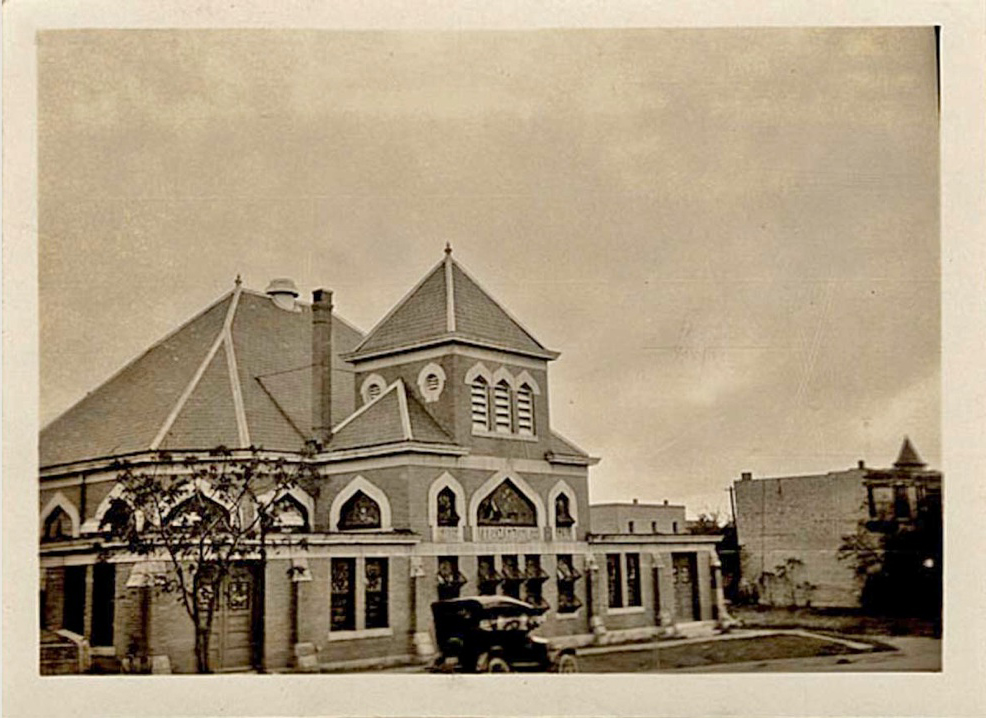
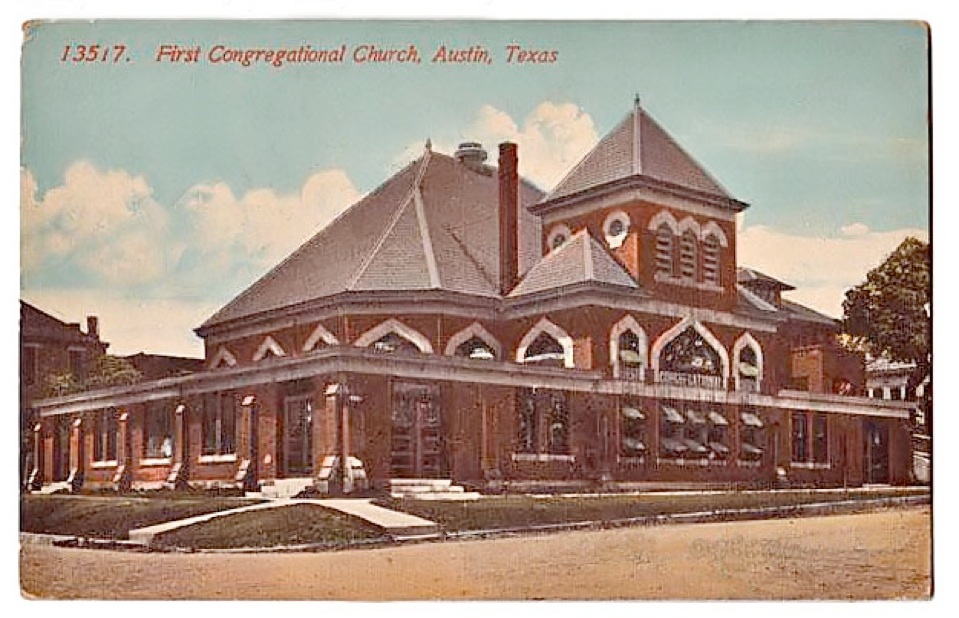
Funding the new church was difficult, and the members decided to affiliate with the Congregational Conference of Texas and changed the name of their church to First Congregational Church of Austin on March 2, 1904. The Articles of Incorporation were amended on July 4, 1905 to reflect this name change. On June 26, 1906 the church entered into an agreement with the Congregational Church Building Society of New York to receive a loan of $1800 to build the new church. The conference made low interest loans available. Arthur Osborn Watson (1864-1935), an architect and member of the church, designed the building, shown above, which was completed in 1906 at Ninth and Colorado St. Stained glass windows in the present building are a heritage from that building. Watson also designed the courthouses in Dewitt, Llano, Milam and Val Verde Counties. An entry in the Texas State Historical Association web site states, “The church was an imaginative stout masonry building with a large center hall spanned by an iron trussed roof. Its style was quite unusual at that time. The gentle gothic-revival All Saints (Episcopal) chapel in Austin was also designed by Watson. Watson was active in the First Congregational Church, the Boy Scouts and, later, was a member of the congregation of St. David's Episcopal Church. He and his wife Minnie (Pope) Watson had one son.”
Reverend Dr. Briggs held four academic degrees and had served as a Methodist minister in a number of states. Rev. Dr. Briggs was a brilliant scholar, a gifted and forceful pulpit orator, and beloved leader of the total community. He ministered to many who were rejected by other ministers. Over the next ten years, the influence of church and Sunday School increased and the congregation attained a membership of two hundred and fifty members. There were a total of nine Sunday School classes with a membership of ninety.
Reverend Briggs became ill in 1914 which later was diagnosed as liver cancer. After surgery in Austin, he sought treatment at the Mayo Clinic in Rochester, MN, however they advised that there was nothing to be done. He had to have assistants to aid him. Assistant ministers included John Harbeson, Dr. P. C. Burhans, A. D. Shaw and A. O. Stevens The inability of Reverend Briggs to preach resulted in a serious loss of membership. The next few years became a period of transition as the leaders of the church decided to move to a location nearer the University of Texas in 1921. This decision was not an easy one. In an undated report of a special committee appointed to consider the proposition to sell the church property and move into the University neighborhood, the committee reports that it had listened to a presentation by Mr. F. C. Morse proposing the move. After deliberation, the committee made the following recommendation, "That it is unwise at the present time to sell the property with a view of locating near the University." Other recommendations were to urge the establishment of a Bible Chair at the University of Texas, to raise the budget of the church expenditure to $2550 to include the full payment of the Pastor's salary and other expenses and finally that the Church officially request an appropriation of $1200 from the national offices in New York City, in order that the Bible Chair may be promptly established with the recommendation that this money "be made available to the man who will serve as Pastor of the Church–thus assuring a much higher grade man than could otherwise be secured for the Bible chair, or Pastorate, at such a small expenditure of money." Members of the committee were prominent people in the church and the city. They were A. O. Watson (architect), Annie Doom Pickrell, daughter of Judge David H. & Esther Prisey Houston Doom, State Historian of the Daughters of the America Revolution and author of “Pioneer Women in Texas", B. F. Pittenger, Dean of the UT College of Education and Chair Dwight Egbert Breed (1884-1926), Executive Secretary of the Texas Public Health Association.
The Texas Bible Chair under discussion above was not a Chair in the university. It would have been part of the program of that name established in 1904 to provide classes in the study of the Bible. Students could receive university course credit for these classes. The teachers were under university supervision. The classes were taught in the Texas Bible Building ( which consisted of an auditorium and residence for the director) and the YMCA Building. The Association of Religious Teachers, consisting of various ministers in Austin, were teaching these classes to university students. Presumably the Congregational Church had hoped to join this program. There are many newspaper stories dedicated to the program, however none list any Congregational Church of Austin involvement.
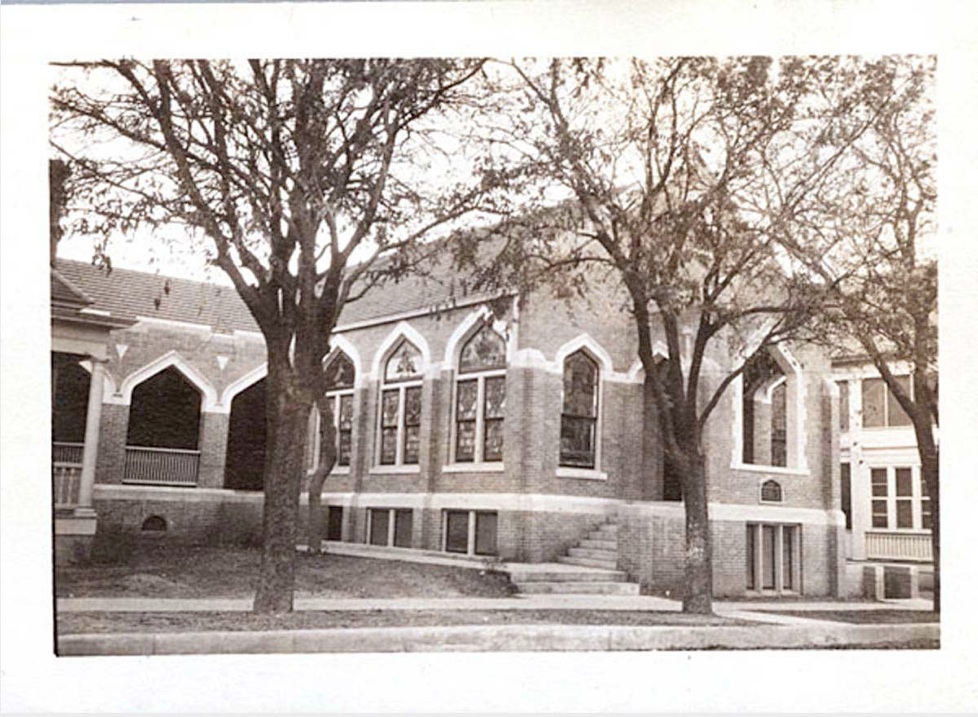
This photograph is from Frank L. Moore Photographs, Amistad Research Center. It is archived in the Tulane University Digital Library under American Missionary Association Photographs, 1839-1954. Written on photograph is, “1st United Congregational Church of Austin, Texas, Dedicated Dec. 9, 1923.”
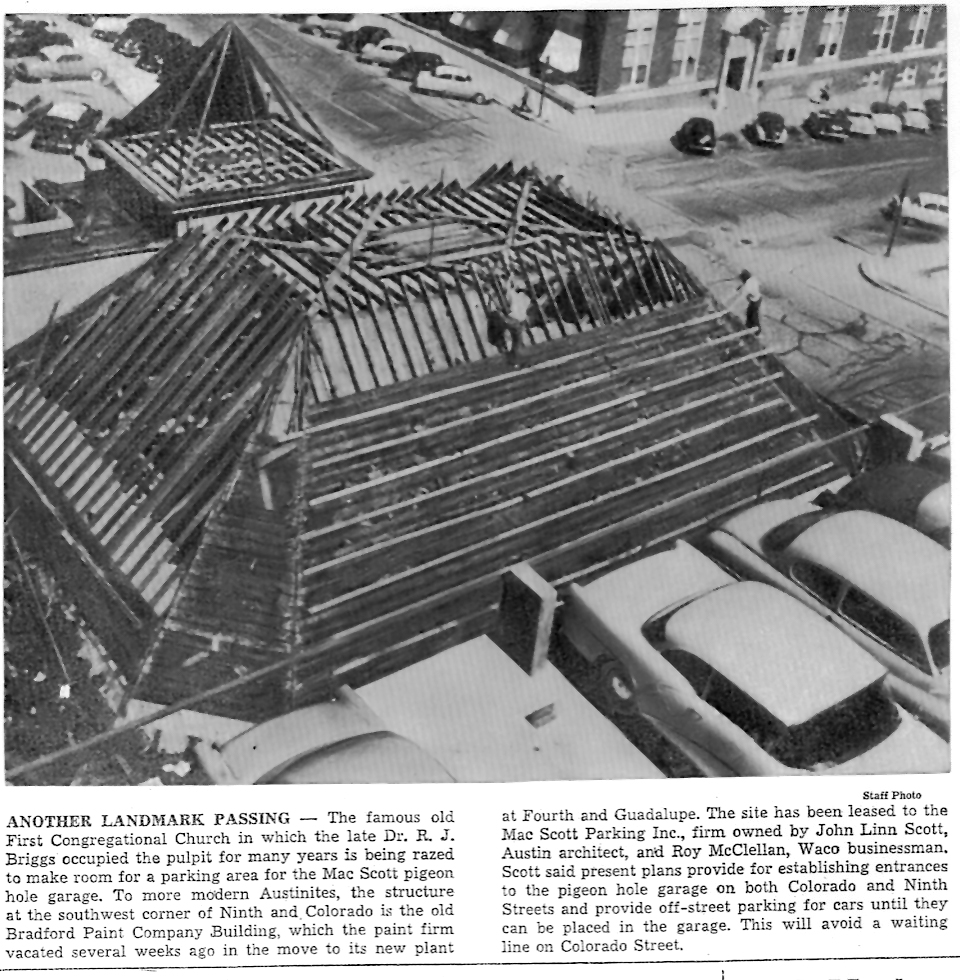
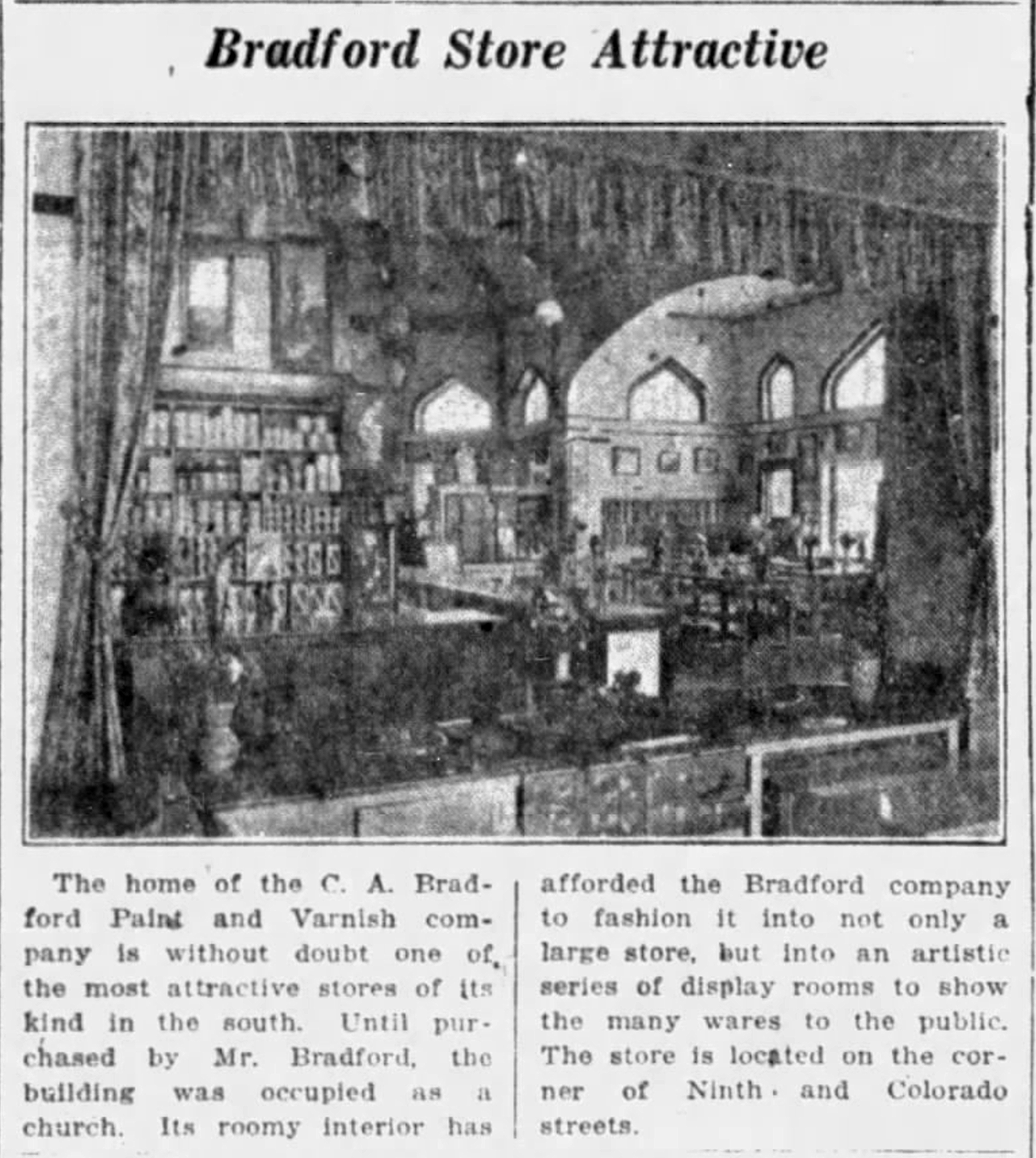 The church sold its building at Nineth and Colorado to Bradford Paint Company. The windows were removed and stored until they could be transferred to the new church at San Antonio Street. A picture, at right, of the inside of Bradford Paint in 1923 lets us see what the church was like inside the sanctuary.
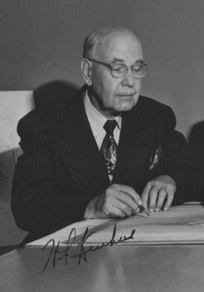 The land at 23rd and San Antonio Streets was purchased March 8, 1923, from Nelson Avery Rector and his wife Willie Stayton Rector, and was formerly used as the Faculty Club of the University of Texas. Rev. Almon O. Stevens made the announcement March 8, 1923 Austin American-Statesman. Details of the planned construction are announced, see below. The Austin American Statesman in its July 2, 1923 issue, reports that construction will start on July 3. Initial construction will be two sections, Sunday School room and chapel. The cost is $25,000. The "church proper" will be built later. A building permit was received in October 1923 for erection of a $27,000 edifice. The new building, designed by Hugo Franz Kuehne, an architect member (shown at left), was dedicated on Dec. 9, 1923. The contractor was Albert Mundt. Mr. Kuehne incorporated many of the stained glass windows from the former sanctuary into the design of our current church. Some of Kuehne’s other buildings in Austin include the Austin Public Library (now the Austin History Center), Steck Building (1932), the Commodore Perry Hotel (1950), the International Life Building (1952), the American National Bank, and the Texas Department of Public Safety Building (1952). A newspaper article by Frances Higginbotham in the Austin paper, likely the Austin Statesman, describes the dedication. "Tudor -Gothic in architecture, the new building of the First Congregational Church has a viril simplicity of design which makes it one of the most beautiful church edifices in the State. The art glass windows are exceedingly good; for the most part they are memorial ones which have been removed from the downtown church at Colorado and Ninth streets. The pews were also moved from the old church.' The congregation met in the University YMCA building auditorium while the church was under construction.
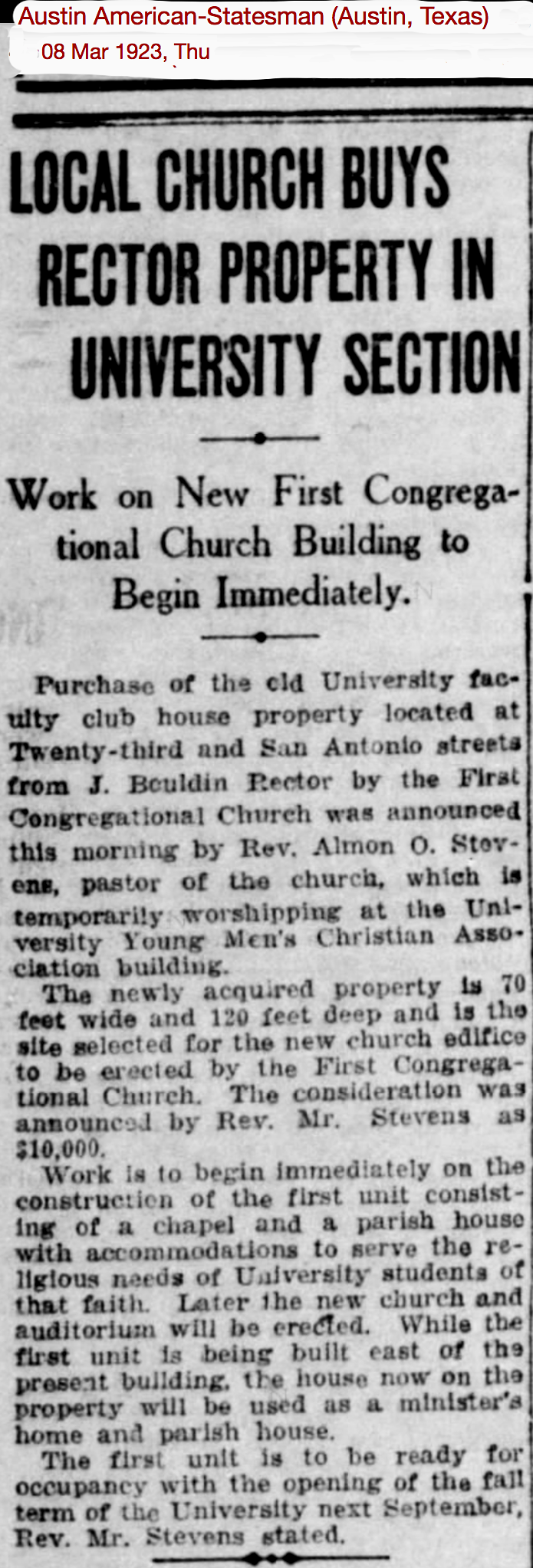 "Plans were drawn by architect, H. S. Kuehne, for a building to cover the whole lot, of which the present building is but a unit. The first unit is so constructed, however, as to make it complete in every way and entirely adequate in size aand equipment for the present needs. Besides the chapel, there is a study for the pastor and a student club room on the first floor, and a conveniently located dining room and kitchen in the basement.'
"Designed primarily for the use of the University students and other young people, the club room will be opened every day as a reading room and for other purposes,, stated Rev. Almon O. Stevens, pastor of the church.'
"No debt has been incurred in onstructing this new chapel. A gift of $12,000 from the National Congregational Church Building Society added to liberal contributions of the members and the amount from the sale of the old church property, has more than paid for the building, the total cost of which Rev. Steven estimated at $26,000."
The church spent $1300 on the dwelling which was remodeled and renovated for use as the minsiter's dwelling. The grounds were extensively landscaped through the courtesy of T. T. Ramsey and Stone of Austin.
Rev. Almon Odell Stevens (1968-) was the assistant who became pastor on Dr. Briggs’ death on June 18, 1923. He and his wife, Laura B. Waters (1867-1948), had three children, daughter Lucia C. and sons Ralph and John M. He was educated at Bucknell ’91, and U. of Chicago and was ordained in 1895. Reverend Stevens, had served churches in Oakland, CA (Plymouth Av), Pontiac City, MI, Elkhorn, WI and Beloit, WI. He resigned on July 1, 1924, because of ill health. Apparently his health improved as he served a church in Stearns, KY in 1930. Rev. Stevens and his wife wrote poetry; two of their poems which won prizes in Beloit are included here.
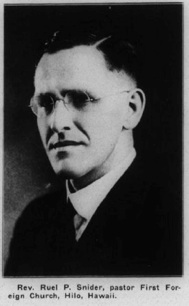 Rev. Ruel P. Snider (shown at right) assumed his duties as minister in January of 1925. He had graduated from UC Berkeley in 1920. He emphasized work with students at the University of Texas. Many members of the University faculty and their families as well as students, became members of the church. The Congregational Conference of Texas considered establishing a Bible Chair but never accomplished this goal. Mr. Snider left on Dec. 2, 1928, for a church at Hilo, Hawaii. He later served churches in Granville, N. D. and Pocatello, Idaho. It should be noted that some time during these years after World War I, several German families left the local churches due to discrimination after the war. They were holding church services in individual homes when the Congregational Church asked them to join their church. Among those families were the Schoch and the Kuehne families.
On Sept. 1, 1929, Rev. S. E. Frost became the minister. Emphasis on student participation continued with an open house on Friday with dancing, which caused dissent from older members. One of the mature members who supported the youth and student activities was Hallie Barrickman. She supported a young women’s calisthenics/dancing class in the Fellowship hall. To prevent young men from being tempted to peek in through the windows, Mrs. Barrickman told the women to open the top windows only. The problem with this suggestion was the University of Texas Men's Dormitory was just across the lot from the Fellowship Hall, and the men could go to the second or third floors and watch the women to their heart's content. The church also sponsored coed dances approved by the Dean of Women at the university, using a gramophone for music. The Fellowship Players was organized and gave four one-act plays each year. When other churches in the area had similar groups, competitions were held. The church invited UT students who had no other church affiliation to attend services and established a special student membership category for them.
In the May 2, 1930, Austin American Statesman, the following article appeared. It gives an interesting account of the progressive activities of the church at that time.
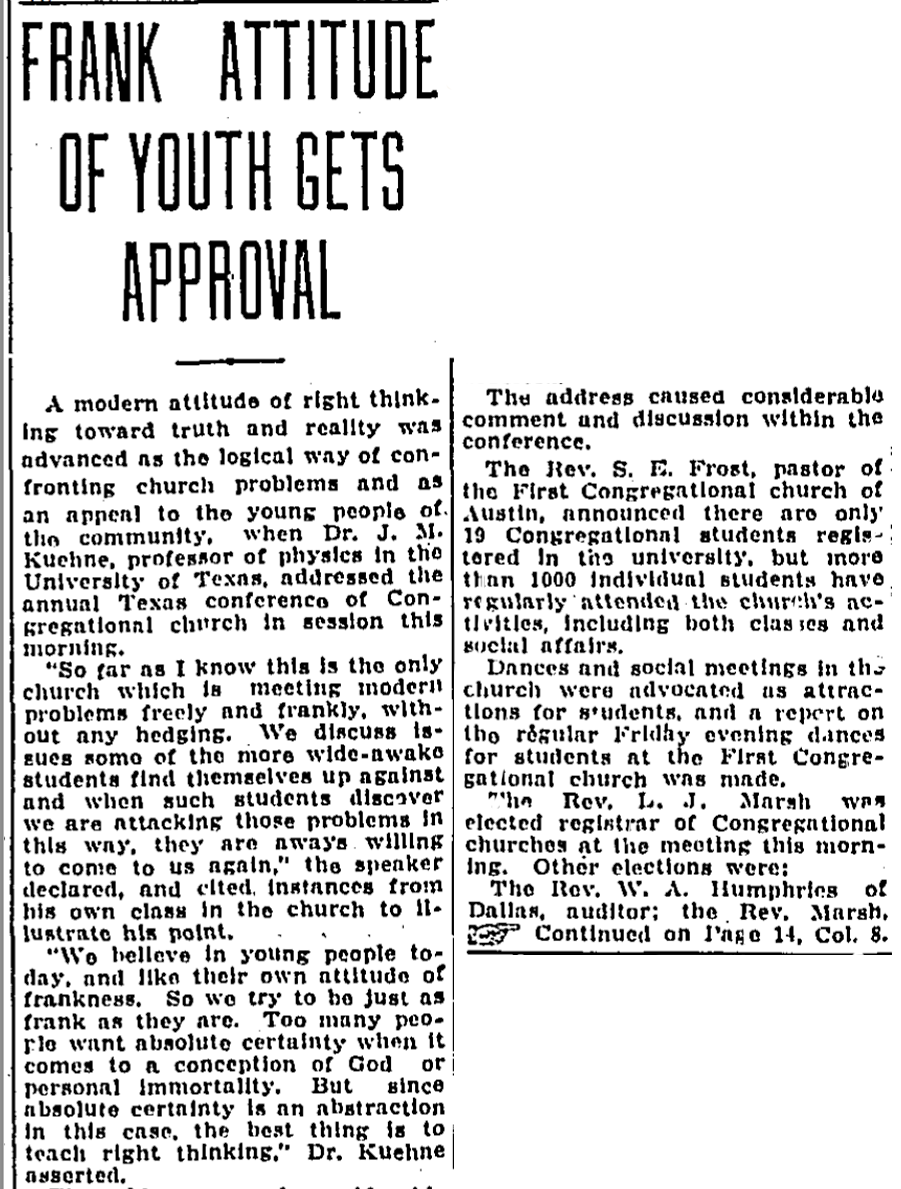
Reverend S. E. Frost was succeeded by Rev. S. Marcus Houge, who continued student ministry with an average attendance of 45 in the Fellowship Club. A group called Campus Critics, which discussed books on social, economic and political issues, was added to the program. Mr. Houge read Lenten meditations on KNOW radio and was asked to continue by popular demand. The Easter service that year was highlighted by the refurbished chancel and the addition of a Junior Choir in new vestments made by the women of the church. The church began a unified church service which was performed at an annual picnic with the San Antonio Congregational Church. A united service with University Presbyterian Church was started. Meetings in the church were concerned with civil liberties, natural resources, taxation, amendments to the Texas Constitution, U.S. non-involvement in the next war, and extension and growth of Militarism (which led to campaigning against the establishment of an R.O.T.C. unit on the campus). The young people of the church started going to church camp at Craterville, Okla. Leadership was given to co-operative student groups.
He served on the Arbitration board in San Antonio dealing with a Pecan Strike. He held services with the University Presbyterian Church. Held meeting on civil liberties, natural resources, taxation, amendments to Texas Constitution and “How the U. S. can stay out of next war.” He supported the Emergency Peace campaign. He campaigned agains the establishing of an R.O.T.C unit on the UT Campus. Many programs were started during his ministry - Student Religious Council, an inter-church youth council of the University churches plus the YMCA and YWCA.
There is an anecdote regarding Reverend Houge's beginnings in Austin. The story goes that he arrived in Austin from Chicago, Illinois by train. When he arrived at his room and opened his luggage, he realized he had luggage belonging to a nun who had since continued on her trip, along with his belongings. Fortunately, Will Trenckman, a church member, took him to Scarbrough's department store and he was nicely fitted in a Scarbrough suit. He arrived the Sunday morning in a white linen suite with matching shoes and sat in the back of the church and observed. He was the subject of much after-church conversation, as he was quite a dashing figure at 6'3" tall. It should also be noted that he married Hildegard Kuehne and Rizer Everett on June 26, 1939. Hildegard was a descendent of one of the German families who had joined the church after World War I.
Another member of the church who benefited from the church family was Mr. Robert “Bob” McNeely. He was studying to be a dentist at U.T and his funds were low. His was allowed to live in a small place in the basement of the church if he would keep the furnace stoked.
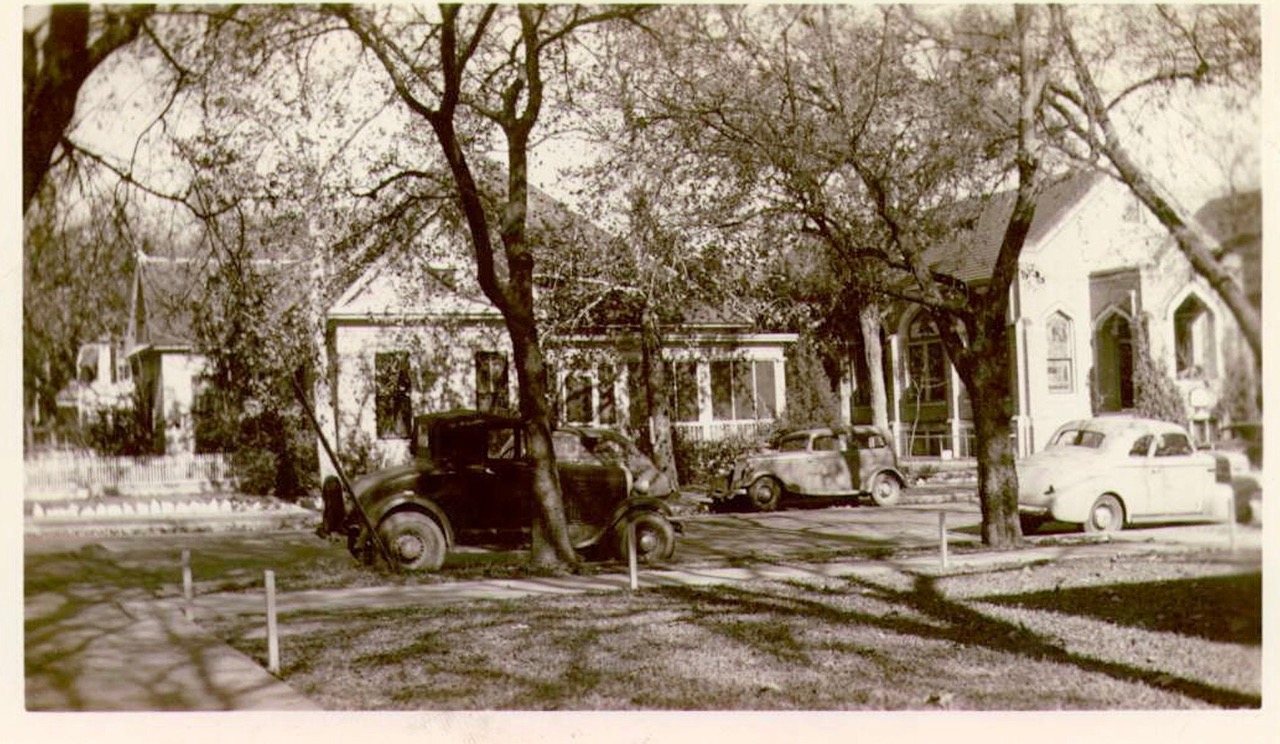
Photo About 1939 The parsonage and the Congregational Church of Austin at 408 W. 23rd St, about 1938 or 39
The Rev. Houge left in the summer of 1940 for Westwood Congregational Church in West Los Angeles.
Rev. Milton Maxwell was called in 1940 and continued the program already begun with steady growth and development. Unitarian, Community, Quaker, Union and Protestant students were invited to a special dinner. Some topics of discussion were: 1. Support of the Committee for War Victims, 2. Research on ways and means of raising the nutritional level of residents of Austin and Texas, 3. Search for more adequate medical care for residents of Austin and Travis County, 4. Study the recommendations made by the Governor's Commission on Improving Public Education in the State of Texas. Some social projects were: 1. A low-cost diet class of ten sessions held in the church kitchen, 2. The Pilgrim Fellowship held joint meetings with students from Tillotson College, 3. A Community Canning Center was established in the kitchen; however, a Sunday American-Statesman article attracted too many participants. Church interest was indicated by an average attendance of 99 with an oversubscribed budget in 1944. Reverend Maxwell served as mentor to young members of the church. Mathis Blackstock said, "Milton's sermons were the antithesis of ponderous or self-importance; they were ‘catchy’ and would make you chuckle occasionally. The ‘meat’ in them fed me in my spiritual life as a college student." Reverend Maxwell served the church part-time and was also a graduate student in sociology at the University of Texas. Following receipt of his Ph.D in 1945, Rev. Maxwell, his wife Charlotte, and their sons, Douglass and Ross, left in August to teach at Washington State College.
Rev. Fred Cole began as minister on Jan. 1, l946, after graduating from Vanderbilt Seminary. He continued the strong student emphasis with Unitarians, E and R, Congregational, and those with progressive backgrounds working together. A large turnover of the faculty at UT in a faculty-administration struggle deprived the church of some of its major financial support, and payments to the Church Building Society were suspended and outside aid was received. A 1948 study of University Community Church (name changed under Mark Houge in June of 1959) was made with these findings: "The Austin Church is the most liberal of Texas churches and has a much more transient membership and attendance than our average church. The average attendance of 90 in 1947 is above average for a church of this size. Church school attendance of 75 had 30 in the children's department, with 45 in the two students and adults groups."
A basement was excavated under the Fellowship Room (then the Student Lounge) with volunteer workers removing the dirt by buckets and wheelbarrows. A room of about 27' by 27' provided additional space for church school and fellowship dinners. Pilgrim Guild, a second women's group, was formed for women who could only meet at night. Fred Cole left to pastor the Congregational Church in Coral Gables, Fla., where he served until his death a few years ago.
Rev. A. Bert Miller arrived on July 1, 1950, after graduating from Yale Divinity School. A new parsonage had been built on a lot donated by J. M. Kuehne and the Millers were its first occupants. The Lutheran Campus Ministry began in the old parsonage beside the church, but the building was later used for a child care establishment. Rev. Miller taught at Huston-Tillotson College and was executive secretary to the Austin Council of Churches.
The name of the church was changed on March 28, 1951 to The Congregational Church of Austin. Some members left the church to start a separate Unitarian church. A member of the Congregational Church of Austin left a legacy to the Unitarian church which paid for its present building. Student work and social emphasis continued and the church became financially self-supporting with some funds being furnished for student work. The Millers left in 1957 to pastor North Congregational Church in St. Johnsbury, Vt.
Rev. William B. Mathews was the minister of the church from Nov. 1957 until January 1959. Rev. Mathews had a proven history of literally building churches and membership at many locations during his career. He came out of retirement in Florida to serve the church. He arranged for leaders of the denomination to talk with the members about what changes could be made. The name change of Pilgrim United Church of Christ was rejected. Three Congregational leaders, Dr. Philip Widenhouse, Dr. Stanley North and Dr. John Scotford suggested worship area changes. These included painting the woodwork the same as the walls, removing the globes under the fans for floodlights located near the ceiling, and bringing the pulpit out of the recessed area to a place in front of the wall at a lower level. The pulpit move would have helped immensely with the ability of the congregation to hear the sermons. The members did not approve these suggestions, however, drawings of renovations to the sanctuary were submitted to the Building Society which also disapproved of them at first. However, by the time they received approval, church school space had become a priority. This was a difficult time of challenge and learning for the church in that the members learned that idealism and desires cannot always overcome basic difference. Reverend Mathews resigned and returned to Florida in 1959.
Reverend Dr. Das Kelly Barnett,, who taught "Church and Society" at the Episcopal Seminary of the Southwest was an energetic and devoted friend to our congregation. He supplied the pulpit, and Reverent Frank Horak, who was working toward a degree, provided student leadership. Dr. Kelly Barnett gave us a six week series of sermons that must have changed us significantly in our pastoral search. He was a child prodigy preacher from a Baptist Church in rural Arkansas as well as a consummate orator who could shout or whisper to our congregation, which would become totally absorbed in his ideas. Reverend Barnett also said to us, "there's a young pastor whom I knew in Seminary at Yale who now serves a church in Green River, Wyoming. I have an idea it's a good time for him to consider a move."
Thus, Reverend John Towery became pastor in September 1959. His wife, Eleanor Towery was the "unofficial" though essential part of the ministry. Together they showed us what Christians look like. Their home was always open, no matter whom the guest might be, including strangers. Again, Mathis Blackstock says, "I remember a time when many of us were ‘uptight’ over, who knows what the issue was? John was the one person present who was calm and at peace; his equanimity gave us the calmness we needed at the time." During this period, work with the university students was done by students from the Episcopal and Presbyterian Seminaries. African-American membership rose to about 11% of the church membership during the 1960s. It should be noted that the first black member of the church joined during Reverend Miller's pastorate.
The parsonage was a bit small for the Towery family, and the present parsonage was purchased in 1961 and eventually sold to Reverend Towery.
Work with the university students was done by students from the Episcopal and Presbyterian Seminaries. Black membership rose to about 11% of the church membership during the 60's (the first black member of the church joined during Rev. Miller's pastorate). The parsonage was a bit small for the Towery family, and the present parsonage was purchased in 1961 and later sold to Rev. Towery.
A legacy of a building on Lavaca Street by E .J. Krohn in the early 60's provided a basis for the new educational wing. A long study under the leadership of Richard P. Swallow, UT Professor of Architecture and member of the church, resulted in plans for renovation of the old building and construction of the new wing. A Building Fund campaign over-subscribed the goal of $25,000 by over $4,000. Spiraling construction costs caused an abbreviation of the project. No renovation work on the old building was accomplished and only three floors of the new wing were completed. Dedication services were held on Sept. 28, 1969.
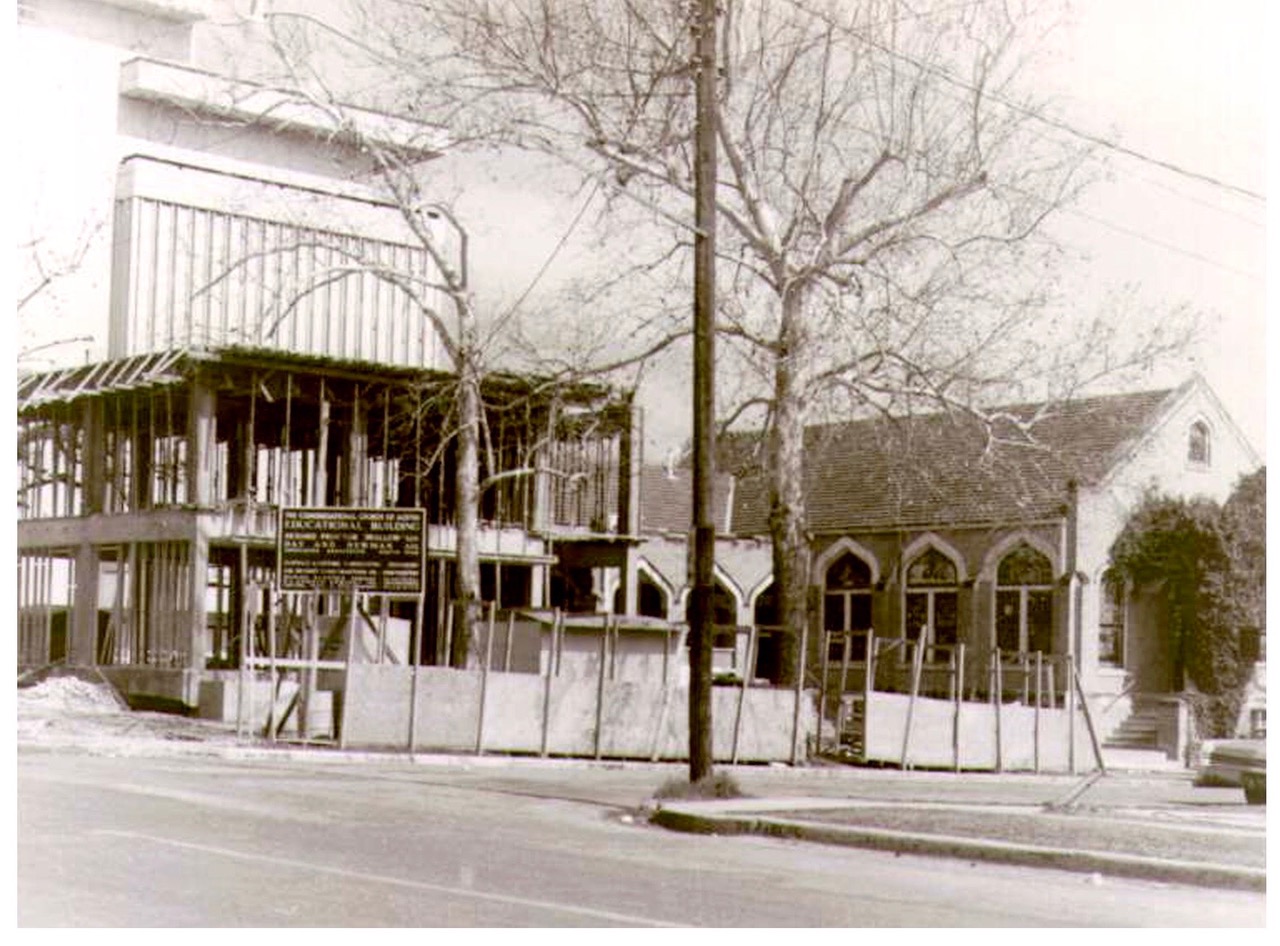
Photo 1969 Church in the snow with the education wing under construction-
The church school grew for a period of time before leveling off in recent years. Donations to Our Christian World Mission increased with the church leading the conference in per capita giving for many years. Short drama productions by the young people have replaced plays but continue an old tradition. Meetings on special topics have evolved through the years, with a guest speaker and a "talkback" session after the sermon.
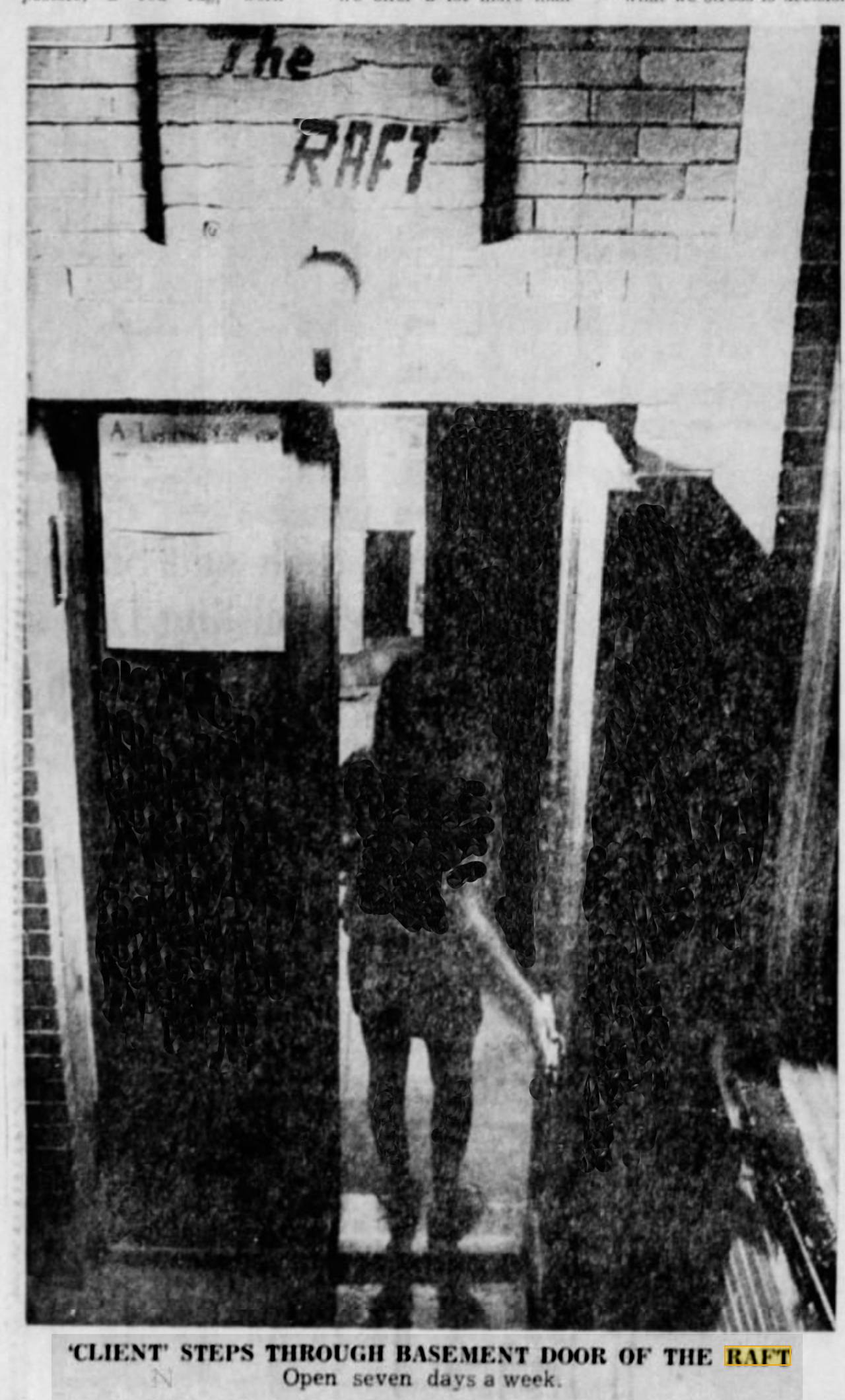 In 1968, the Austin Police Department had reported that on any given night there were 150 to 200 runaway teenagers in Austin. Working with a university psychology professor, Michael Kahn, and his class of 16 students, a program for runaways was established and housed in the church basement. "The Raft" modeled after Larry Biggs' Huckleberry House for Runaways in San Francisco began in March of 1969. Students in Professor Kahn's class volunteered to staff the program. Bill Peters a student from Tyler, Texas described the procedure. "A 'client' walks down stairs through the open door. They pause at one of the three Raft bulletin boards, where they need to make a decision. Their choices are 1) Keep on running; 2) Stay with a friend; 3) Use the Raft as a referral service to get in touch with parents; 4) Stay at the Raft temporarily with parents permission; 5) Use the Raft as a referral service to some other agency. It was expected that the client would stay no more that four or five days. The Raft was open from 9 pm to 9 am. Everyone has to leave by 9 am. The purpose of the Raft as stated by Rev. Frank Doremus, instructor at th Episcopal Theological Seminary is "not to provide a home for runaways, but rather to bring them face to face with their parents to discuss their problems. There were two shifts at night for members and volunteers: 9 pm to 3 am and 3 am to 9 pm. Some of the church member volunteered for shifts. Church members also provided maintenance support. The Raft could not keep anybody overnight without the parents' permission. There were three phones upstairs so the client and a staff member could speak with the parents. Long distant calls were paid for by the Raft. From 9 pm to midnight, the Raft served as a coffeehouse for teenagers. Facilities were available for both male and female clients. Twenty mattresses were available for boys and a small room was designed for female clients. The Fellowship Room was used for family sessions. The Raft opened with $400 which included a $250 donation for the mother of a staff member. Posted around the basement was a quote from "Huckleberry Finn"; "We said there wasn't no home like a raft, after all. Other places do seem so cramped up and smothering, but a raft don't. You feel mighty free and easy and comfortable on a raft." The Raft was staffed by the 16 class students and 50 volunteers that included high school students, secretaries, college students, church members and a grandfather. Names of a few of the student volunteers: Tom Tudor, Bob Mosby, Diane Mosely and Bill Peters, (This writeup includes information from an April 27, 1969, Austin American Statesman article written b John Bryant)
The People’s Community Clinic took over this space and developed a medical service to the community.
In recent years, the church members have done much of the work of painting, repairing, and cleaning and have now realized their earlier hopes with the complete renovation of the pastor's study.
Several pastors served the church following the retirement of John Towery in 1989. First was Yoshi Kaneda, who became pastor in September 1989. Yoshi's wife Setsuko became an active member of the church. Yoshi served until March 2001 when he retired. Yoshi, having grown up in Japan during WWII brought new cultural perspectives on scripture and worship. Tom VandeStadt followed Pastor Kaneda as pastor. He brought a strong commetment to the homeless community and led the church in many outreach programs to this community, including Freeze Night Shelter and Front Porch Lunch. The Covid Pandemic interupted sanctuary services. The church replace the Sunday service with online presentations and Zoom Fellowship Hour. Church bookclubs also went to Zoom format. Tom retired in 2021. The church next appointed an interim transistional pastor, Amelia Fubright. Amelia brought a strong commitment to the LGBTQ community and support for women's reproductive rights. She served until August 2023. Rev. Ginny Brown Daniel was appointed Interim Pastor.
In 2021, the church voted to raze the church building and consider options for the property.
| Signers of Articles of Incorporation, March 26, 1901 |
|||||
|---|---|---|---|---|---|
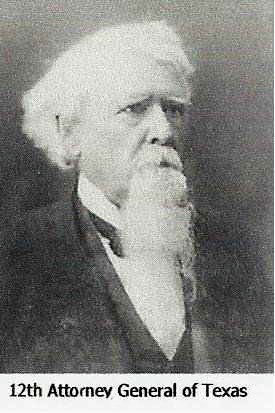
Major William Martin Walton
|
Judge David William Doom
|
A. O. Watson
|
Joel Henry Berry Miller
|
C. C. Moore
|
John Hardeman Pope
|
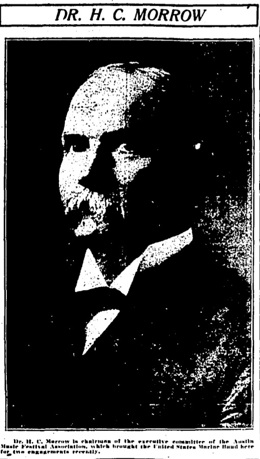
Dr. Horace Carey Morrow
|
Norman Potter
|
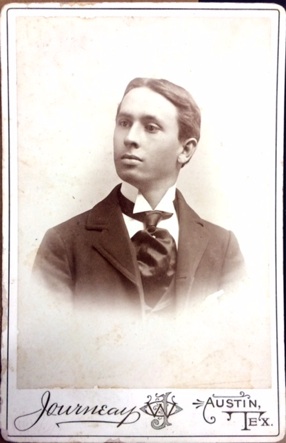
David Houston Doom
|
Valentine O. Weed (1849–1935)
|
James Pleasant Hamer (1867–1930) Attorney and ice manufacturer
|
William Rust Neville
|